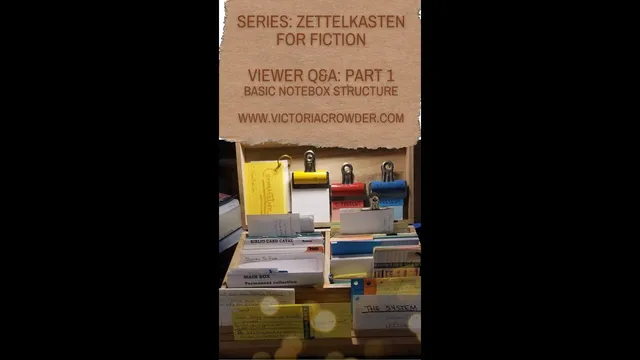
Zettelkasten for Fiction, Q&A, Part 1 - Basic Notebox Structure
Based on Victoria Crowder's video on YouTube. If you like this content, support the original creators by watching, liking and subscribing to their content.
Use three cross-referenced card sets—index (keywords), bibliography (sources), and main cards (developed writing notes)—to keep research usable during drafting.
Briefing
A Zettelkasten setup for fiction hinges on separating notes into three card “buckets” — keywords, bibliographic sources, and main idea notes — then cross-referencing them so information can be pulled back into writing quickly. The core workflow is simple: keyword cards act like a searchable index, bibliography cards function like a library catalog for primary research, and main cards hold the actual story-relevant thoughts that get developed later.
The system starts with three sets of cards lettered A to Z. Index cards record keywords so the writer can locate where a topic lives. Bibliography cards record primary source details—author, title, publication information—so research can be traced and revisited. The main card is where the writer stores the usable material: observations, scene-building notes, and ideas that will later feed chapters or specific scenes.
In the example layout, the main box contains the “thought” cards, organized behind numbered tabs (shown as 1,000 through 7,000). Bibliography cards are filed alphabetically by the first author’s last name. For instance, a bibliography card for Raymond Clemens’ manuscript studies book is filed under “Clemens, Ray” (and also reflects Timothy Graham as a second billing). The card includes publication details such as Cornell University Press and the year (2007). A visual layer—color coding—is used to mark connections to characters; Cornell University Press is underlined in blue because the writer’s character Marshall Branch attended Cornell University, creating a quick visual cue for later character-relevant links.
Finding information is driven by the back of each bibliography card. Along the left side are numbers that correspond to page references, and each referenced word or phrase points to where the writer might consult that source again. One example notes that on page 23 the source discusses the PCA system of copying University manuscripts—an especially relevant detail given the story’s focus on manuscripts.
The main cards then connect back to the research through numbering and slash-based insertion. A main card labeled “1511 SL1” indicates it sits behind “15011,” with “/1” signaling that it is an additional card inserted behind that earlier entry. These main cards contain practical writing material: notes on the shift from papyrus to parchment, process details such as “checkout processes,” and even page-specific prompts for photos. They also include narrative-usable research, such as notes on the VMS (Voyage Manuscript) and how it appears in the book through a character point of view.
Taken together, the system creates a cross-referenced network: keywords lead to where research is stored, bibliography cards point to exact source pages, and main cards hold the developed notes ready for drafting. The payoff is speed and retrieval—pulling the right cards while typing a scene—so research becomes directly usable rather than trapped in memory.
Cornell Notes
The Zettelkasten structure for fiction uses three cross-referenced card sets: (1) index cards for keywords (A–Z), (2) bibliography cards for primary sources (A–Z), and (3) main cards for developed writing notes. Bibliography cards are filed by author last name and include publication details plus page-linked prompts on the back that point to where specific ideas appear in the source. Main cards store story-ready material and are organized with numbered tabs; slash notation (e.g., “SL1”) indicates an inserted card that belongs behind a parent entry. Color coding on bibliography cards provides a quick visual link to characters tied to specific research details. The system matters because it turns research into retrievable building blocks during drafting, not just background reading.
What are the three card “buckets” in this fiction-focused Zettelkasten, and what does each one store?
How does the system help a writer trace a keyword to the right research material?
What information goes on a bibliography card, and how is it organized for lookup?
How do color coding and underlining function in the bibliography example?
What does the slash notation on main cards mean, and why does it matter?
What kinds of content belong on main cards for fiction drafting?
Review Questions
- How do index cards, bibliography cards, and main cards work together to turn research into draft-ready notes?
- Explain how page numbers on a bibliography card connect to specific ideas a writer might reuse later.
- What does a label like “1511 SL1” indicate about how main cards are organized behind a parent entry?
Key Points
- 1
Use three cross-referenced card sets—index (keywords), bibliography (sources), and main cards (developed writing notes)—to keep research usable during drafting.
- 2
File index and bibliography cards alphabetically (A–Z) so retrieval is predictable when recalling a topic or author.
- 3
Store publication details and page-linked prompts on bibliography cards so specific ideas can be traced back to exact source locations.
- 4
Apply character-based color coding on bibliography cards to create fast visual links between research facts and story characters.
- 5
Organize main cards with numbered tabs and slash-based insertion (e.g., “SL1” behind “15011”) to keep related notes clustered.
- 6
Pull main cards while typing scenes so character details, process notes, and source-backed references are immediately at hand.