Zettelkasten in Obsidian: How One Note Unlocked Everything
Based on Greg Wheeler's video on YouTube. If you like this content, support the original creators by watching, liking and subscribing to their content.
Anchor the system with a single quote or principle, then link everything back to that starting node to keep the network coherent.
Briefing
A single quote about “making a beautiful garden” becomes the seed for a growing network of insights inside Obsidian—showing how one well-chosen note can trigger a chain reaction of connections, labels, and retrieval paths. The core move is treating note-taking less like storage and more like idea cultivation: instead of chasing outcomes directly, build the conditions that make the desired results show up. That framing matters because it turns scattered thoughts into a navigable system where each new note can reinforce the next.
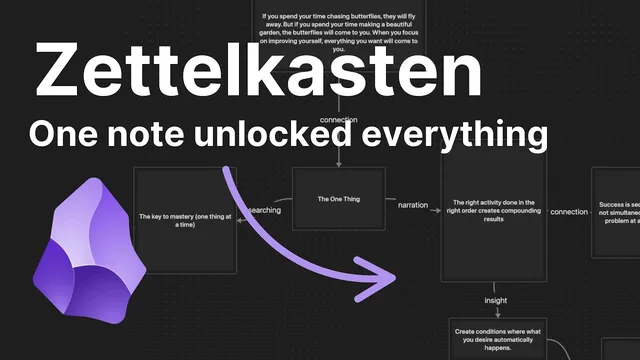
The process starts with a quote attributed to Leno Caneli: if you chase butterflies, they fly away; if you make a beautiful garden, butterflies come to you. The “One Thing” book idea is then used as the conceptual bridge: the right activity done in the right order creates compounding results, where the “lead domino” isn’t the butterfly itself but the intentional actions that attract it. In Obsidian Canvas, the quote is added as a note, and an existing note titled “The key to mastery is one thing at a time” is discovered via search and linked back to the “One Thing” anchor. From there, the workflow becomes visibly structured: links represent relationships, and new notes are created as the author narrates the idea in their own words.
Narration is a key technique in the method. As the concept is retold—“the right activity done in the right order creates compounding results”—the retelling itself produces new cards. One new insight becomes: create conditions where what you desire automatically happens. Another insight is captured as “the jacket off, jacket on principle,” built through a chain of associations that starts with productivity ideas and then moves into the Karate Kid story (Jackie Chan and Jaden Smith). The method treats analogies as legitimate knowledge objects: the “outcome is hidden inside the ordinary” line is saved as its own insight after reflecting on the film’s training montage logic.
The network keeps expanding by pulling in additional sources and themes. Eugene Peterson’s “faithfulness is long obedience in the same direction” is linked to the butterfly-garden metaphor, tying staying power to delayed results: without patience and continued watering, flowers don’t bloom and butterflies don’t arrive. Existing notes like “Faithfulness” are reused, while related concepts such as “staying power” are added as separate rooms in an “idea mansion” metaphor. Even a “gold vein” room is created to act as an invitation space for future connections, emphasizing that some notes are meant to be doors rather than fully populated content.
Finally, the author uses Obsidian’s local graph to reveal how far the connections reach. By increasing graph depth from one layer to two and three layers, previously unlinked notes appear connected through shared neighbors—such as “creation equals credibility” surfacing through links to “faithfulness,” “to obey God requires faithfulness,” and ultimately “faithfulness requires focus,” which includes saying no to everything except the assigned task. The takeaway is practical: a single anchored note, combined with narration, deliberate linking, and graph-based exploration, can turn one spark into a web of reusable insights.
Cornell Notes
A quote about attracting butterflies by building a “beautiful garden” becomes the anchor for a growing Obsidian network. The method links the quote to “One Thing” ideas—especially that the right activity in the right order creates compounding results—then uses narration to retell concepts in the author’s own words and generate new notes. Each new insight is saved as a node and connected back to the original anchor, including analogies like the “jacket off, jacket on principle” from Karate Kid and the line “the outcome is hidden inside the ordinary.” Reusing existing notes (like “Faithfulness”) and creating “room” notes (like “staying power” and “gold vein”) turns the system into a set of navigable doors. Expanding the local graph depth reveals additional connections that weren’t directly linked, showing how one starting note can unlock many related ideas.
How does the “butterflies vs. garden” quote translate into a note-taking strategy rather than just motivation?
What role does narration play in turning a concept into multiple Obsidian notes?
Why connect productivity ideas to unrelated material like Karate Kid?
How does the system handle reuse versus creation of notes?
What does increasing graph depth accomplish in the local graph?
Review Questions
- If the “lead domino” isn’t the outcome itself, what kinds of notes would you create to represent the intentional actions that attract the outcome?
- How would you apply narration to a concept you’re learning so that it produces new, linkable notes rather than just a summary?
- When you increase local graph depth, what new connections might you expect to appear, and how would you decide which ones to save as insights?
Key Points
- 1
Anchor the system with a single quote or principle, then link everything back to that starting node to keep the network coherent.
- 2
Use narration—retell concepts in your own words—to generate new insights that become separate notes.
- 3
Search your existing notes for keywords to avoid duplicating ideas and to strengthen connections through reuse.
- 4
Treat analogies and stories as legitimate sources of principles; save the resulting takeaway as its own node (e.g., Karate Kid → “jacket off, jacket on principle”).
- 5
Create “room” notes that function as future connection hubs (e.g., “gold vein”) rather than forcing every node to be fully populated immediately.
- 6
Use Obsidian’s local graph and increase depth to reveal indirect relationships that weren’t explicitly linked.
- 7
Label links with context (line labels) so the network captures not just relationships, but why each connection matters.