Zettelkasten Note-Taking: What I wish I knew about Smart Notes
Based on Martin Adams's video on YouTube. If you like this content, support the original creators by watching, liking and subscribing to their content.
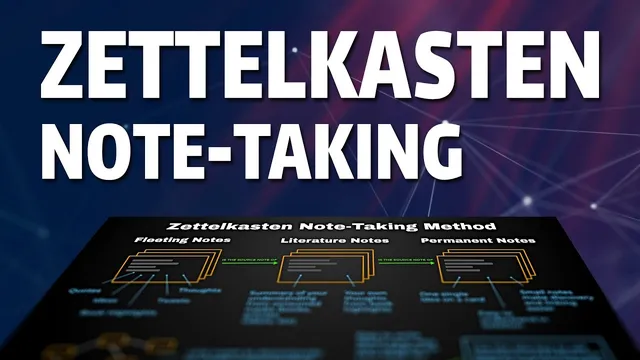
Zettelkasten-style Smart Notes uses three stages: fleeting captures, literature notes that distill personal understanding from sources, and permanent notes that store one idea each for long-term reuse.
Briefing
Smart Notes and the Zettelkasten “slip box” method hinge on a simple workflow: capture raw ideas quickly, convert them into concise personal understanding, then link single-idea notes together so new insights emerge and can be turned into writing. The payoff is long-term recall and creativity—notes stay usable years later because each permanent note is written to stand alone and is built for discovery, not storage.
The method starts with three note types. Fleeting notes are temporary captures of ideas—highlights, quotes, tweets, or “shower thoughts”—that get recorded fast and moved through the system. Literature notes come next: they represent understanding of a specific source (books, articles, YouTube videos, podcasts, and more). Instead of copying large sections, a literature note distills the meaning in the writer’s own words, often breaking the source into parts and capturing how it sparked new thinking. These literature notes can also originate from the writer’s own reactions to something read or watched, not necessarily staying tied to the original topic.
Permanent notes are the core of Zettelkasten. Each permanent note holds one idea per card, designed to be understandable in isolation—so it can be read months or years later without needing the surrounding document. This approach avoids “archiving for another purpose,” like paraphrasing entire blocks or copy-pasting text into a growing pile. Instead, permanent notes are small enough to discover and link, which is where the system becomes powerful.
Linking is done bi-directionally: a note about one concept points to related notes, creating a network rather than a folder hierarchy. The transcript illustrates this with a chain of ideas: a note about “brain stress triggers” (e.g., how the “croc” or “monkey” brain reacts emotionally) and a note about “imposter syndrome” (an anxiety response in workplace settings). When those notes are connected, a new insight becomes possible: imposter syndrome may be driven by environmental triggers that activate stored emotional memories, leading to a physical/impulsive anxiety response. That new insight can then be captured as its own permanent note and used as raw material for writing.
The slip box also supports question-driven thinking. By asking the system prompts like “Does imposter syndrome link to brain stress triggers?” the writer can pull relevant notes, test whether the connections hold, identify gaps, and generate insight notes that may require more research. The goal isn’t always to prove claims true or false; it’s often to clarify understanding, build confidence, and guide next steps—especially in scientific contexts where hypotheses eventually need testing.
Finally, the workflow is positioned as a practical engine for consistent creation: insights become topics for blog posts or YouTube videos. The creator ties the method to daily study habits—organize fleeting notes, process literature notes, and build permanent notes a little at a time—so knowledge compounds over time. A related note-taking app is mentioned as an effort to automate and streamline this process, with a waitlist for pre-release access and options to use other tools like Obsidian.
Cornell Notes
Zettelkasten-style “Smart Notes” turns quick captures into durable thinking. Fleeting notes record raw ideas fast; literature notes convert sources into concise, personal understanding in the writer’s own words. Permanent notes store one idea per note, written so it’s understandable on its own years later. The system’s real leverage comes from bi-directional linking between permanent notes, which can surface new insights—like connecting “brain stress triggers” to “imposter syndrome” to form a new explanation. Asking the slip box questions helps correlate related notes, reveal gaps, and generate insight notes that can later feed writing or further research.
Why split notes into fleeting, literature, and permanent categories?
What makes a literature note different from simply summarizing a book?
What does “one idea per permanent note” accomplish?
How do bi-directional links create new insights?
How does question-driven use of the slip box work?
How does the method connect to writing and content creation?
Review Questions
- What specific characteristics make a permanent note “stand alone” and useful years later?
- In the workflow, where does a highlighted quote from a book first enter the system, and what transformation happens next?
- Give an example of how linking two separate permanent notes could produce an insight that neither note contains on its own.
Key Points
- 1
Zettelkasten-style Smart Notes uses three stages: fleeting captures, literature notes that distill personal understanding from sources, and permanent notes that store one idea each for long-term reuse.
- 2
Literature notes should be concise and written in the creator’s own words, capturing meaning and sometimes new thoughts sparked by a source rather than copying large sections.
- 3
Permanent notes are designed to be understandable in isolation, avoiding document-style paraphrasing and copy-paste archiving.
- 4
Bi-directional linking between permanent notes turns a pile of ideas into a network that can generate new insights.
- 5
Question prompts to the slip box help correlate related notes, surface gaps, and guide further research or clearer understanding.
- 6
The system is meant to feed writing: insights created through linking become topics and angles for blogs, videos, and other outputs.
- 7
Consistent daily processing—organizing and converting notes in small steps—supports compounding knowledge over time.