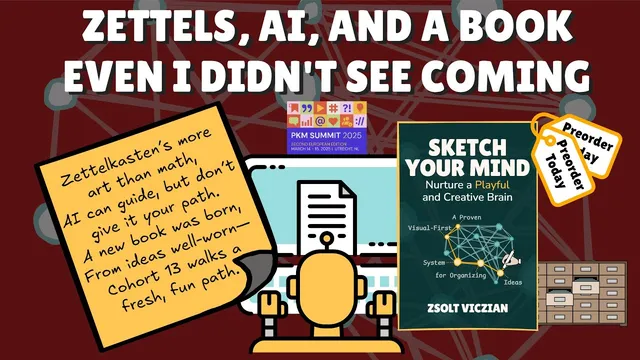
Zettels, AI, and a Book Even I Didn't See Coming
Based on Zsolt's Visual Personal Knowledge Management's video on YouTube. If you like this content, support the original creators by watching, liking and subscribing to their content.
Zettelkasten chains don’t require finding an “ideal” parent note; linking to the least versatile option is enough to create meaningful trains of thought.
Briefing
Zettelkasten’s “train of thought” doesn’t require finding the perfect parent note—success comes from linking to the least versatile (least “fit”) option, turning the order of discovery into a personal fingerprint. After struggling to build coherent chains because the process kept demanding an “ideal parent,” the creator learned that Zettelkasten is designed to work with imperfect matches. The sequence in which ideas appear, get observed, and get linked to the least versatile candidate is what makes the resulting chain uniquely theirs, rather than a universal structure they’re trying to force.
That shift reframes how they think about note-making and writing. Instead of treating note connections as a correctness problem, it becomes a creativity problem: the chain is “yours” because it reflects your path through ideas. The insight also echoes a well-known idea attributed to Steve Jobs—dots can’t be connected looking forward, only looking backward—supporting the claim that perfection in forward planning isn’t necessary. For future work, the creator says they’ll focus more on building true chains rather than “pools of thought,” using the least-versatile linking strategy to create a more structured storyline. If a second book happens, they expect to be better prepared because the methodology will already be more tightly organized.
The second major takeaway centers on AI, shifting attention away from privacy or “fraud” concerns toward a more fundamental risk: giving up agency. The creator acknowledges the obvious worry—sharing personal notes with AI can leak sensitive information—but highlights a larger danger raised in workshop discussions: dependence that gradually replaces independent thinking. The mechanism is familiar in everyday life. People offload memory by searching for book titles or facts on demand; they remember not the content itself, but how to retrieve it. That’s manageable. The danger escalates when AI becomes a source of decisions—brainstorming ideas, proposing initiatives, and shaping the direction of work.
A corporate example illustrates the pattern: when a boss speaks first, subordinates tend to align with that perspective, and “group think” replaces genuine contribution. With AI, prompting it first to brainstorm can similarly steer outcomes toward what the model produces, leaving less room for the user’s own perspective. The creator isn’t claiming AI is inherently catastrophic—writing their book with AI as a tool is part of their reality—but they found that without a clear story line and constraints, AI output meandered, repeated itself, and lacked an arc. The core message and narrative structure still have to come from the human mind; AI can support the writing process, but initiative must originate with the user.
Alongside these insights, the creator announces a book pre-order on Amazon (release set for June 15) and promotes cohort 13 of a visual thinking workshop, starting April 12, centered on Tiny Experiments by Ann Lur Lant—framing their approach as a series of small experiments that accumulate into a coherent methodology.
Cornell Notes
The creator’s Zettelkasten breakthrough is that building “train of thought” chains doesn’t depend on finding the ideal parent note. Instead, the system works by linking each new idea to the least versatile (least “fit”) candidate, and the order of discovery becomes the user’s fingerprint. That same mindset—imperfect inputs, personal structure—also informs their writing plans.
On AI, the key risk isn’t mainly privacy or misinformation; it’s losing agency. Offloading simple recall to tools is one thing, but prompting AI first for brainstorming and decisions can steer thinking toward model-driven group think. Their own experience writing with AI shows that a clear human story line is required; otherwise AI output meanders, repeats, and lacks an arc.
Why does “least versatile” linking matter in Zettelkasten, and how does it change the goal of note connections?
How does the Jobs-style “connect dots backward” idea support the Zettelkasten insight?
What’s the difference between using tools to retrieve information and using AI to shape decisions?
How does “boss speaks first” illustrate the agency problem with AI?
What did the creator learn from writing their book with AI about maintaining a human narrative arc?
Why is Tiny Experiments positioned as relevant to their methodology?
Review Questions
- In Zettelkasten, what does “least versatile” linking replace, and what does it preserve about the user’s thinking process?
- What does “giving up agency” mean in the context of AI prompting, and how is it different from using tools to look up facts?
- How can a clear human story line prevent AI-assisted writing from becoming repetitive or directionless?
Key Points
- 1
Zettelkasten chains don’t require finding an “ideal” parent note; linking to the least versatile option is enough to create meaningful trains of thought.
- 2
The order in which ideas are discovered and linked becomes the user’s personal fingerprint, making the chain inherently theirs.
- 3
Planning perfect connections in advance isn’t necessary; connections can be made by looking back at what emerged.
- 4
The biggest AI risk highlighted is not only privacy or fraud, but gradual loss of agency when AI is used to generate decisions and direction.
- 5
Prompting AI first for brainstorming can produce group think by steering outcomes toward the model’s suggestions rather than the user’s own perspective.
- 6
AI can assist writing, but the human must supply the core message and narrative arc; without a clear story line, AI output can meander and repeat.
- 7
Small experiments are treated as a practical method for building a coherent personal knowledge workflow over time.