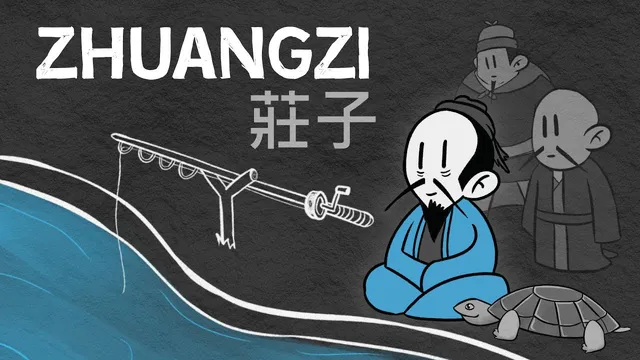
Zhuangzi's Timeless Wisdom to Stress-Free Living | Taoist Philosophy
Based on Einzelgänger's video on YouTube. If you like this content, support the original creators by watching, liking and subscribing to their content.
Zhuangzi’s stress-free living message emphasizes rejecting fixed status and ceremonial honor in favor of preserving freedom and natural life.
Briefing
Zhuangzi’s core lesson for stress-free living is that peace comes from loosening fixed judgments—about status, beauty, usefulness, and even life and death—and instead aligning with the natural flow of change. The most telling parable begins with an offer of political power: vice-chancellors arrive to recruit Zhuangzi as prime minister. He refuses, comparing the choice to a sacred turtle removed from its habitat, dressed in silk, and displayed in a palace—honored, yet effectively turned into a lifeless object. For Zhuangzi, the “better” option is ordinary life, even if it looks less impressive, because it preserves freedom and wholeness rather than trading them for ceremony and sacrifice.
That refusal sets the tone for the broader Taoist worldview attributed to Zhuangzi and the text bearing his name: a philosophy that treats the universe as ever-changing and human perspectives as limited. Rather than building life around rigid rules and social hierarchy associated with Confucian ritual, Zhuangzi’s stories favor playfulness, humility, and direct engagement with the present. The “Butterfly Dream” is highlighted as a way to question the stability of identity and the credibility of objective reality—suggesting that what feels real may depend on subjective experience. Even beauty, a seemingly universal category, becomes relative in a waterfront story where a stunning woman draws human admiration while fish and birds flee. The point isn’t merely that tastes differ; it’s that perceptions don’t manufacture facts. Human standards may cluster around traits like youthfulness, symmetry, clear skin, and fitness, but Zhuangzi’s perspective still denies a truly objective beauty—because other beings may find the same person unattractive or irrelevant.
The path to calm also runs through “wu-wei,” often translated as effortless action or non-doing. Cook Ding’s ox-cutting story shows mastery without strain: after years of practice, he stops seeing the carcass as a whole and instead lets instinct and the natural order guide his movements. The result is a craft that feels automatic—like being “in the zone”—where overthinking fades and action flows. A driving analogy reinforces the same idea: beginners micromanage every detail, while experienced drivers operate more instinctively.
Zhuangzi then reframes what people dismiss as useless. Huizi complains about a crooked, knotty tree that cannot be turned into planks. Zhuangzi counters with examples of animals that survive through their own “fit” and with the claim that uselessness can be protective. The tree becomes a place to rest, shelter, and eventually even a holy landmark due to its longevity. More broadly, usefulness and uselessness are interdependent: emptiness makes a cup usable; a door’s “useless” space enables passage. Even social roles follow the same logic—doctors require patients, and “good” depends on a contrast with “bad.”
Finally, Zhuangzi confronts impermanence without theatrics. When his wife dies, he grieves at first, then reflects on her transformation from nonexistence to form and back again, treating death as part of the same cosmic rhythm as seasons. He also declines a grand funeral, arguing that whether crows and vultures or ants and worms consume him, the outcome is the same. The takeaway is consistent: accepting change reduces fear, and living lightly—without clinging to fixed meanings—makes life’s turbulence more manageable.
Cornell Notes
Zhuangzi’s philosophy for stress-free living centers on loosening rigid judgments and accepting the world’s constant change. Stories contrast political status, social ritual, and fixed standards with a calmer alignment to nature and “Tao.” Beauty, usefulness, and even identity are treated as perspective-dependent rather than objectively fixed, as shown by the waterfront woman and the “useless tree” parable. “Wu-wei” (effortless action) appears through Cook Ding’s mastery, where over-intellectualizing fades and action flows naturally. Impermanence is faced directly in grief and funeral stories, portraying death as another transformation in the same cosmic process.
Why does Zhuangzi reject the prime minister offer, and what does the turtle parable add to the lesson?
How does Zhuangzi use the waterfront beauty story to challenge “objective” standards?
What is “wu-wei,” and how does Cook Ding illustrate it?
Why does Zhuangzi treat the crooked, unusable tree as valuable?
How does Zhuangzi connect impermanence to emotional coping?
What does the funeral exchange reveal about Zhuangzi’s attitude toward death?
Review Questions
- Which parts of human life does Zhuangzi treat as perspective-dependent rather than objectively fixed (give at least two examples from the stories)?
- How does “wu-wei” differ from simply working hard, and what evidence is used to show it (e.g., Cook Ding’s progression)?
- Why does Zhuangzi consider “uselessness” potentially necessary for usefulness, and how is this illustrated with everyday objects like cups or doors?
Key Points
- 1
Zhuangzi’s stress-free living message emphasizes rejecting fixed status and ceremonial honor in favor of preserving freedom and natural life.
- 2
Beauty is treated as perspective-dependent: different beings can experience the same person or object in opposite ways.
- 3
“Wu-wei” describes effortless action achieved through practice, where conscious overthinking fades and movement aligns with natural order.
- 4
Seemingly useless things can be protective and even foundational to later forms of value, because usefulness depends on context.
- 5
Uselessness and usefulness are interdependent: emptiness enables function (cups, doors), and social categories rely on contrasts (good/bad).
- 6
Impermanence is faced through transformation thinking—life and death are part of the same ongoing cosmic process.
- 7
Grand rituals around death are questioned when the physical outcome is the same; acceptance reduces fear and attachment.