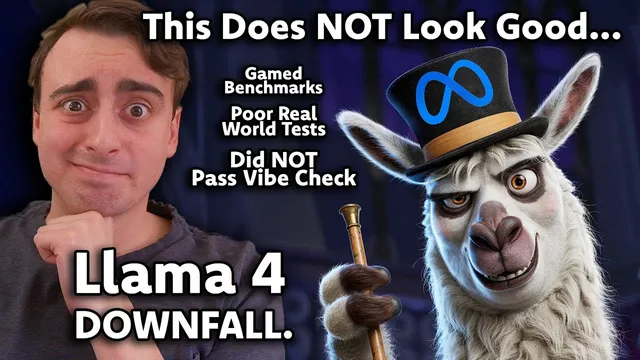
Zucc What are we DOING?! Llama 4 Launches with... Interesting Results
Based on MattVidPro's video on YouTube. If you like this content, support the original creators by watching, liking and subscribing to their content.
Meta’s Llama 4 lineup includes Scout, Maverick, and a Behemoth preview, with marketing centered on multimodality and extremely large context windows.
Briefing
Meta’s Llama 4 launch landed with a jarring mismatch between headline claims and early real-world results—especially around long-context performance and benchmark credibility. The lineup includes Llama 4 Scout (17B active parameters via 16 experts), Llama 4 Maverick (17B active parameters via 128 experts), and a not-yet-released Llama 4 Behemoth preview described as a “teacher model” for distillation with 288B active parameters and 2T total parameters. Meta also markets a “10 million token” context window and positions the models as strong performers across common benchmarks, including comparisons against models like GPT-4 Omni and Gemini 2.0 Flash.
But the rollout quickly triggered skepticism on two fronts: hardware feasibility and benchmark-to-reality gaps. The smallest model, Llama 4 Scout, is claimed to fit on a single Nvidia H100 GPU (80 GB VRAM). That immediately clashes with the expectation that open-source Llama models should run on consumer hardware; the transcript cites that even an RTX 5090 can’t run Scout. Further, community estimates for quantized variants suggest steep VRAM requirements—52 GB for the smallest quant and 70 GB for larger quants—plus multi-GPU setups for Maverick (with figures like 254 GB VRAM and even larger multi-GPU requirements). The result is a model that may be “open source” but still effectively locked behind enterprise-scale infrastructure.
Long-context claims drew even sharper criticism. Meta’s own materials reportedly show “perfect” retrieval at 10 million tokens for Scout (100% retrieval), yet community testing paints a different picture. In long-form creative writing evaluations, Llama 4 models show high “slop” and heavy repetition as context grows, alongside poor degradation metrics. Llama 4 Maverick is described as struggling with repetition (with repetition figures cited around 40) and a degradation score that looks far worse than competitors such as Gemini 2.5 Pro, DeepSeek V3, and GPT-4’s newer variants. Scout fares even worse in those same community-style long-context writing tests.
Coding and other task benchmarks also appear inconsistent. A coding “physics maze” demo reportedly shows Gemini 2.5 Pro nailing the behavior, GPT-4 Omni performing better than Llama 4 Maverick, and Maverick producing glitches and unrealistic motion. Separate community benchmarks are cited where Scout and Maverick underperform expectations, including cases where Maverick—supposedly the stronger model—lags behind DeepSeek R1 and DeepSeek V3.
Beyond performance, controversy escalated into allegations of benchmark gaming. An anonymous post on a Llama subreddit claims internal training efforts fell short of open-source state-of-the-art targets and alleges leadership suggested “blending test sets” during post-training to hit benchmark targets—described as “cooking” or nerfing the process. The transcript notes that such claims are unverified, but the community reaction is intense, including references to resignations and calls for Meta to “come clean” if benchmarks were manipulated. Additional community commentary suggests Scout and Maverick may come from different training/distillation paths, and a separate leak claims Meta may have rushed to copy competitor techniques after falling behind.
Taken together, the launch narrative shifts from “industry-leading multimodal, long-context breakthrough” to “expensive, hard to run, and unreliable under real tasks,” with the biggest question now being whether the gap stems from model design tradeoffs—or from questionable benchmark alignment.
Cornell Notes
Meta’s Llama 4 lineup is marketed around multimodal capability and a 10 million token context window, but early community tests highlight major gaps between those claims and real task performance. The smallest model (Llama 4 Scout) is also described as effectively non-consumer due to high VRAM needs, despite being open source. Community evaluations—especially long-context creative writing—report high repetition (“slop”) and poor degradation as context grows, with Scout and Maverick underperforming stronger competitors like Gemini 2.5 Pro and DeepSeek V3. Separate allegations also circulate that benchmark results may have been influenced by training/post-training choices, further undermining trust. The practical takeaway: Llama 4 may require enterprise hardware and still may not deliver the promised long-context reliability.
What are the headline specs Meta gave for Llama 4, and why do they already raise questions?
How does the transcript connect hardware requirements to the credibility of the launch?
What long-context performance claims are disputed, and what do community tests report instead?
What examples are used to show that Llama 4 may underperform in practical tasks like coding?
What allegations about benchmark gaming appear, and why are they consequential?
How do community theories about model lineage (Scout vs Maverick) affect interpretation?
Review Questions
- Which specific long-context metrics (slop/repetition and degradation) are cited as failing for Llama 4, and how do they compare to Gemini 2.5 Pro or DeepSeek V3?
- Why does the transcript argue that “open source” doesn’t automatically mean easy consumer testing for Llama 4? Cite the VRAM/H100 claim and at least one quantization requirement mentioned.
- What does the anonymous benchmark-gaming allegation claim about post-training, and what would that imply for how to interpret published benchmark scores?
Key Points
- 1
Meta’s Llama 4 lineup includes Scout, Maverick, and a Behemoth preview, with marketing centered on multimodality and extremely large context windows.
- 2
The smallest Llama 4 model is described as requiring Nvidia H100-class VRAM, making local consumer testing impractical despite open-source availability.
- 3
Community evaluations dispute the “10 million token” promise, especially in long-form creative writing where repetition (“slop”) and degradation worsen with context length.
- 4
Coding and reasoning-style demos cited in the transcript show Llama 4 Maverick underperforming Gemini 2.5 Pro and sometimes GPT-4 Omni variants in practical behavior tasks.
- 5
Allegations circulate that benchmark results may have been influenced by post-training choices (e.g., blending test sets), raising concerns about benchmark credibility.
- 6
The transcript suggests Scout and Maverick may follow different training/distillation paths, which could explain inconsistent performance across benchmarks and tasks.