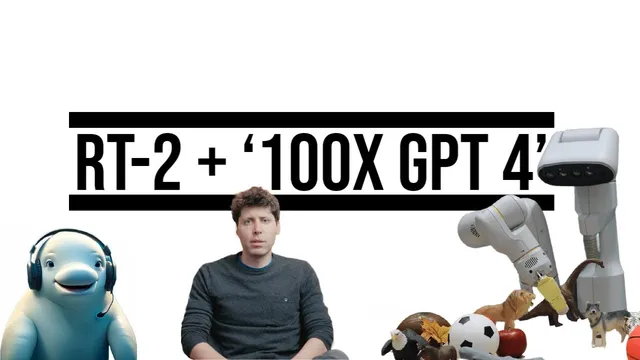
11 Major AI Developments: RT-2 to '100X GPT-4'
Based on AI Explained's video on YouTube. If you like this content, support the original creators by watching, liking and subscribing to their content.
RT-2 demonstrates a shift from scripted robot instructions to vision-language action models that can generalize from prompts to novel objects and scenes.
Briefing
Robotics is taking a major step toward general-purpose manipulation as “visual language action” models start linking language, images, and real-world actions. In the RT-2 demonstration, a robot was asked to pick up an extinct animal; it grabbed a plastic dinosaur it had never seen before, combining object manipulation with a logical leap from the prompt to the right physical target. The shift matters because earlier robots typically relied on long, task-specific instruction lists. Now, robots can use a vision-language model pre-trained on web-scale image-and-text data, then fine-tuned on robotics data, to learn how to act—whether that’s picking up an empty soda can, hammering a nail by selecting the right object from a scene, or planning intermediate steps via “chain of thought” style reasoning. Google frames this as a strategic advantage: better vision-language models can directly improve robot learning, with future possibilities ranging from household chores to operating in unseen environments.
The week’s other headline theme is scaling—both the promise and the uncertainty around where it leads. In a Barons interview, Mustafa Suleiman (Inflection AI) said large language models are on track to become roughly 10 times larger than GPT-4 and then 100 times larger within about 18 months, calling the change “eye-wateringly different.” The transcript also notes Inflection AI’s reported access to massive compute (22,000 H100 GPUs) and treats the scaling forecast as a key signal of how quickly capabilities may jump. At the same time, an Atlantic report highlights how OpenAI leadership has repeatedly emphasized “the god of scale,” while also raising concerns about agency and misalignment—suggesting it may be prudent to develop AI with “true agency” before systems become too powerful to understand.
That tension—capability rising faster than safety—runs through multiple threads. The Atlantic discussion includes worries about harmful uses of advanced models, including step-by-step assistance for synthesizing explosives and designing attacks, alongside concerns about AI enabling biological misuse by filling in missing steps in bioweapons production. A Senate testimony segment reinforces the bio-risk framing: Dario Amodei (Anthropic) warned that today’s tools show “nascent signs of danger,” and that extrapolating forward 2–3 years could allow AI to enable many more actors to carry out large-scale biological attacks. He urged action on a tight timeline (targeting 2025–2026, with some chance of 2024) and recommended securing the AI supply chain—from semiconductor equipment and chips to the protection of models on servers.
Not all developments are grim. New real-time speech transcription for deaf people is described as costing under $100, delivering live captions in a user’s field of view. Text-to-speech improvements are also accelerating, with demonstrations of whispering voices and a growing challenge for authenticity as it becomes harder to distinguish real from AI-generated content. Meanwhile, open-source models are catching up: Stable Beluga 2 (based on Llama 2) is reported as competitive with ChatGPT on major benchmarks, and a “universal jailbreak” technique is described as automating the creation of jailbreak strings that transfer across models. Even so, safety claims are emerging—Mustafa Suleiman’s comments on “Pi” suggest it resists those jailbreaks by pushing back politely but clearly.
Taken together, the week’s developments point to a near-term world where robots can act on language and images, models scale rapidly, and biological and cyber risks intensify—while accessibility and media realism improve in parallel.
Cornell Notes
Robotics is moving from scripted instructions toward “visual language action” systems that connect language and images to physical control. RT-2’s demonstrations show it can generalize from prompts to novel objects and scenes, using a vision-language model pre-trained on web-scale data and fine-tuned on robotics. Scaling remains the other major driver: Mustafa Suleiman predicts models 10× and then 100× larger than GPT-4 within about 18 months, while safety discussions focus on misalignment and misuse. Senate testimony from Dario Amodei emphasizes biological risk, arguing AI could fill missing steps in bioweapons production within 2–3 years, raising urgency for supply-chain security and faster safeguards. Meanwhile, accessibility gains (real-time captioning) and open-source progress (Stable Beluga 2) arrive alongside rapid improvements in synthetic media and jailbreak automation.
What makes RT-2’s performance feel like a leap beyond traditional robotics?
Why does Mustafa Suleiman’s scaling forecast matter for near-term AI capabilities?
How do safety concerns shift when AI can automate harmful instructions?
What does the Senate testimony say about timing and what actions are recommended?
What are the week’s “good news” and “bad news” developments in synthetic media and accessibility?
Review Questions
- How does the transcript describe the training pipeline that enables RT-2’s “visual language action” behavior?
- What specific biological-risk mechanism is highlighted in the Senate testimony, and what timeline does it imply?
- Which developments suggest both rapid capability gains and rapid erosion of trust (e.g., authenticity and jailbreak resistance), and how are they linked?
Key Points
- 1
RT-2 demonstrates a shift from scripted robot instructions to vision-language action models that can generalize from prompts to novel objects and scenes.
- 2
Visual language action models rely on web-scale pretraining (images and text) followed by robotics fine-tuning, enabling robots to plan and act in real environments.
- 3
Mustafa Suleiman predicts large language models will scale to roughly 10× and then 100× GPT-4 within about 18 months, implying fast capability jumps.
- 4
Safety discussions increasingly emphasize misuse risks, especially biological threats, where AI could fill missing steps in bioweapons production within 2–3 years.
- 5
Senate testimony urges rapid action (targeting 2025–2026, possibly 2024) and recommends securing the AI supply chain from chips to model storage.
- 6
Accessibility improvements include real-time speech transcription for deaf people under $100, while synthetic media advances make authenticity harder to verify.
- 7
Open-source models like Stable Beluga 2 are improving quickly, but automated universal jailbreak methods raise new security challenges across model ecosystems.