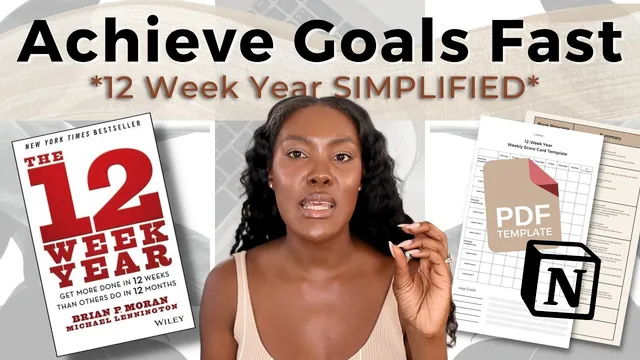
12 Week Year Template PDF + Book Summary
Based on Dr. Tiffany Shelton's video on YouTube. If you like this content, support the original creators by watching, liking and subscribing to their content.
Replace annual goal-setting with one or two major goals assigned a 12-week sprint to create urgency and repeatable momentum.
Briefing
The core promise behind the “12 Week Year” framework is simple: goals fail less because people lack effort and more because they plan on a timeline that’s too distant to create urgency. By compressing annual ambitions into 12-week sprints, the method brings targets close enough to feel actionable—turning vague “someday” dreams into deadlines that arrive four times a year.
The approach starts with a mindset shift away from willpower and toward structure. Annual goals often feel like a mountaintop seen from far away—easy to admire, hard to climb. The 12-week year flips that distance by making the finish line immediate. Instead of setting only yearly plans, the framework recommends choosing one or two major goals and giving them just 12 weeks, so focus and urgency can intensify on a repeating cycle.
But the system doesn’t begin with tasks. It begins with vision. Before setting targets, the method asks people to define a meaningful life direction—described through a layered metaphor: “sun goals” (5–10 year dreams), “moon goals” (1–3 year midterm milestones), “star goals” (quarterly/12-week targets), and “earth goals” (weekly, tangible actions). The vision must be taken seriously (not treated as a wish), be personally meaningful (not chosen to please others), be big enough to feel slightly frightening, and be connected to daily behavior rather than staying in the realm of daydreams.
Once the vision is clear, execution depends on separating outcomes from controllable actions. The framework distinguishes between lag goals—measurable results such as “hit 100K on YouTube by the end of the year”—and lead goals, the behaviors that drive progress, like posting a video weekly for 12 weeks. The key is that lead goals keep progress visible, so people know what to do next instead of waiting for results.
Planning then becomes a rhythm of monthly priorities and weekly tactics. Goals should be written clearly—specific, measurable, attainable, realistic, and time-bound—and assigned accountability. Each week, people track lead-goal performance using a scorecard and aim for at least 85% completion to stay on course for the sprint. The method also emphasizes time-blocking: strategic deep-work blocks (about one 3-hour focus session weekly), buffer blocks for admin and surprises (30–60 minutes daily), and breakout blocks for nonwork recovery (a 3-hour recharge window). Daily wind-down check-ins ask whether actions aligned with the vision and moved the needle.
Accountability is treated as a measurable lever, not a motivational slogan. The framework recommends a weekly accountability meeting (WHAM) with a friend or group to share wins and challenges. It also cites a progression of success rates tied to planning and accountability—rising from roughly 24% with goal-setting alone to as high as 95% when an accountability appointment is built in.
Finally, the system argues that time management and energy management are prerequisites for follow-through. Distraction control (phone out of sight, Pomodoro timers, and alpha-wave study music) supports focus, while a daily “MAX” routine—mindfulness, appreciation, pleasure, and self-care—builds the psychological foundation to sustain effort. The closing theme is ownership: high performers take responsibility for actions and results, commit to keystone actions, count the cost, and act on commitments rather than feelings—so greatness is built in the everyday moments, not just at the finish line.
Cornell Notes
The 12 Week Year framework tackles goal failure by replacing annual timelines with 12-week sprints that create urgency and repeatable momentum. It starts by defining a meaningful vision using layered “sun goals” (5–10 years), “moon goals” (1–3 years), “star goals” (12-week targets), and “earth goals” (weekly actions). Execution then separates lag goals (outcomes like subscriber growth) from lead goals (controllable behaviors like posting consistently), tracked weekly with a scorecard aiming for at least 85% completion. Planning is supported by monthly priorities, SMART-style goal setting, time-blocking (strategic, buffer, and breakout blocks), and daily reviews. Accountability—especially a scheduled weekly check-in—functions as a major success driver, alongside routines that protect focus and energy.
Why does compressing goals into 12-week sprints change outcomes compared with annual resolutions?
How does the framework build a “vision” before setting targets, and what are sun, moon, star, and earth goals?
What’s the difference between lag goals and lead goals, and why does that distinction matter?
What does a practical planning and tracking system look like across a 12-week sprint?
How do time blocks and daily reviews support follow-through?
Why is accountability treated as a success multiplier, and what is WHAM?
Review Questions
- How does the framework ensure a vision doesn’t become “daydreaming,” and what four-part goal structure translates it into weekly action?
- Explain lag goals vs. lead goals and give an example of each from the framework’s logic.
- What weekly and daily routines (planning, scorecard tracking, time blocks, and reviews) are required to stay on track during a 12-week sprint?
Key Points
- 1
Replace annual goal-setting with one or two major goals assigned a 12-week sprint to create urgency and repeatable momentum.
- 2
Build a meaningful vision first using sun goals (5–10 years), moon goals (1–3 years), star goals (12-week targets), and earth goals (weekly actions).
- 3
Separate outcomes (lag goals) from controllable behaviors (lead goals) so progress is measurable and actionable before results arrive.
- 4
Set sprint goals with clear criteria (specific, measurable, attainable, realistic, time-bound), assign accountability, and use monthly priorities to bridge to the sprint target.
- 5
Track lead-goal performance weekly with a scorecard and aim for at least 85% completion to stay aligned with the 12-week outcome.
- 6
Use time-blocking—strategic deep work, daily buffer time, and breakout recharge blocks—then run a short daily review to calibrate actions to the vision.
- 7
Treat accountability as a system by scheduling regular check-ins (WHAM) and pairing it with routines that protect focus and energy (phone limits, Pomodoro, MAX).