13 Years of No BS Study Advice in 58 Minutes
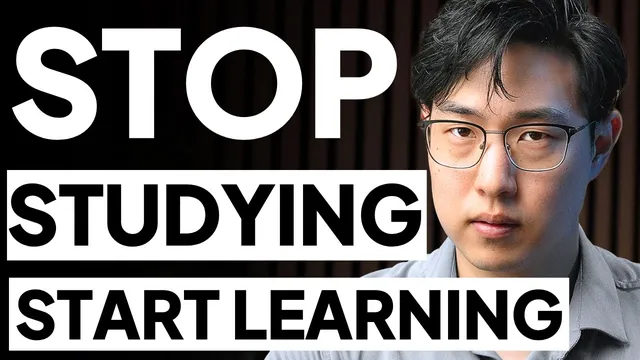
Based on Justin Sung's video on YouTube. If you like this content, support the original creators by watching, liking and subscribing to their content.
Treat “learning” as recall + deep understanding + application, not as time spent studying or note-taking volume.
Briefing
Learning isn’t the time spent with books, lectures, or note-taking—it’s what the brain retains, understands deeply, and can apply. After 13 years coaching learners worldwide, Justin Sung frames “study” as the activity and “learning” as the outcome: knowledge only counts when it sticks well enough to be recalled, explained with real understanding, and used under pressure. That distinction matters because many people can spend 4–10 hours “studying” while producing little learning—especially when the methods used don’t create durable retention or application.
A central theme is that studying effectiveness sits on a spectrum. At the low end are habits that feel productive but rarely generate learning, such as rereading and highlighting. At the high end are approaches that force the brain to connect ideas and retrieve them, turning information into knowledge. Sung argues that the fastest path forward is to remove low-yield behaviors and replace them with methods that reliably produce learning, rather than treating “study problems” as vague personal flaws.
He also pushes back hard against “study hacks.” Short-form promises of instant test scores are portrayed as a distraction from the real causes of poor performance: years of stacked habits that can’t be undone overnight. When students rely on hacks and still struggle, they often conclude they “aren’t smart enough”—a belief Sung calls both sad and incorrect. Instead, he recommends looking at what successful learners do in real life, but not copying them blindly.
Copying successful students fails because learning is personalized. Sung introduces “deep processing” as a key differentiator: the brain’s ability to connect information, extract meaning, and build understanding. Deep processing can be trained, but it varies—partly due to genetics and early experiences—and it explains why two people using the same techniques can get different results. His car-engine analogy captures the point: technique matters, but baseline processing power changes how much speed you can reach.
From there, Sung reframes learning as a system rather than a search for a perfect technique. There is no one best tool; each method has a purpose and limitations. Flashcards, for example, can be powerful, but abusing them can waste time and create “learning debt.” He warns about the “illusion of learning,” where activities like rewriting notes or passively reviewing feel like progress while failing to improve memory or application.
The practical prescriptions become increasingly specific: test earlier and more often, test at the same level of thinking as the exam (not just memorization), and test in different ways that match both declarative knowledge (knowing concepts) and procedural knowledge (doing the work). He argues that mistakes usually signal real gaps, not “silly mistakes,” and that active recall quality matters more than spacing alone. Finally, he recommends using spaced repetition with better recall mechanics (favoring free recall over recognition), treating rote memorization as a last resort, and using friends strategically for accountability and gap-finding through practice exams.
Sung closes with higher-level learning mechanics: “scope” subjects for priming before deep study, raise cognitive load through analogies and critique, and keep a learning log to iterate slowly—because changing too many things at once is biologically hard. The overall message is blunt but actionable: optimize what produces recall, understanding, and application, and build a learning system you can measure and refine over time.
Cornell Notes
The core distinction is between studying (activities like reading and note-taking) and learning (what the brain retains, understands deeply, and can apply). Sung argues that many common study habits create an “illusion of learning,” producing comfort without durable memory, so learners should replace low-yield methods with systems built around testing and retrieval. Deep processing—how well the brain connects ideas—helps explain why identical techniques don’t work equally for everyone, and it can be trained. Effective learning requires testing early and often, testing at the right level (conceptual and application-based), and using active recall in ways that truly measure recall rather than recognition. Over time, learners should prime topics, manage cognitive load, and track experiments in a learning log to improve step by step.
How does Sung define “learning,” and why does that definition change what a learner should do next?
Why does Sung say “study hacks” usually fail, and what should replace them?
What is “deep processing,” and how does it explain why copying successful students doesn’t work?
What does “illusion of learning” look like in practice?
How should testing be done to match real exam demands?
What makes active recall effective, and what traps does Sung warn against?
Review Questions
- Which study activities are most likely to create an “illusion of learning,” and what measurable outcome would prove they’re failing?
- How do deep processing and personalized learning explain why the same study technique can produce different results for different people?
- Design a testing plan for a subject: how would you test early, at the right knowledge level, and in both declarative and procedural ways?
Key Points
- 1
Treat “learning” as recall + deep understanding + application, not as time spent studying or note-taking volume.
- 2
Replace low-yield study behaviors (like rereading and highlighting) with methods that force retrieval and connection of ideas.
- 3
Avoid study hacks and instead build a learning system that targets the real bottlenecks created by long-standing habits.
- 4
Don’t copy successful students blindly; learning is personalized and deep processing strongly affects outcomes.
- 5
Test earlier and more often, and test at the same cognitive level as the exam (not just memorization).
- 6
Use active recall in a way that trains free recall rather than recognition or over-cued matching.
- 7
Prime subjects with a big-picture “scoping” overview and raise cognitive load through techniques like analogy creation and critique, while tracking changes in a learning log.