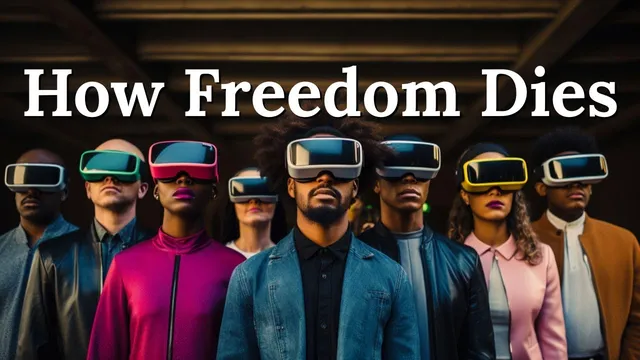
1984 vs Brave New World - How Freedom Dies
Based on Academy of Ideas's video on YouTube. If you like this content, support the original creators by watching, liking and subscribing to their content.
Orwell ties totalitarianism to collectivism, where collective goals override individual rights and power concentrates in an elite.
Briefing
The central warning tying George Orwell’s 1984 to modern politics is this: freedom can die without a dramatic “boot on the face” moment—because societies can slide into totalitarian control either by adopting collectivist power structures or by surrendering attention and agency to pleasure-driven distraction.
Orwell’s pessimism starts with a causal chain. Totalitarianism, in his view, grows out of collectivism—the idea that the goals of a collective (state, nation, class, ethnicity, society) override individual aims. He links the 20th-century rise of Nazi Germany and Soviet Russia to “oligarchical collectivism,” where an elite centralizes power through force and deception. Crucially, Orwell believed capitalism was doomed, but he worried about what would replace it. If capitalism collapses, the “real question” becomes whether it yields to oligarchy (totalitarian rule) or to “true democracy” in the form of democratic socialism.
Democratic socialism, as described here, would mean centrally planned economic policy, nationalization of major industry, and a sharp reduction in wealth inequality—paired with civil liberties like freedom of speech and assembly. The problem, according to the transcript’s logic, is that there are few real-world examples of democratic socialism working at scale, and history suggests that removing economic freedom tends to erode civil liberties too. Central planning invites corruption, waste, and mismanagement; maintaining power then requires limiting dissent. Orwell’s fear is that Western countries, after capitalism, could follow the same path as earlier collectivist regimes—trading economic autonomy for political control.
That risk is intensified by a second trend: hedonism. Hedonism is framed as the ethical pursuit of pleasure and avoidance of pain. Orwell argues that an increasingly urban, consumerist culture can produce a population that is “feeble” and resistant to organizing against coercive rulers. A key distinction is drawn between the lover of pleasure and the fanatic: the fanatic is more self-sacrificing and remorseless, and the pleasure-seeking public becomes “easy meat.”
Aldous Huxley’s Brave New World shifts the mechanism. Where Orwell fears pain-based control, Huxley fears pleasure-based control: people may willingly give up freedom when their appetites for consumption and gratification are constantly met. In this model, oppression relies less on overt force and more on persuasion, conditioning, and distraction—so citizens never focus long enough on political realities. Neil Postman’s contrast sharpens the difference: Orwell fears truth will be concealed; Huxley fears truth will be drowned in irrelevance. The transcript then argues that contemporary life resembles Huxley’s warning—screens, normalized self-medication, and a steady stream of diversions that make coercion unnecessary.
Yet Orwell is not dismissed. The transcript notes Orwell could accept hedonism as a temporary phase that creates the conditions for a harsher regime to seize power during a crisis. The final implication is stark: if a major social emergency arrives, many may accept the more brutal totalitarian option—suggesting that what’s missing for a permanent slide into 1984 may be not ideology alone, but a triggering breakdown.
Cornell Notes
Orwell links totalitarianism to collectivism: when collective goals override individual rights, power tends to concentrate in an elite that uses force and deception. Even if capitalism is seen as doomed, Orwell worries that its replacement could be “oligarchical collectivism” rather than democratic socialism, because centralized planning and the need to maintain rule typically erode civil liberties. He also warns that rising hedonism—pleasure-seeking and distraction—weakens people and makes them easier to control. Huxley offers a different pathway: people can be oppressed through pleasure and constant distraction, surrendering freedom without noticing. Together, the two dystopias suggest freedom can collapse either through coercive collectivist power or through voluntary, pleasure-driven disengagement—especially when a crisis arrives.
Why does Orwell connect collectivism to totalitarianism?
What is the key fork in the road after capitalism, in Orwell’s view?
Why does the transcript claim democratic socialism is unstable for civil liberties?
How does Orwell think hedonism makes totalitarian control easier?
What mechanism does Huxley emphasize in Brave New World?
How does Postman’s contrast sharpen the difference between Orwell and Huxley?
Review Questions
- What does Orwell mean by “oligarchical collectivism,” and how does it differ from democratic socialism?
- According to the transcript, why does removing economic freedom tend to undermine civil liberties?
- Compare Orwell’s and Huxley’s models of how a society loses freedom: pain-based coercion versus pleasure-based distraction.
Key Points
- 1
Orwell ties totalitarianism to collectivism, where collective goals override individual rights and power concentrates in an elite.
- 2
The critical question after capitalism’s collapse is whether replacement becomes oligarchy or democratic socialism with preserved civil liberties.
- 3
Central planning is portrayed as corruption- and mismanagement-prone, which increases the need to suppress dissent to maintain rule.
- 4
Rising hedonism is framed as weakening resistance, making populations easier to dominate by more fanatical actors.
- 5
Huxley’s model suggests oppression can work through pleasure, conditioning, and distraction—so people surrender freedom without noticing.
- 6
Postman’s contrast captures the difference: Orwell fears truth is concealed; Huxley fears truth is drowned in irrelevance.
- 7
A major social crisis is presented as a potential trigger that could push a distracted, apathetic society toward the harsher Orwellian form of totalitarianism.