3 Fundamental Laws of Chemistry
Based on ChemistryNotes Videos's video on YouTube. If you like this content, support the original creators by watching, liking and subscribing to their content.
Conservation of mass requires that atoms are conserved in chemical reactions, which is why balanced equations must match atom counts on both sides.
Briefing
Three foundational chemistry laws—conservation of mass, definite proportions, and multiple proportions—set the rules for how matter behaves in reactions and how elements combine in compounds. Together, they explain why chemical equations balance, why every sample of a given compound has the same elemental ratios, and why different compounds formed from the same two elements show simple whole-number relationships.
The first law, conservation of mass, holds that matter is neither created nor destroyed in chemical processes. Antoine Lavoisier (1743–1794) is credited with the principle, which is why chemists balance equations: the number of atoms of each element must match on both sides. The transcript illustrates this with a balanced example structure—equal counts of hydrogen and oxygen atoms—reinforcing that mass conservation is fundamentally an atom-counting constraint.
The second law, the law of definite proportions, says a given compound always contains the same mass ratio of its constituent elements. Water (H2O) serves as the example. Because hydrogen has an atomic mass of about 1.01 and oxygen about 16 (as given in the transcript), water’s total mass is always split in the same way: hydrogen accounts for about 11.2% of the mass and oxygen about 88.8%. More importantly, the ratio of hydrogen atoms to oxygen atoms stays fixed at 2:1 no matter how much water is sampled. The key word is “definite”: one specific compound means one specific elemental ratio.
The third law, the law of multiple proportions, addresses what happens when the same two elements form more than one compound. John Dalton is linked to the development of this idea. When two elements form a series of compounds, the mass ratios of the second element relative to the first can be reduced to small whole-number ratios. The transcript contrasts this with definite proportions by emphasizing that multiple proportions compares the same element across different compounds.
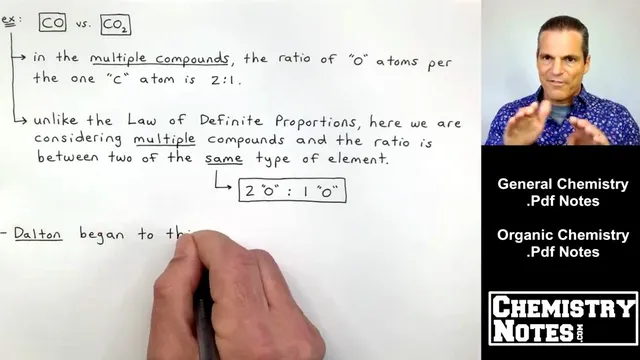
An example is given using carbon and oxygen: carbon monoxide (CO) and carbon dioxide (CO2). The oxygen-to-carbon ratios differ as 1:1 in CO versus 2:1 in CO2, and intermediate non-whole-number ratios like CO1.5 are treated as impossible under the law because the ratios must reduce to whole numbers. The logic is tied to Dalton’s atomic view: if elements combine in whole-number multiples, then matter must be built from discrete units—atoms—rather than fractional pieces.
Finally, a worked sample problem with nitrogen and oxygen demonstrates multiple proportions quantitatively. Three compounds (X, Y, Z) each contain 1 gram of oxygen but different masses of nitrogen: 1.750 g for X, 0.8750 g for Y, and 0.4375 g for Z. Comparing nitrogen masses in whole-number ratios yields X:Y = 2:1, Y:Z = 2:1, and X:Z = 4:1. Those small whole-number relationships illustrate the law of multiple proportions directly and connect the abstract rule to measurable data.
Cornell Notes
Three laws anchor early chemistry: conservation of mass, definite proportions, and multiple proportions. Conservation of mass (credited to Lavoisier) requires that atoms—and thus mass—are not created or destroyed, which is why chemical equations must balance. The law of definite proportions says every sample of a specific compound has the same mass ratio of elements; water always has a 2:1 hydrogen-to-oxygen atom ratio (about 11.2% H and 88.8% O by mass, using the transcript’s atomic masses). The law of multiple proportions applies when two elements form several compounds: the mass ratios of one element relative to the other reduce to small whole-number ratios. Dalton’s atomic theory is motivated by the idea that these whole-number relationships reflect discrete atoms.
Why does balancing a chemical equation connect directly to conservation of mass?
What makes the law of definite proportions “definite,” and how does water illustrate it?
How does the law of multiple proportions differ from the law of definite proportions?
Why are ratios like CO1.5 treated as invalid in the multiple-proportions framework?
In the nitrogen–oxygen sample problem, how do the numbers demonstrate multiple proportions?
Review Questions
- Give an example of how conservation of mass would constrain a chemical equation, and describe what must match on both sides.
- Explain why water’s composition stays fixed under the law of definite proportions, and state the hydrogen-to-oxygen atom ratio used in the transcript.
- Using the nitrogen–oxygen compounds X, Y, and Z, compute the nitrogen mass ratio for X to Z and interpret it using the law of multiple proportions.
Key Points
- 1
Conservation of mass requires that atoms are conserved in chemical reactions, which is why balanced equations must match atom counts on both sides.
- 2
The law of definite proportions says every sample of a specific compound has the same mass ratio of its elements.
- 3
Water (H2O) is used to show a fixed 2:1 hydrogen-to-oxygen atom ratio and consistent mass contributions (about 11.2% H and 88.8% O using the transcript’s atomic masses).
- 4
The law of multiple proportions applies when the same two elements form multiple compounds, requiring that relevant mass ratios reduce to small whole-number ratios.
- 5
Dalton’s atomic theory is motivated by the observation that element combinations follow whole-number patterns rather than fractional ones.
- 6
A nitrogen–oxygen example demonstrates multiple proportions by comparing nitrogen masses across compounds that share the same oxygen mass, yielding ratios like 2:1 and 4:1.