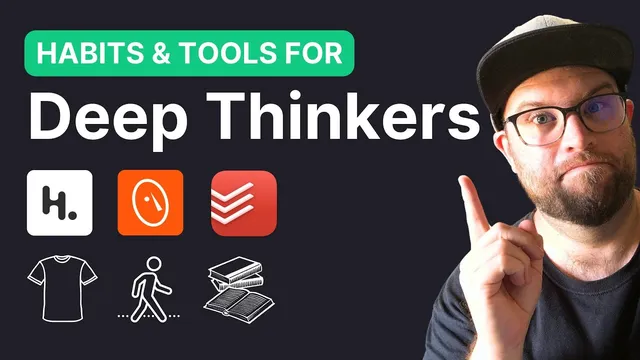
6 habits and tools for deep thinkers and creators (Heptabase, mymind, todoist)
Based on Greg Wheeler's video on YouTube. If you like this content, support the original creators by watching, liking and subscribing to their content.
Heptabase is the central PKM and journaling system, with Journal meta app used for date-specific reminders and ongoing idea capture.
Briefing
Deep thinkers and creators don’t rely on a single “perfect” system so much as a small stack of tools paired with repeatable rhythms. The core idea is practical: capture what matters quickly, store it so it’s easy to retrieve, then process it on a schedule—so attention doesn’t get consumed by endless collecting.
For capturing and thinking, Heptabase is presented as the main PKM (personal knowledge management) hub. It functions as a journal through the Journal meta app inside Heptabase, where small reminders can be attached to specific dates—like a future prompt on October 26, 2024 to adjust a contract job. The system also supports deeper work: photos and other saved artifacts from elsewhere can be brought into Heptabase for “deep and wide” reflection.
That capture pipeline is powered by mymind, used primarily as a visual memory bank. Instead of treating photos as disposable, the workflow turns everyday images—sunsets, nature, quotes, and other moments—into prompts for later thinking. Books to read are tracked in a simple list: once a book is started and finished, it’s removed, keeping the queue visually clear. The emphasis is on fast intake and low friction: capture with a phone, organize nothing heavy, and let the thinking happen later.
Tasks and time are handled separately to keep the mental load light. Todoist serves as the task engine, relying on natural-language input (for example, “next Monday”) and using a work project plus a “today” filter to surface exactly what needs doing. Personal scheduling is routed to Google Calendar, described as straightforward event and appointment tracking.
Even physical accessories get folded into the system. A Fruit of the Loom pocket tee is used as a practical reading tool because it carries a highlighter and pen. The point isn’t the shirt itself; it’s designing for readiness—so highlighting can happen immediately when something resonates. The highlighter preference is functional: pointed tips allow different marking styles, helping distinguish what truly stood out from what didn’t.
The rhythms section reframes habits as timing and flow, borrowing from music: daily, weekly, and monthly patterns guide when to push and when to rest. The daily keystone is waking up at 5:30 a.m., built from an early-morning UX design boot camp schedule in 2018 and maintained because it “fills the cup” before family, friends, and work. The second keystone is a two-mile walk, described as the primary clarity-builder. During walks, photos are snapped and saved to mymind, scripture is read from a dedicated note (“praying the scripture”), and ideas are jotted into Heptabase’s journal meta app. The walk also fuels creativity, including playful “dad joke” entries tagged for later retrieval.
Daily reading centers on the Bible, treated as the main text and a source of varied literature and long-standing ideas worth continually re-placing in the mind. A slower pace is also framed as a paradox: “the slower I go the faster I arrive,” balancing urgency with intentionality.
Weekly rhythms add processing without over-analysis. Other books are read at least once a week, with a preference for books over articles for depth and craft. A weekly review note acts like a tidy-up: it collects “meaningful moments” and “favorite notes” by linking selected daily entries, tagged so every note has a home. Those weekly reviews then scale into an annual review—essentially a “big weekly review” that surfaces what to celebrate and what shifted perspective across the year.
Cornell Notes
The system pairs a small set of tools with scheduled rhythms to prevent “collecting” from turning into mental clutter. Heptabase is the core PKM and journaling space, supported by mymind for fast visual capture and Todoist/Google Calendar for tasks and appointments. Daily life runs on two keystone rhythms: waking at 5:30 a.m. and taking a two-mile walk, during which photos, scripture, and ideas are captured for later reflection. The weekly review then processes the week by linking only the most meaningful moments and favorite notes into one place, keeping notes tagged and retrievable. Over time, those weekly reviews roll up into an annual review that highlights what to celebrate and what challenged perspective.
How does the workflow connect quick capture to deeper thinking without losing everything in the backlog?
Why is walking treated as a “keystone habit,” and what exactly gets done during the walk?
What role does the early-morning wake time play beyond simple productivity?
How does the weekly review avoid becoming another deep-analysis project?
What’s the practical purpose of the “pocket tee + highlighter” detail?
Why prefer books over articles for weekly reading?
Review Questions
- Which tool handles visual capture, and how does that content later feed into Heptabase for reflection?
- What are the two keystone daily rhythms, and what specific activities happen during each?
- How does the weekly review decide what gets linked into the “Meaningful moments” and “favorite notes” sections?
Key Points
- 1
Heptabase is the central PKM and journaling system, with Journal meta app used for date-specific reminders and ongoing idea capture.
- 2
mymind functions as a low-friction visual capture library for photos, quotes, and reading goals, enabling later “deep and wide” reflection in Heptabase.
- 3
Todoist is used for tasks with natural-language input and a work project plus a “today” filter to keep daily execution focused.
- 4
Google Calendar provides simple event and appointment tracking, separating scheduling from knowledge work.
- 5
A Fruit of the Loom pocket tee is treated as a functional tool for immediate highlighting—emphasizing readiness over gear obsession.
- 6
Daily clarity is anchored by waking at 5:30 a.m. and taking a two-mile walk, during which photos, scripture, and ideas are captured.
- 7
Weekly review is a processing step that links only meaningful moments and favorite notes into one tagged note, then scales into an annual review.