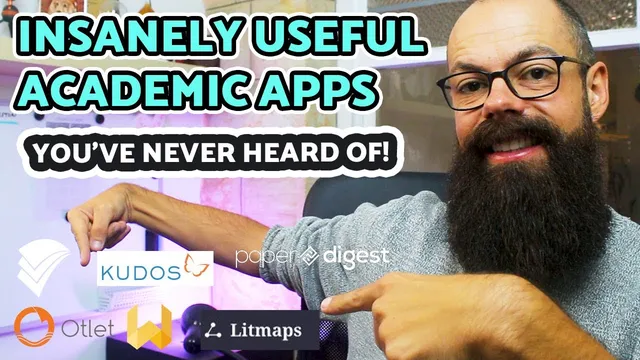
7 insanely useful academic apps you've not heard about!
Based on Andy Stapleton's video on YouTube. If you like this content, support the original creators by watching, liking and subscribing to their content.
Paper Digest converts a DOI into a fast AI summary for open-access papers or available PDFs, helping researchers triage what to read next.
Briefing
Academic work often stalls not because researchers lack ideas, but because the paperwork, formatting, literature tracking, and communication grind becomes overwhelming. This roundup spotlights lesser-known tools aimed at removing those friction points—turning dense writing into clearer drafts, speeding up journal-ready formatting, making citation networks easier to navigate, and even improving how results are shared beyond paywalled papers.
Paper Digest targets the first bottleneck: understanding and triaging new research quickly. Users paste a DOI and, as long as the paper is open access (or a PDF is available), the service generates an AI summary. The value is practical rather than perfect—researchers still need to manually verify whether the paper fits their topic—but the DOI-to-summary workflow makes it easier to build a “read now / read later” pipeline and decide what deserves deeper attention.
For writing itself, Rightful is positioned as an academic-writing assistant trained on large volumes of papers and journals. The focus is on dense, non-conversational academic language—grammar, terminology, and the “cart before the horse” logic of explanations that need proper sequencing. The tool aims to help researchers produce stronger academic sentences and structure, especially for those who find the style difficult to master.
Formatting and journal compliance are handled by Penelope.ai. Instead of rewriting content, it checks manuscripts against common submission requirements: presence of key sections like authors and an abstract, and correct reference formatting for a given journal. As text is copied and pasted and edited, the system analyzes it in real time and flags what needs changing—designed to catch the small errors that can delay or derail acceptance.
Keeping track of the literature is another recurring pain point, and Litmaps addresses it with visual citation mapping. Starting from a seed article or an author, users explore connected papers through interactive citation maps. Email updates can also notify researchers about new links to their map, helping them maintain an up-to-date view of a field without spending hours manually searching.
Presentation quality matters too, since figures now need to look publication-ready. BioRender is described as a “Canva for science,” letting researchers create professional biology and natural-science figures quickly. A free tier supports trial use, while publishing-ready output requires payment—often covered by labs or institutions.
Collaboration and resource sharing show up in two more tools. Otlet.io focuses on sharing biological samples: researchers can upload samples so others can request them, and those seeking material can collaborate by finding what’s available. Finally, Kudos (GrowKudos via growkudos.com) targets science communication. It helps researchers capture the “story” behind their work on a web page in more accessible language—an effort to ensure published research isn’t forgotten and to increase the odds that others understand, remember, and reuse it.
Taken together, the list reframes academic productivity as a chain of small, solvable problems: summarize faster, write better, format correctly, map the literature, publish with stronger visuals, share resources, and communicate clearly so the work actually lands in the world.
Cornell Notes
The roundup argues that academic progress often depends on practical tooling—summarizing papers, improving writing, meeting journal formatting rules, and staying on top of literature. Paper Digest turns a DOI into a quick AI summary (with manual verification still needed), while Rightful helps refine dense academic writing by learning from large sets of papers and journals. Penelope.ai checks manuscripts for common submission mistakes, especially authors, abstracts, and journal-specific reference formatting. Litmaps uses interactive citation maps plus email updates to help researchers track how papers connect over time. BioRender speeds up creation of publication-quality figures, while Otlet.io supports sharing biological samples and Kudos/GrowKudos helps translate research into accessible web stories for wider uptake.
How does Paper Digest reduce the time spent triaging new research?
What kinds of writing problems Rightful is designed to help with?
Why does Penelope.ai matter even when the research content is already strong?
How does Litmaps help researchers keep up with a field without constant manual searching?
What problem BioRender targets in the publication process?
How do Otlet.io and Kudos/GrowKudos differ in their approach to collaboration and impact?
Review Questions
- Which step in the academic workflow—triage, writing, formatting, literature tracking, figures, collaboration, or communication—do you personally struggle with most, and which tool from the list best targets that bottleneck?
- What limitations still require human judgment when using AI summarization tools like Paper Digest?
- How would you design a workflow that combines at least three of these tools from manuscript drafting through submission and post-publication communication?
Key Points
- 1
Paper Digest converts a DOI into a fast AI summary for open-access papers or available PDFs, helping researchers triage what to read next.
- 2
Rightful focuses on improving dense academic writing by learning patterns from large collections of papers and journals, including grammar, terminology, and argument sequencing.
- 3
Penelope.ai checks manuscripts for common journal submission problems, including required sections like authors and abstracts and journal-specific reference formatting.
- 4
Litmaps uses interactive citation maps plus email updates so researchers can visually track how papers connect and stay current with new links.
- 5
BioRender accelerates creation of publication-quality figures in biology and natural sciences, with a free trial and paid publishing output.
- 6
Otlet.io enables biological sample sharing so researchers can request and collaborate using materials already available in labs.
- 7
Kudos/GrowKudos helps researchers communicate their work in more accessible language via web pages, aiming to prevent published research from being overlooked after release.