A Brain-Inspired Algorithm For Memory
Based on Artem Kirsanov's video on YouTube. If you like this content, support the original creators by watching, liking and subscribing to their content.
Associative recall can be framed as energy minimization: store memories as local minima in an energy landscape and retrieve by descending toward the nearest well.
Briefing
A brain-inspired memory system can retrieve stored information without searching through an astronomically large space of possibilities by turning memories into “energy wells” and letting dynamics fall downhill. The core insight is to mimic how proteins fold: instead of brute-force searching for the best configuration, a physical system moves toward lower energy states. Hopfield networks implement this idea for associative memory, using an energy function whose local minima correspond to stored patterns.
The transcript starts with a familiar human scenario—hearing a short song snippet and instantly recalling lyrics and related experiences—and frames the computational challenge: recognizing and associating information quickly seems to require searching among countless past inputs and memories. The proposed solution is to avoid explicit matching against every stored item. Hopfield networks provide a model where the system’s state evolves through local updates until it settles into a stable configuration that matches the closest stored memory.
To motivate the approach, the transcript draws an analogy to Levinthal’s paradox in protein folding. Proteins have an enormous number of possible conformations, yet they reach their native structure in milliseconds. The resolution is the energy landscape: each configuration has a potential energy, and physical dynamics drive the system toward low-energy valleys. Translating that to memory, the goal becomes twofold: (1) “sculpt” an energy landscape so that desired memories become local minima, and (2) use an update rule that reliably drives the network toward the nearest minimum when given a partial or noisy cue.
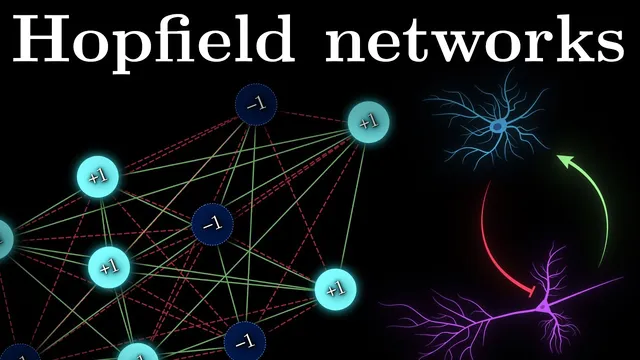
The Hopfield network is built from neurons with binary states (±1) connected in a fully connected, symmetric weight matrix. Positive weights encourage alignment between neuron pairs; negative weights encourage anti-alignment. The network defines an energy function based on how well the current neuron states agree with the pairwise weight structure. Learning corresponds to choosing weights so that each target memory pattern becomes a low-energy state—specifically, a Hebbian rule emerges naturally for storing a single pattern by setting each weight to the product of the corresponding neuron states in that memory. For multiple memories, the weights are formed by summing the contributions from each pattern, creating multiple basins of attraction.
Retrieval (inference) assumes weights are fixed. Starting from an initial state—often a noisy or incomplete version of a stored pattern—the network repeatedly updates neurons one at a time. Each neuron computes a weighted input from all other neurons and flips to the state that reduces energy, effectively performing a majority-vote-like update. With symmetric weights, this deterministic descent is guaranteed to converge to a stable local minimum rather than oscillate indefinitely. That stable state performs pattern completion: the network settles into the stored memory whose basin is closest to the cue.
The transcript also emphasizes a practical limitation: the number of reliable memories grows only linearly with network size and is capped at about 0.14 times the number of neurons. Beyond that capacity, stored patterns interfere, producing spurious “mixed” memories and unreliable convergence. Even with these constraints, Hopfield networks remain a foundational, intuitive model for energy-based associative recall, with later extensions such as Boltzmann machines and modern variants mentioned as next steps.
Cornell Notes
Hopfield networks turn associative memory into an energy-minimization problem. Each stored pattern is engineered to become a local minimum (“energy well”) in a landscape defined by a network energy function. When a cue is incomplete or noisy, the network updates neurons one at a time using a weighted input rule that lowers energy, so the system converges to the nearest stable minimum. Symmetric weights guarantee convergence, enabling reliable pattern completion. The tradeoff is capacity: the network can store only about 0.14N patterns reliably for N neurons; too many memories cause interference and spurious mixed states.
Why does the transcript compare associative memory to protein folding and Levinthal’s paradox?
How does a Hopfield network define “energy,” and what does it mean for memory storage?
What is the inference (retrieval) procedure once weights are fixed?
Why does symmetric connectivity matter for convergence?
How are weights learned for one memory, and what rule emerges?
What limits the number of memories a Hopfield network can store reliably?
Review Questions
- How does the energy landscape concept replace brute-force search in associative memory retrieval?
- Describe the neuron update rule in Hopfield inference and explain why it decreases energy.
- What causes spurious mixed memories when too many patterns are stored, and how does the capacity estimate relate to network size?
Key Points
- 1
Associative recall can be framed as energy minimization: store memories as local minima in an energy landscape and retrieve by descending toward the nearest well.
- 2
Hopfield networks use binary neuron states (±1) and symmetric weights to define a network energy function based on agreement between neuron pairs and their connection weights.
- 3
Learning corresponds to choosing weights so target patterns become stable configurations; for a single pattern, weights follow a Hebbian rule based on pairwise state products.
- 4
Inference starts from a noisy or partial cue and repeatedly updates neurons one at a time using the sign of a weighted input, ensuring energy decreases.
- 5
With symmetric weights, the single-neuron update process is guaranteed to converge to a stable local minimum rather than oscillate.
- 6
Hopfield networks have limited capacity: reliable storage is approximately 0.14 times the number of neurons; beyond that, memories interfere and recall can become incorrect.