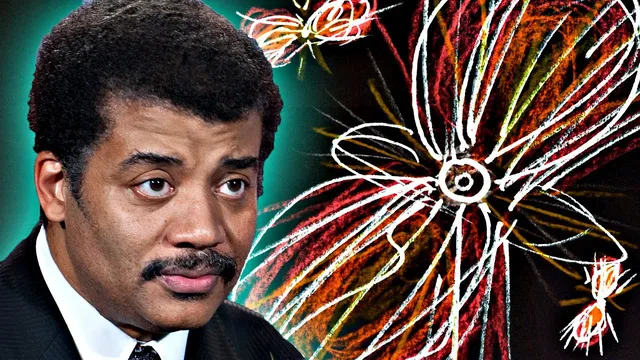
A Brief History of Everything, feat. Neil deGrasse Tyson
Based on minutephysics's video on YouTube. If you like this content, support the original creators by watching, liking and subscribing to their content.
A tiny matter–antimatter surplus early in cosmic history prevented complete annihilation and made a matter-dominated universe possible.
Briefing
The universe’s story hinges on one rare early accident: a tiny imbalance between matter and antimatter. In the first fractions of a second after the Big Bang, conditions were so extreme that the basic forces of nature were unified and space-time itself behaved in a highly curved, “foamlike” way. As the cosmos expanded and cooled, gravity separated from the other forces, then the strong nuclear force and the electroweak force split, triggering rapid inflation that stretched and smoothed the distribution of matter and energy to near-uniformity.
As temperatures remained high, photons repeatedly converted into matter–antimatter pairs—until a later cooling phase made that process impossible. At that point, matter and antimatter annihilated each other, and only a slight asymmetry remained: for every billion antimatter particles, a billion plus one matter particles survived. Without that matter-over-antimatter excess, the universe would have ended up as light with nothing else, eliminating the possibility of stars, planets, and chemistry.
From there, the timeline becomes a chain reaction of “firsts.” Over roughly three minutes, protons and neutrons assembled into the simplest atomic nuclei. For hundreds of thousands of years afterward, free electrons kept scattering light, leaving the universe opaque. Once the temperature dropped below a few thousand Kelvin, electrons combined with nuclei to form atoms of hydrogen, helium, and lithium, and the cosmos became transparent—allowing visible photons to stream freely as the cosmic microwave background.
Over the next billion years, gravity gathered matter into galaxies—tens of billions of them—each hosting hundreds of billions of stars. In stellar cores, thermonuclear fusion built heavier elements. Stars more than about ten times the Sun’s mass manufactured many elements beyond hydrogen, but those ingredients would have been trapped inside stars without stellar explosions. Supernovae dispersed enriched material across galaxies, seeding later star systems with the heavy elements needed for rocky planets.
The formation of the Sun and Earth followed that enriched path. The gas cloud that birthed the Sun contained enough heavy elements to create planets, asteroids, and comets. Early impacts kept Earth’s surface molten for hundreds of millions of years, delaying complex chemistry until cooling allowed oceans to persist. Earth’s distance from the Sun—neither too hot nor too cold—kept water largely liquid, setting the stage for life.
Life emerged through an unknown mechanism in oxygen-poor oceans: simple anaerobic bacteria altered Earth’s carbon-dioxide-rich atmosphere, enabling aerobic organisms to later dominate. Oxygen also formed ozone high in the atmosphere, shielding the surface from ultraviolet radiation. Yet life remained fragile. About 65 million years ago, a massive asteroid impact at the Yucatan peninsula wiped out over 70% of species, including dinosaurs, opening ecological space for small mammals. From that surviving branch came primates, and eventually Homo sapiens—capable of tools, science, and the ability to deduce the universe’s origin.
The final takeaway is both cosmic and personal: every atom in human bodies traces back to the Big Bang and to element-making inside high-mass stars. The universe is not merely the setting for life; it is the source of life’s building blocks—and, through human curiosity, a system learning its own history.
Cornell Notes
Early-universe physics produced a decisive asymmetry: a slight excess of matter over antimatter. After inflation smoothed the cosmos and forces separated, photons could no longer create new matter–antimatter pairs; annihilation then left behind roughly one matter particle for every billion photons, with essentially no antimatter. That survival enabled nucleosynthesis of light elements, recombination into atoms, and a transparent universe whose leftover light became the cosmic microwave background. Later, stars forged heavier elements and supernovae spread them into new generations of gas clouds, allowing rocky planets like Earth to form. Life then arose in liquid oceans, oxygenated the atmosphere, and survived long enough—despite mass extinctions—for primates to evolve into Homo sapiens, who can trace their atoms back to the Big Bang and stellar fusion.
What single early-universe factor determines whether matter ever dominates over light?
How did inflation change the universe’s initial conditions?
Why did the universe become transparent, and what is seen today as a result?
Where did Earth’s heavy elements come from?
What sequence links early chemistry on Earth to oxygen and then to protection from ultraviolet light?
How did a mass extinction help shape human emergence?
Review Questions
- What chain of events turns an early matter–antimatter imbalance into a universe capable of forming atoms, stars, and planets?
- How do force separations and inflation influence the large-scale structure of the cosmos?
- Trace the pathway from stellar nucleosynthesis to Earth’s ability to host liquid oceans and complex life.
Key Points
- 1
A tiny matter–antimatter surplus early in cosmic history prevented complete annihilation and made a matter-dominated universe possible.
- 2
Inflation, driven by rapid expansion during force-splitting, smoothed density variations to less than one part in one hundred thousand.
- 3
Recombination—when electrons bound to nuclei—ended photon scattering and produced a transparent universe whose leftover light is the cosmic microwave background.
- 4
Heavy elements needed for rocky planets were manufactured in high-mass stars and dispersed by stellar explosions into later star-forming gas clouds.
- 5
Earth’s distance from the Sun helped keep oceans largely liquid, enabling complex chemistry rather than vaporization or freezing.
- 6
Oxygenation began with anaerobic bacteria and later produced ozone, which protects surface life from most ultraviolet radiation.
- 7
A mass extinction about 65 million years ago opened ecological niches that helped mammals—and eventually primates and Homo sapiens—take over.