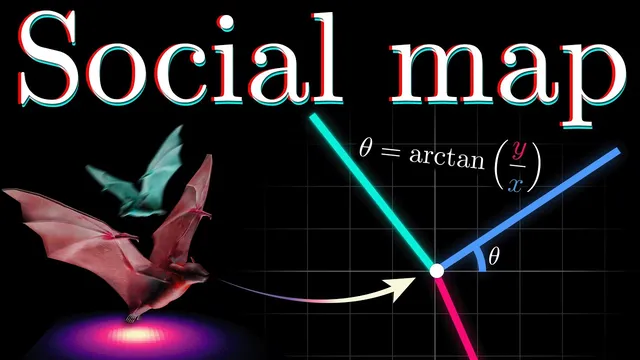
A Map of Social Space in Your Brain
Based on Artem Kirsanov's video on YouTube. If you like this content, support the original creators by watching, liking and subscribing to their content.
Place cells in the hippocampus fire for specific locations, and their tiled activity supports route planning in physical environments.
Briefing
A growing body of neuroscience suggests the hippocampus—long known for building maps of physical space—also helps build “social maps,” letting brains track where other individuals are, how they relate, and how far they sit in a person’s social landscape. The key idea is that the same neural machinery used for navigation can be repurposed as the brain moves from concrete locations to increasingly abstract relationships, from tracking another bat in flight to mapping a boss or grandma in a coordinate system of dominance and affiliation.
The story starts with the hippocampus’s original job in mammals: efficient computation in the physical world. Place cells in the hippocampus fire when an animal occupies a specific location, and together their place fields tile the environment to support path planning and route optimization. That “cognitive map” raises an obvious question: what would place fields look like when there’s no literal ground to stand on?
In social animals, researchers have found a direct answer at the next level of abstraction. Studies of bats trained in pairs for observational learning show hippocampal neurons in the observer that become tuned to the demonstrator’s position. When the observer bat flies to the same landing ball as the demonstrator, some neurons act like “social place cells,” tracking where the other bat is rather than where the observer itself is. Importantly, these social representations aren’t just generic object-following: when the task involves following an inanimate moving object instead of another bat, single-neuron activity patterns differ, indicating the hippocampus treats conspecifics as socially meaningful entities.
The experiments also probe how social and spatial coding coexist inside the same neurons. One possibility is strict separation—some cells only represent self-location during flight, while others only represent the demonstrator during observation. Another possibility is flexible switching, where a neuron can represent either self or the other bat depending on task demands. The data point to a middle ground: neurons form a continuum from “congruent” cells whose spatial and social place fields overlap closely to “non-congruent” cells where the fields diverge. In other words, physical and social information can be conjoined within single cells, with the balance shifting according to context.
Humans push abstraction even further, using social metaphors that behave like coordinates. In an fMRI study using a “Choose Your Own Adventure” game with fictional characters, participants interact with one character at a time while their hippocampal activity is monitored. The characters occupy a two-dimensional social space defined by dominance/authority and affiliation/intimacy. As choices change these values in discrete steps, researchers track each character’s trajectory through the social plane. Hippocampal activity correlates with movement in this social space—particularly with the vector angle and the implied social distance—and the strength of prediction improves in people with better social skills.
Taken together, the findings support a unifying view: the hippocampus can reuse spatial navigation circuitry to represent social relationships, first by mapping another individual’s location, then by binding social meaning to neural representations, and finally by constructing an abstract “social landscape” where distance and hierarchy can be navigated even while sitting still on a couch.
Cornell Notes
Neuroscience evidence links the hippocampus’s spatial mapping role to social cognition across species. In bats, hippocampal neurons can track a demonstrator bat’s position during observational learning, forming “social place cells” that differ from representations used for inanimate objects. Neurons show a continuum between purely spatial and purely social coding, with some cells switching or partially overlapping self- and conspecific-related place fields depending on context. In humans, an fMRI study used a game that places characters in a 2D social space (dominance/authority and affiliation/intimacy), and hippocampal activity correlated with how characters move through that space. The implication is that brains may navigate social relationships using the same core machinery that supports navigation in physical environments.
How do place cells in the hippocampus create a “cognitive map” of physical space?
What evidence shows that hippocampal neurons can represent another individual’s position in bats?
Why does the hippocampus’s response to another bat differ from following an inanimate object?
How do researchers distinguish between separate spatial vs social neuron populations and flexible coding?
How is “social space” represented in the human fMRI study, and what does hippocampal activity track?
Review Questions
- What are place cells, and how do their place fields enable navigation in physical environments?
- In the bat observational learning task, what distinguishes social place cells from representations of inanimate objects?
- How do the human study’s dominance/authority and affiliation/intimacy axes relate to the hippocampal activity correlations?
Key Points
- 1
Place cells in the hippocampus fire for specific locations, and their tiled activity supports route planning in physical environments.
- 2
In bats, some hippocampal neurons track the position of a demonstrator conspecific during observational learning, indicating “social place” coding.
- 3
Neural representations differ when the target is another bat versus an inanimate moving object, implying conspecifics carry special social meaning in hippocampal maps.
- 4
Self-location and conspecific-location coding are not strictly separate; neurons show a continuum from overlapping (congruent) to diverging (non-congruent) spatial and social place fields depending on context.
- 5
In humans, hippocampal activity correlates with changes in an abstract 2D social space defined by dominance/authority and affiliation/intimacy.
- 6
Across levels of abstraction, the hippocampus appears capable of reusing spatial navigation machinery to support social cognition and social distance mapping.