A Physics Prof Bet Me $10,000 I'm Wrong
Based on Veritasium's video on YouTube. If you like this content, support the original creators by watching, liking and subscribing to their content.
Wind-gradient and gust timing were the two primary ways the “faster than wind” claim could be misread, so the response focused on multi-height wind measurements and evidence of sustained acceleration.
Briefing
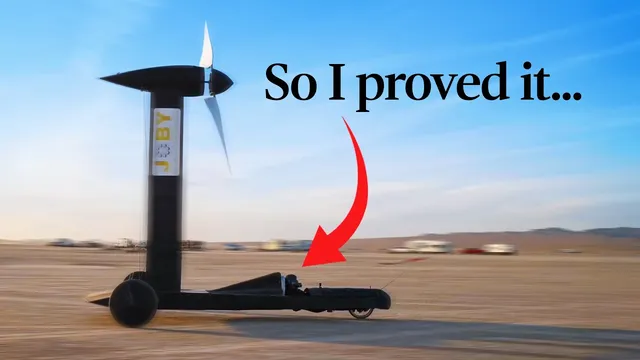
A UCLA physics professor publicly bet $10,000 that a wind-powered downwind vehicle couldn’t truly sustain speeds faster than the wind pushing it—and the wager ended after a chain of experimental and theoretical rebuttals that ultimately supported the counterintuitive claim. The core issue was whether Blackbird’s apparent “faster-than-wind” motion could be explained away by gust timing, wind-speed measurement errors, or flawed physics.
The challenge centered on two main objections. First, the wind was measured near the ground (about a meter or a meter and a half), while the propeller sits roughly three meters up. Because wind speed typically increases with height (a wind gradient), the vehicle might look faster than the wind at the tell-tale height even if it’s not actually outrunning the air at the propeller. Second, gusts could create a misleading sequence: a strong gust might accelerate the craft, and then the wind could drop while the vehicle coasts, briefly exceeding the later, weaker wind speed.
Alex Kusenko’s analysis also raised concerns about treadmill tests performed in still air. On a treadmill, the ground moves backward to mimic a steady tailwind; if the car accelerates forward relative to the treadmill, that suggests it can accelerate relative to the “wind.” But the objections included the possibility of subtle steering bias and the claim that the physics equations might imply pathological behavior when the car’s speed matches the wind speed.
The resolution came in two steps: stronger evidence and a clearer mechanism. On the evidence side, Blackbird’s tell-tales were mounted on fishing poles at multiple heights, including above the propeller. They consistently flipped backward in a way indicating that different parts of the craft were moving faster than the local wind, not just during a brief gust-and-coast interval. Additional checks used wheel rotation and GPS-based measurements, including a record run where the craft was still accelerating even after reaching its top speed in a 10 mile per hour tailwind.
On the mechanism side, the explanation hinges on how the propeller is driven. The propeller is not a windmill that passively spins with the airflow. Instead, it behaves like a fan powered by the wheels via a bike chain. As the wheels spin, they drive the propeller to push air backward, producing forward thrust. The apparent paradox—how the craft can keep accelerating when the propeller’s thrust depends on relative airspeed—turns out to be a power-and-geometry problem: the wheels move much faster relative to the ground than the propeller moves relative to the air, so the power transfer can still work out so that thrust exceeds the resisting force on the wheels.
The “divide by zero” worry at exactly wind speed was addressed by noting that the problematic form disappears once propeller efficiency is treated with a properly defined expression in the zero-relative-speed limit. A simplified demonstration with a wheel-and-spool cart reinforced the intuition: when two media move relative to each other, a system in contact with both can move faster than their relative velocity, with the driven wheel rotating in the opposite direction.
Finally, replication mattered. Xyla Foxlin built multiple downwind cart versions using a 3D-printable design list; the later versions worked, including a treadmill-store test. With that combined experimental and theoretical case, Kusenko conceded the bet and transferred the $10,000 prize. The money was then redirected into a science-communication contest, framing the dispute as a productive path to better explanations rather than a dead-end argument.
Cornell Notes
Blackbird’s downwind performance sparked a $10,000 bet: could a wind-powered vehicle sustain speeds faster than the wind without an external energy source? The main objections were (1) wind gradient—wind measured near the ground might be slower than wind at the propeller height—and (2) gust artifacts—strong gusts could accelerate the craft, then the wind could drop while the vehicle coasts. Stronger measurements used tell-tales at multiple heights, wheel-rotation estimates, and GPS runs showing continued acceleration even after reaching record speeds. The mechanism also reframed the paradox: the propeller is driven by the wheels like a fan, and a power/force argument (with properly handled propeller efficiency near zero relative speed) removes the “infinite force” concern. Replicated model carts further supported the claim.
Why did wind gradient threaten the “faster than the wind” interpretation?
How could gusts create a misleading “faster than wind” moment?
What was the dispute over treadmill tests in still air?
What mechanism makes Blackbird different from a windmill?
How does the power/force argument avoid the “infinite force at wind speed” problem?
How did replication strengthen the case beyond theory?
Review Questions
- What specific measurement strategy addresses the wind-gradient objection, and why does it matter for interpreting tell-tale direction?
- Explain why treating the propeller as a wheel-driven fan (not a windmill) changes the physics of thrust.
- What two fixes are used to defuse the apparent divide-by-zero issue when the car’s speed matches the wind speed?
Key Points
- 1
Wind-gradient and gust timing were the two primary ways the “faster than wind” claim could be misread, so the response focused on multi-height wind measurements and evidence of sustained acceleration.
- 2
Tell-tales mounted at multiple heights (including above the propeller) were used to show that different parts of the craft were moving faster than the local wind, not just during brief gust-driven coasting.
- 3
Wheel-rotation and GPS-based measurements were used to corroborate speed and acceleration during record runs, including cases where the craft was still accelerating at top speed.
- 4
Blackbird’s propeller acts like a fan driven by the wheels via a bike chain, turning opposite to what a passive windmill would do.
- 5
A power/force argument (power in at the wheels equals power out at the propeller, assuming no losses) explains how thrust can exceed the resisting force on the wheels.
- 6
The “infinite force” concern at exactly wind speed is resolved by using a properly defined propeller efficiency term in the zero-relative-speed limit.
- 7
Replicated downwind cart models built with accessible materials provided practical support for the mechanism behind the effect.