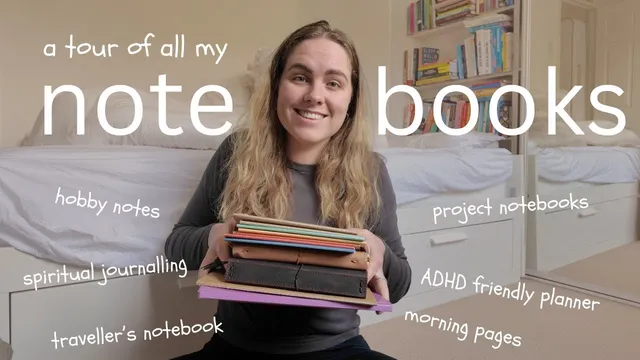
A tour of the journals I use to be productive & creative
Based on Ciara Feely's video on YouTube. If you like this content, support the original creators by watching, liking and subscribing to their content.
Three handwritten morning pages are treated as a daily non-negotiable ritual that produces clarity and often sparks creative ideas.
Briefing
A long-running morning “pages” practice is the anchor of a notebook system built for both creativity and reflection—then the rest of the paper stack is organized to handle spirituality, project work, and reference material without letting information sprawl. The core payoff is clarity: writing three handwritten pages every day (often as stream-of-consciousness) turns vague thoughts into usable ideas, from content planning to creative writing, while also slowing mornings down into a deliberate ritual.
The practice starts with an A4 notebook (160 pages) used for “morning pages” from *The Artist’s Way*. Each day, the writer fills three pages in plain lined paper, producing a first-draft brain dump that can include to-do lists, messy concerns, and creative sparks. After roughly 18 months of consistent use, the habit has become less about loosely “trying it” and more about treating it as non-negotiable. Looking back through past notebooks, the entries don’t read like a continuous diary of day-to-day life—there’s continuity in themes and emotional texture (especially during stressful periods), but not the kind of narrative record that tracks what happened with Susan and Joe. That limitation is part of why a more journal-like approach has grown in importance.
Spiritual reflection is handled separately through a “spiritual planner” setup: a binder containing two small plain black bullet journals. One larger bullet journal (200 pages) serves as the main spiritual notebook, with reference tables at the front—birth chart details, the wheel of the year, astrology houses, moon phases, planetary notes, and tarot card meanings. The working body of the notebook is organized around recurring gatherings aligned to new moons and full moons. For each cycle, the writer records notes on what the moon event meant and includes tarot spreads created at the time. This structure makes personal growth feel less like abstract self-improvement and more like seasonal practice, and it also helps loosen perfectionism: the notebook starts out aiming for beauty, then naturally becomes messier as reflection deepens. There’s also a plan to reduce overwhelm by switching to smaller, more manageable notebooks over time.
For planning and day-to-day execution, a newer multi-notebook system from Creators Friend combines a future planner, a plain “working on right now” notebook, a weekly to-do notebook using a Getting Things Done-inspired approach, and a daily planner called Fast Brain Friend designed for neurodivergent brains. The daily planner’s rotating spreads let the writer pick a layout that matches the day—more tasks, more meetings, or lighter days—rather than forcing the same format onto every date. Meal planning is also used as a corrective tool after noticing missed meals.
Finally, the system separates information by purpose. Lightweight “reference notebooks” (about 30 pages each, with back-to-back pages) store long-term notes—such as yoga exam material—so they can be carried during study and later organized at home. “Project notebooks” act as short-term idea capture for ongoing work (like teacher training manuals and process improvements), with an index and numbered pages so thoughts don’t get lost. The writer is also considering how to integrate these paper notes with Notion for accessibility, especially so other teachers can benefit from improv notes, and is open to adding more memory-focused formats—travel journals, junk journaling, and monthly memory notebooks—on a weekly or monthly cadence rather than daily.
Overall, the notebook stack functions like a set of specialized containers: morning pages for clarity and creativity, spiritual notebooks for seasonal reflection, planners for execution, and project/reference notebooks for keeping ideas usable instead of scattered.
Cornell Notes
The system centers on a daily “morning pages” practice—three handwritten A4 pages—used to turn stream-of-consciousness thoughts into clarity and creative output. Those pages don’t function as a traditional diary, so spirituality and deeper reflection get their own notebook structure tied to moon cycles, tarot, and astrology reference tables. Planning is handled with a multi-notebook setup (including Creators Friend’s Fast Brain Friend daily planner) that uses rotating spreads to match different kinds of days. For information management, the writer separates notes into lightweight reference notebooks for long-term study and indexed project notebooks for short-term work, aiming to prevent ideas from getting lost. The next step is better integration with Notion and adding memory-focused journaling formats like travel or monthly memory notebooks.
Why do the “morning pages” notebooks matter more for clarity than for day-to-day journaling?
How does the spiritual notebook structure reduce perfectionism while increasing reflection?
What’s the practical difference between reference notebooks and project notebooks?
How does the Fast Brain Friend daily planner handle variability in daily workload?
What role does Notion play compared with paper notebooks?
What new journaling formats is the writer considering, and why?
Review Questions
- How does the system prevent “information sprawl” across multiple notebooks, and what criteria determine whether something goes into reference vs project storage?
- Why does the writer prefer rotating daily planner spreads over a single fixed layout, and what problem does that solve?
- What trade-off does the morning pages practice create (in terms of diary continuity), and how does the writer compensate for it with other notebooks?
Key Points
- 1
Three handwritten morning pages are treated as a daily non-negotiable ritual that produces clarity and often sparks creative ideas.
- 2
Morning pages function more like a stream-of-consciousness brain dump than a day-to-day diary, so they don’t reliably preserve narrative continuity of daily life.
- 3
Spiritual reflection is organized around moon cycles and tarot, supported by astrology and tarot reference tables stored at the front of a dedicated notebook.
- 4
A multi-notebook planning system separates future planning, weekly to-dos, and daily execution, with rotating daily spreads to match different kinds of days.
- 5
Lightweight reference notebooks are used for long-term study notes that can be carried during work, while indexed project notebooks capture short-term ideas for specific ongoing tasks.
- 6
The writer is actively refining how paper notes and Notion work together, especially for follow-ups and sharing improv notes with other teachers.
- 7
Upcoming additions include memory-focused journaling formats (travel, junk, monthly memories) to address forgetfulness without requiring daily habit maintenance.