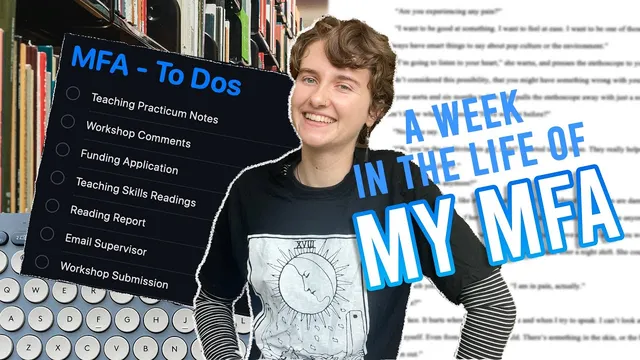
a week in my life as an MFA student 🖋️WRITING VLOG
Based on ShaelinWrites's video on YouTube. If you like this content, support the original creators by watching, liking and subscribing to their content.
She balances three courses in her first MFA semester—multi-genre workshop, teaching skills, and an elective—while also pursuing a major Canadian master’s funding application (Sherk).
Briefing
An MFA student’s first semester runs on a tight, three-course schedule—workshop, teaching skills, and an undergrad elective—while a major funding application and ongoing novel revisions compete for attention. The core throughline is not just workload, but how deadlines force constant triage: reading reports, workshop comments, edit letters, and course assignments all stack up, and sleep (or the lack of it) becomes a make-or-break factor for performance.
Early in the week, she balances administrative and academic tasks: catching up on long readings for a teaching course, completing workshop edit letters, and planning for a teaching practicum where she must submit materials to the supervising professor shortly before an undergrad workshop. Her workshop workload is lighter than usual because her cohort is small and she is the only fiction student in her genre group, meaning she handles fewer sets of workshop comments. Still, the teaching skills track adds pressure in a different way—she has to translate her understanding of writing pedagogy into concrete classroom leadership, including preparing critique letters and line edits for the practicum.
Writing work continues in parallel, but it’s uneven. Editing a short story from workshop proves difficult because the feedback is more speculative than prescriptive, and the narrative eventually shifts into a surreal landscape where the story’s possible directions feel almost infinite. That uncertainty slows revision, even as she tries to keep momentum by filming a Q&A vlog and doing incremental passes on her draft. She also keeps a longer-term goal in view: finishing revisions to her novel, Animal Sense, so she can send it to her agent. A friend’s feedback session becomes a turning point, generating “concrete” revision ideas that help her move from overwhelm toward actionable next steps.
The semester’s rhythm shifts again around midweek when sleep deprivation hits hard. After a workshop practicum and a long day on campus, exhaustion forces an executive decision to rest rather than push through more tasks. The following day, her teaching skills class becomes a live, discussion-heavy space—students attend an undergrad lecture on interactive narrative and serious games, including examples like games about poverty and socioeconomic status and anti-war games—turning class time into a learning sprint rather than passive instruction.
By Thursday, the workload tightens around long readings and a final set of course deliverables. She finishes chapters from bell hooks’ Teaching to Transgress, completes a weekly reflection prompt for her sex-in-fiction class (choosing an erotica ghost prompt for Halloween), and starts to manage the emotional complexity of editing a novel alongside school. The editing challenge centers on pacing and causality: events cluster in “chunks,” and moving scenes risks breaking the logic of the story, so she must find new “causal glue” to smooth the narrative flow. The week ends with a deliberate reset—watching Survivor, reading nightly when possible, and sourcing materials for a syllabus she’s designing—signaling that inspiration and structure are both treated as survival tools in the MFA grind.
Cornell Notes
The semester is run like a constant triage system: three courses (multi-genre workshop, teaching skills, and a sex-in-fiction elective) plus a major funding application and ongoing novel revisions. Teaching skills adds practical pressure through a practicum that requires critique letters and line edits submitted on a tight timeline. Workshop and revision work are not always straightforward—short-story edits stall when feedback is speculative and the narrative becomes surreal, while novel edits feel harder as pacing problems require reworking causality rather than simply moving scenes. Sleep deprivation briefly derails confidence, but peer feedback and classroom discussions on interactive narrative and pedagogy restore momentum. The week ends with reflection, syllabus planning, and a conscious decision to rest to protect creative output.
How does the small size of the MFA program change the workload inside the workshop course?
What makes her short-story revision unusually difficult compared with typical workshop-to-draft workflows?
What are the practical demands of the teaching skills practicum, and how does she prepare for them?
How does sleep deprivation affect her performance and decision-making during the week?
What’s the central technical problem in her novel revision, and why isn’t it solved by rearranging scenes?
How does she keep creative momentum while juggling school tasks?
Review Questions
- Which parts of her workload are most deadline-sensitive, and what specific submission timelines does she mention?
- Compare the revision challenges of her short story versus her novel—what causes each to be difficult in different ways?
- How do classroom experiences (workshop practicum, interactive narrative lecture) feed back into her own writing and teaching preparation?
Key Points
- 1
She balances three courses in her first MFA semester—multi-genre workshop, teaching skills, and an elective—while also pursuing a major Canadian master’s funding application (Sherk).
- 2
Workshop and teaching tasks are time-bound: edit letters and line edits for a teaching practicum must be submitted 48 hours before the undergrad class.
- 3
Short-story revision stalls when workshop feedback is speculative and the narrative becomes surreal, making revision less prescriptive and more open-ended.
- 4
Sleep deprivation temporarily undermines confidence, but she protects productivity by choosing rest when exhaustion becomes unmanageable.
- 5
Her novel revision focuses on pacing and causality: clustered subplots create rhythm problems that can’t be fixed by simple scene shuffling without breaking logic.
- 6
She uses peer feedback sessions and classroom discussions to generate actionable revision ideas and to inform her teaching approach.
- 7
She maintains creative momentum through habits like nightly reading and syllabus sourcing, while also scheduling deliberate downtime to avoid burnout.