Accelerating the Value From a Process Framework
Based on APQC's video on YouTube. If you like this content, support the original creators by watching, liking and subscribing to their content.
Mosaic can accelerate framework value only when organizations define how the framework will be used, governed, and measured—not when teams simply adopt the tool.
Briefing
A process framework only delivers real business value when it’s governed, connected to performance, and made usable across the organization—APQC’s Mosaic environment is positioned as the mechanism to do that, but Mosaic’s benefits depend on how the framework is set up and adopted. The core message from the session is that organizations should not “jump in” with the tool; they should first decide how they will use a framework, who can change it, how knowledge will be stored and accessed, and how results will be measured. Done well, Mosaic helps turn process documentation, benchmarks, and lessons learned into a shared operating system for execution.
APQC frames process management around five lifecycle phases: identify and organize processes, capture and design process knowledge, perform and manage work, monitor and control performance, and then improve and integrate to close the loop. Under that lifecycle sit seven process-management tenants—such as strategy alignment, process governance, usable process models, and accessible process knowledge—that define what “well-managed” looks like. Mosaic is presented as a way to operationalize those tenants by linking the framework to roles, tools, performance measures, and best-practice research.
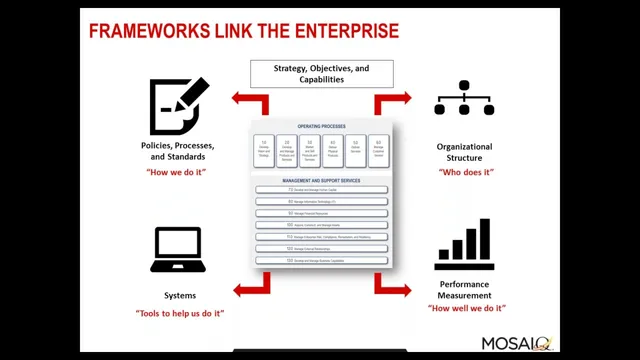
In APQC’s definition, a process framework is a catalog of mutually exclusive, collectively exhaustive, hierarchically decomposed processes—ranging from enterprise-level strategy down to granular activities. The “mutually exclusive” principle prevents the same work from appearing multiple times in conflicting ways, while “hierarchical decomposition” breaks large goals into manageable chunks that can be owned by departments and functions. Just as importantly, the framework becomes a bridge between what the organization does and who does it: roles and responsibilities in the org chart can be mapped to the processes they execute, and tools, data architecture, policies, standards, and constraints can be connected to the work.
Mosaic (and Mosaic Accelerator) is described as a structured environment for managing that process knowledge. Mosaic provides three linked views—Manage, Measure, and Learn. “Manage” centralizes process content such as flowcharts and lessons learned, either directly in Mosaic or via links to internal systems like SharePoint. “Measure” ties process work to benchmarks and performance metrics, including live feeds from APQC’s benchmarking portal for comparisons across industries, regions, and organization sizes. “Learn” connects users to APQC’s knowledge base research, white papers, and reports relevant to specific processes.
The session’s practical emphasis lands on governance and adoption. Mosaic Accelerator is laid out as a five-step approach: run a health/readiness check (including how many frameworks exist and how they fit together), assemble a design team, make design decisions (including access control such as read-only versus edit permissions and how changes get reviewed), implement with training and communications, and then provide ongoing support so the business uses the system correctly. A key warning appears repeatedly: without that structured setup, organizations risk clutter, inconsistent process knowledge, and even publishing the wrong version of “how we do the work.”
In the Q&A, participants described using Mosaic selectively—especially for knowledge management through communities and embedding lessons learned into workflows. APQC also shared that shared services functions (finance, human capital management, supply chain) can benefit because standardized processes can be mapped to how work connects across the enterprise. One example from APQC itself highlighted a gradual migration strategy: link existing process knowledge wherever it currently lives, then move content into Mosaic’s consistent storage over time rather than pausing all work to migrate everything at once.
Cornell Notes
APQC positions Mosaic as a way to accelerate the value of a process framework, but only after organizations make governance and adoption decisions. A process framework is treated as a structured catalog of mutually exclusive, collectively exhaustive, hierarchically decomposed processes that links “what we do” to “who does it,” along with tools, standards, and constraints. Mosaic’s Manage-Measure-Learn structure centralizes process knowledge, connects it to benchmarks and performance metrics, and routes users to relevant best-practice research. Mosaic Accelerator adds a disciplined rollout approach: health check readiness, design team alignment, access and change-control decisions, implementation with training/communications, and ongoing support. The result is more consistent, sustainable process management rather than scattered documentation across SharePoint, directories, or individual laptops.
What makes a process framework more than a list of documents?
How does Mosaic connect process knowledge to performance and best practices?
Why does governance matter when adopting Mosaic?
What is the five-step Mosaic Accelerator approach?
How can lessons learned be used inside Mosaic to improve execution?
How does Mosaic help shared services or cross-enterprise work?
Review Questions
- What governance decisions (access control, change approval, framework ownership) would you need to define before allowing teams to use Mosaic for process knowledge updates?
- How would you use Mosaic’s Manage-Measure-Learn structure to support a cross-functional process improvement initiative from discovery through deployment?
- What risks arise when process frameworks are maintained in multiple disconnected tools (e.g., SharePoint, directories, spreadsheets), and how does Mosaic address those risks?
Key Points
- 1
Mosaic can accelerate framework value only when organizations define how the framework will be used, governed, and measured—not when teams simply adopt the tool.
- 2
A process framework should be structured as mutually exclusive, collectively exhaustive, and hierarchically decomposed processes to maintain continuity and clarity across the enterprise.
- 3
Mosaic’s Manage-Measure-Learn model centralizes process knowledge, links it to benchmarks and performance metrics, and routes users to relevant best-practice research.
- 4
Access control (read-only vs edit) and change-control workflows are essential to prevent inconsistent or incorrect process knowledge from spreading.
- 5
Mosaic Accelerator’s five-step approach—health check, design, solution design decisions, implementation, and support—turns adoption into a sustainable process-management capability.
- 6
Shared services and knowledge-management use cases (communities and embedded lessons learned) benefit when process views show both scope and cross-enterprise connections.
- 7
Organizations should plan migrations thoughtfully (link first, move later) to avoid pausing ongoing work while consolidating process knowledge into Mosaic’s consistent storage.