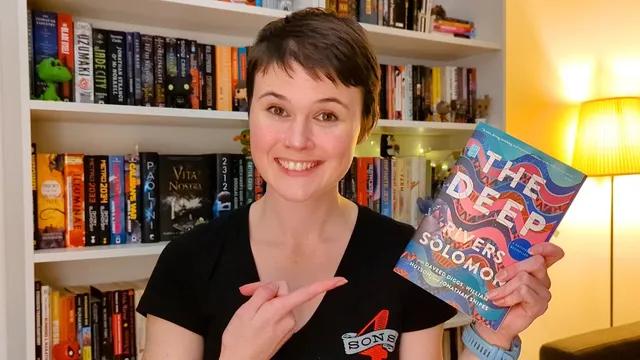
AFROFUTURIST FANTASY recommendation - "The Deep" by Rivers Solomon (with clipping.)
Based on morganeua's video on YouTube. If you like this content, support the original creators by watching, liking and subscribing to their content.
“The Deep” (2019) is an Afrofuturist novel that uses an underwater origin myth rooted in real slave-trade violence to examine how trauma persists across generations.
Briefing
“The Deep” by Rivers Solomon turns a piece of brutal slave-trade history into an underwater Afrofuturist civilization—and then makes the emotional cost of that history the engine of the story. Published in 2019, the novel was nominated for the Hugo and Nebula Awards, won the Lambda Literary Award, and draws attention not only to world-building but to how trauma travels across generations. Its premise traces back to 2017, when This American Life commissioned the experimental hip-hop group clipping to write “The Deep” for an afrofuturism segment; the song was inspired by drexia, a mythology created alongside the group’s work. In that mythology, pregnant women are thrown overboard during the slave trade, fetuses adapt to breathing underwater, and a new underwater society—descended from those survivors—forms over time.
Solomon’s book follows the Washington Roux, the fictional underwater people whose origins are rooted in real, horrifying facts: during the transatlantic slave trade, over a million people died during voyages, and many were thrown overboard. The novel’s most distinctive narrative device assigns the burden of remembering that history to a single role: a “historian.” Once a year, the historian joins the community for immersive remembrance ceremonies, then returns the burden to the next historian—so only one person carries the full psychological weight at a time. The story centers on the current historian, a young woman named Yetu, who received the role when she was very young and has been shaped by it so deeply that she can disappear from her own body for days or even months during remembrances.
When Yetu begins the next ceremony, she leaves in the middle, raising the central tension: what happens to an individual who has never fully been allowed to be one? The novel also asks what the community owes itself when memory is both identity and injury. Themes run through the book—cultural and individual memory, intergenerational trauma, racism and speciesism (the Washington Roux are treated like fish or animals by land dwellers), and belonging. It also includes queer elements, including non-normative mating among the Washington Roux.
One of the book’s most compelling ideas is the balance between collectivity and individuality. Yetu wants to escape the collective memory to reclaim her own sense of self, but leaving the community with those memories would harm everyone else. That conflict is reinforced by the writing’s point of view. Solomon’s world uses pronouns that shift with the remembrance: the community’s language leans on “we/us/ours,” and the remembered experience feels plural—almost as if multiple lives are happening at once. The video transcript highlights how this approach echoes clipping’s “The Deep,” where the only pronoun used is “y’all.”
At 163 pages (or about four hours as an audiobook narrated by David Diggs, with an afterword by clipping), the novel is brief but dense in implications. The world-building is intentionally suggestive—rules are present but sometimes vague—inviting readers to imagine what the society keeps, what it abandons, and what utopia might cost. For readers seeking adjacent titles, the transcript points to Chana Porter’s “The Seep” (queer sci-fi with utopia/dystopia tension) and “Follow Me to Ground” (also about non-human people, though less liked by the reviewer).
Cornell Notes
“The Deep” by Rivers Solomon uses an Afrofuturist underwater civilization to reframe real slave-trade history and its aftereffects. The Washington Roux assign the task of remembering their traumatic origins to a single “historian,” limiting how many people carry the psychological burden at once. The story follows Yetu, the current historian, whose immersive remembrances can remove her from her own body for days or months—until she abruptly leaves the ceremony. The novel’s central conflict pits individual identity against collective survival: reclaiming selfhood risks harming the community that depends on shared memory. Themes also include intergenerational trauma, racism/speciesism, belonging, and queer relationships, with a distinctive plural “we/us/ours” remembrance voice.
How does the novel structure the burden of traumatic history, and why does that matter for character agency?
What is the origin myth behind the underwater civilization, and how is it tied to real history?
Why does the pronoun shift (“we/us/ours”) during remembrance change the reading experience?
What major themes compete in Yetu’s internal conflict?
How do the book’s world-building “rules” function, and who might find them frustrating or liberating?
Which companion recommendations are suggested, and what similarities do they share?
Review Questions
- How does the historian system in “The Deep” reshape the meaning of trauma—who carries it, who gets to live with it, and what does that cost?
- In what ways does the plural remembrance voice (“we/us/ours”) reinforce the novel’s themes of collectivity, belonging, and identity?
- What trade-off does Yetu face between individual selfhood and communal well-being, and how does that trade-off drive the story’s emotional stakes?
Key Points
- 1
“The Deep” (2019) is an Afrofuturist novel that uses an underwater origin myth rooted in real slave-trade violence to examine how trauma persists across generations.
- 2
The Washington Roux assign the role of “historian” to one person at a time, limiting how many people endure the psychological impact of remembering their past.
- 3
Yetu’s struggle centers on the cost of being the historian—remembrances can remove her from her own body for days or months—until she leaves a ceremony mid-way.
- 4
The novel’s core tension pits individuality against collectivity: reclaiming Yetu’s selfhood risks harming the community that depends on shared memory.
- 5
Land dwellers treat the Washington Roux with racism and speciesism, often reducing them to animal-like status, which reframes belonging as both social and existential.
- 6
The narrative voice shifts during remembrance toward “we/us/ours,” making history feel plural and re-experienced rather than merely recalled.
- 7
The transcript recommends “The Seep” by Chana Porter and “Follow Me to Ground” as shorter, adjacent queer sci-fi reads, with “The Deep” singled out as the strongest match.