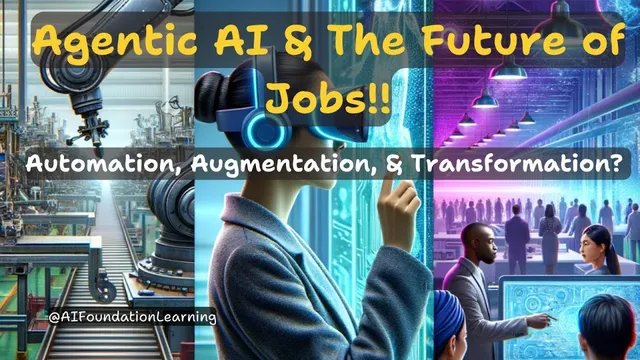
Agentic AI and the Workforce: Automation, Augmentation, and Transformation | Agentic AI Explained
Based on AI Foundation Learning's video on YouTube. If you like this content, support the original creators by watching, liking and subscribing to their content.
Agentic AI can take actions on behalf of humans, which makes it more likely to reshape day-to-day workflows than purely advisory AI.
Briefing
Agentic AI is reshaping work by taking actions on behalf of people—often with a degree of autonomy—so the workforce is being pulled in two directions at once: automation of routine tasks and augmentation of human decision-making. That dual impact matters because it determines which skills become obsolete, which roles expand, and how companies redesign operations across industries.
Automation is already visible in manufacturing, logistics, and customer service. Warehouses increasingly rely on autonomous robots to move goods and on AI-powered chatbots to handle customer questions around the clock. Amazon is cited as an example where AI-driven robots transport products while route optimization helps speed deliveries. The practical payoff is straightforward: higher efficiency, fewer human errors, and easier scaling. Yet automation also raises the central labor concern—job displacement—especially for roles built around repetitive, rules-based work.
At the same time, agentic AI is creating new jobs rather than only eliminating old ones. As AI systems become embedded in healthcare, finance, and education, demand rises for AI specialists, data scientists, and machine learning engineers. A World Economic Forum estimate is used to quantify the shift: AI could create 97 million new jobs globally by 2025 while automating 85 million existing roles. The takeaway is not that employment is guaranteed to grow, but that the net effect depends heavily on whether workers and institutions can pivot into emerging AI- and data-focused careers.
Beyond replacement, the transcript emphasizes augmentation—using AI to enhance how people work. In healthcare, AI tools such as IBM Watson are described as analyzing large volumes of medical data to detect patterns and suggest treatments that may not be obvious immediately. The goal is not to replace clinicians, but to improve diagnostic accuracy and decision quality. In marketing, Adobe Sensei is presented as an augmentation layer for creativity and productivity, helping designers generate visuals, recommend design elements, and automate repetitive tasks like resizing images for different platforms.
The balance between automation and augmentation is framed as a practical strategy: AI can remove tedious work so humans can focus on higher-level, creative, and strategic tasks. Several tools and techniques are highlighted as enablers of this shift. Microsoft Azure is positioned as a customizable suite spanning machine learning, computer vision, natural language processing, and decision-making. OpenAI Codex—linked to the model behind GitHub Copilot—is described as accelerating development by suggesting code snippets from natural-language prompts. For on-the-job interaction, Microsoft’s HoloLens is cited for augmented reality guidance, overlaying instructions and troubleshooting information onto the real world while keeping workers’ hands free.
Looking ahead, the future of work is portrayed as hybrid: humans and AI systems collaborating closely. Humans are expected to concentrate on creativity, emotional intelligence, and complex judgment, while AI handles repetitive, data-driven processes. In financial services, for example, AI automates fraud detection and risk assessment, but human experts remain responsible for strategic decisions grounded in that information. The central message is that workers who treat AI as a collaborator—learning to leverage it—are more likely to thrive as job roles evolve.
Cornell Notes
Agentic AI systems can take actions on behalf of humans, often with autonomous decision-making, and that capability is driving two major workforce shifts: automation and augmentation. Automation targets repetitive work in areas like logistics, manufacturing, and customer service, using tools such as autonomous robots and 24/7 chatbots. Augmentation focuses on improving human performance—healthcare AI (e.g., IBM Watson) supports diagnosis by analyzing medical data, while marketing AI (e.g., Adobe Sensei) boosts creative output and reduces repetitive design tasks. The net employment impact is mixed: a World Economic Forum estimate projects 97 million new jobs by 2025 alongside 85 million roles automated, implying a need for reskilling. The emerging model is hybrid collaboration, where AI handles data-heavy tasks and humans lead on judgment and creativity.
What makes agentic AI different from earlier AI tools, and why does that matter for jobs?
Where does automation show up first, and what benefits does it bring?
How does augmentation change the relationship between AI and workers?
What employment shift is suggested by the World Economic Forum estimate?
Which tools are presented as enabling workplace automation and augmentation?
What does a “hybrid workforce” look like in practice?
Review Questions
- How does agentic AI’s ability to take actions autonomously increase its impact on employment compared with more limited AI tools?
- Give one example each of automation and augmentation mentioned in the transcript, and explain the role of human judgment in each.
- What does the World Economic Forum projection imply about reskilling, and which job categories are most emphasized as growing?
Key Points
- 1
Agentic AI can take actions on behalf of humans, which makes it more likely to reshape day-to-day workflows than purely advisory AI.
- 2
Automation is already concentrated in logistics, manufacturing, and customer service through autonomous robots and 24/7 chatbots.
- 3
Augmentation aims to improve human performance—such as AI-assisted diagnosis in healthcare and AI-supported creative workflows in marketing.
- 4
A World Economic Forum estimate projects 97 million new jobs by 2025 alongside 85 million roles automated, signaling a need for workforce transition.
- 5
Microsoft Azure, OpenAI Codex (behind GitHub Copilot), and Microsoft HoloLens are presented as practical tools enabling automation and augmentation.
- 6
The future is framed as hybrid collaboration: AI handles repetitive, data-driven tasks while humans lead on creativity and complex judgment.