AI Agent Employee #1 Is Already Making Money - My Setup
Based on All About AI's video on YouTube. If you like this content, support the original creators by watching, liking and subscribing to their content.
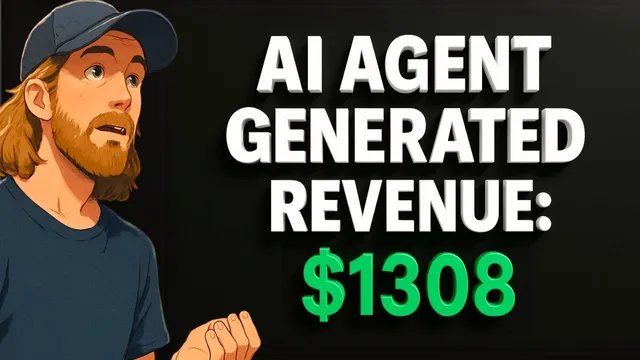
The AI agent has generated over $1,300 in revenue in roughly six to seven weeks while running about once per day.
Briefing
An AI agent running on a daily schedule has generated more than $1,300 in revenue over roughly six to seven weeks, with costs described as only a few dollars per day—leaving a healthy margin. The setup is intentionally simple: the system collects data from a specific YouTube channel, turns short excerpts into parody-style AI shorts, publishes them with basic metadata, and uses those uploads to funnel viewers to a $9.99 AI video course hosted on a lightweight platform.
Revenue tracking is tied directly to Stripe sales, which the creator uses as proof the pipeline is working. The course itself is built as a “simple AI video course platform” using a Vercel template, with sign-in and upgrade flow, plus a page that links to AI tools. The marketing mechanism is straightforward and non-intrusive: the generated shorts promote the course with a link, aiming to convert viewers who enjoy the parody content into paying students.
The automation pipeline is built around a six-step workflow. First, it pulls the latest videos from the chosen channel using the YouTube API and a Python-based download process. It then uses FFmpeg to extract the first five seconds, capturing audio for transcription. That short transcript becomes the seed for a voiceover and a script that can carry the parody tone across a longer clip.
Second, the system generates a voiceover script and continues the audio conceptually from the extracted intro. For voice similarity, it uses ElevenLabs to create an AI voice that matches the style well enough to keep the parody coherent. Third, the system assembles the final short by generating multiple segments—three prompts designed to produce a 30-second output. Those segments are created via Replicate’s API (with Google AI used for the model work), and the prompts drive the visual and narrative beats.
To keep the segments from feeling disjointed, the assembly step uses frame continuity: it takes snapshots/images and uses the last frame of one five-second clip as the starting point for the next 10-second portion, creating smoother transitions. After generation, the pipeline cleans up temporary files, then creates YouTube metadata—title, tags, and description—and uploads the finished short automatically.
The resulting shorts are fully automated and vary in quality. Some are described as funnier than others, but the key point is consistency: the agent runs once per day and publishes without manual editing. The creator also emphasizes transparency, adding “AI generated” labeling in titles and/or YouTube metadata so viewers aren’t misled.
Finally, the business model is framed as a passive income stream built on content-to-product conversion. The course is currently being sold separately, and the creator plans to update it as new AI models arrive, while using the shorts as ongoing promotional fuel rather than as the primary product.
Cornell Notes
A daily AI agent pipeline has produced over $1,300 in revenue in about six to seven weeks by turning short excerpts from a target YouTube channel into parody AI shorts that link to a $9.99 course. The workflow starts by pulling the latest videos via the YouTube API, extracting the first five seconds with FFmpeg, and transcribing that audio to generate a voiceover script. ElevenLabs creates a voice that fits the parody, and Replicate generates three video segments that are merged into a single 30-second short with frame continuity for smoother transitions. After cleanup, the system auto-creates YouTube metadata and uploads. The approach works as a low-cost, high-automation marketing channel, with emphasis on labeling content as AI-generated.
How does the system turn a real YouTube channel into a steady stream of monetizable content?
What role do transcription and voice generation play in making the parody shorts coherent?
Why are there multiple prompts, and how are they combined into one 30-second video?
What happens after video generation to make the shorts publish-ready?
What makes the approach feel “passive,” and what quality tradeoff comes with automation?
How does the setup handle audience trust when using AI-generated content?
Review Questions
- Walk through the pipeline from “latest video found” to “short uploaded.” Which steps depend on FFmpeg and which depend on transcription?
- How does the system maintain continuity when merging multiple generated segments into a single 30-second short?
- What monetization mechanism connects the AI shorts to revenue, and how is that revenue tracked?
Key Points
- 1
The AI agent has generated over $1,300 in revenue in roughly six to seven weeks while running about once per day.
- 2
A $9.99 course hosted on a simple Vercel-based platform is the conversion target for the generated parody shorts.
- 3
The pipeline uses the YouTube API to fetch the latest videos and FFmpeg to extract the first five seconds for transcription.
- 4
ElevenLabs is used to generate a voiceover that fits the parody based on the transcribed intro.
- 5
Replicate generates three video segments via three prompts, which are merged into a 30-second short with frame continuity.
- 6
After merging, the system auto-creates YouTube metadata (title, tags, description) and uploads the short, then deletes temporary files.
- 7
AI-generated labeling is added in titles/metadata to maintain transparency with viewers.