AI Frontiers: Annie Hill (OpenAI DevDay)
Based on OpenAI's video on YouTube. If you like this content, support the original creators by watching, liking and subscribing to their content.
Boston Children’s Hospital is prioritizing generative AI use cases that reduce workload, improve education, and strengthen patient safety.
Briefing
Boston Children’s Hospital is positioning generative AI as a practical tool to reduce healthcare burden, improve learning, and strengthen patient safety—while building guardrails around equity and inclusion. Annie Hill, from the hospital’s Innovation & Digital Health Accelerator, frames the work around three priorities: operational efficiency (especially for staff and patient-facing materials), clinical support that reduces time spent hunting for information, and research acceleration for labor-intensive qualitative analysis.
A central theme is matching real “pain points” gathered from staff to areas where large language models can deliver measurable value. Hill describes collecting challenges across the hospital and sorting them into three buckets: operational, clinical, and research. Operationally, one standout need is patient education—creating materials that work across multiple languages and reading levels. The hospital wants AI to make translation and adaptation more efficient without sacrificing accessibility for a diverse pediatric audience.
In clinical settings, the focus is not on replacing clinical decision-making with AI recommendations. Instead, the goal is to reduce workload and put the right information in front of clinicians when it matters. Hill highlights Swirl, a provider-facing system that aggregates patient data from multiple sources—notes, labs, medications, orders, and forms—into a real-time patient view. The proposed upgrade is an LLM integration that lets providers ask patient-specific questions and receive answers grounded in the aggregated record. Hill also emphasizes traceability: responses would link out to underlying sources for validation, aiming to cut down the time clinicians spend switching between platforms.
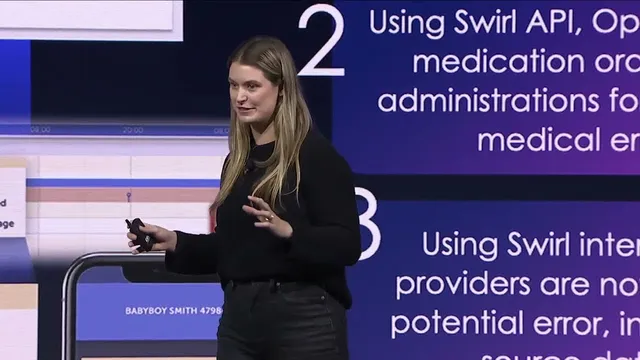
Swirl is also a testbed for context-driven error detection and alerting. Traditional alerting can overwhelm clinicians and contribute to alarm fatigue. By using the patient record as context, the system could identify potential errors more accurately—for example, recognizing when a medication previously prescribed becomes unsafe after a new or recent medical event. The intended payoff is fewer clinical mistakes and safer care, not just fewer alerts.
On the research side, Hill points to the heavy lift of working with large qualitative datasets such as interview data. The hospital is exploring using LLMs as a first-pass analysis tool to speed up initial interpretation before deeper review.
For education, the hospital is developing MedTutor, an interactive medical tutor for learners including medical students, residents, and fellows. MedTutor will guide users through medical cases that are currently non-personalized, non-interactive, and hard to access. The plan is to fine-tune a model using hospital education data, start narrowly by generating cases for specific disease areas, and then adapt the case walkthrough based on the learner’s responses—aiming to improve both access to practice and the quality of learning through personalization.
Finally, Hill underscores that equity is not an afterthought. Boston Children’s is building an LLM implementation equity guideline to embed equity, diversity, and inclusion principles into AI research and development, including how models are evaluated and deployed across different patient and learner populations. The overall message: generative AI is being treated as an operational and clinical workflow tool—implemented carefully, grounded in hospital data, and designed to reduce burden while improving safety and education outcomes.
Cornell Notes
Boston Children’s Hospital is using generative AI to tackle concrete hospital pain points—reducing staff burden, improving patient education, accelerating qualitative research, and enhancing medical training. The work is organized into operational, clinical, and research buckets, with a deliberate emphasis on matching staff-identified challenges to where LLMs can help. In clinical workflows, the hospital plans to extend Swirl so providers can ask patient-specific questions and get answers grounded in aggregated record data, with links for validation. Swirl is also being considered for context-driven error detection to reduce irrelevant alerts and improve patient safety. For education, MedTutor will guide learners through interactive, personalized medical cases fine-tuned on hospital education data.
How does Boston Children’s decide which generative AI use cases to pursue?
What operational problem stands out in the patient education work?
How is the clinical focus framed around clinician workflow rather than automated decision-making?
What does “context-driven error detection” mean in this setting?
What is MedTutor, and how will it personalize learning?
Why does equity matter in the hospital’s AI plans?
Review Questions
- Which three buckets of pain points does Boston Children’s use to structure its generative AI initiatives, and what is one example from each?
- How would the proposed LLM integration in Swirl reduce clinician time spent searching, and what mechanism supports validation of answers?
- What learning and safety goals drive MedTutor and Swirl’s context-driven error detection, respectively?
Key Points
- 1
Boston Children’s Hospital is prioritizing generative AI use cases that reduce workload, improve education, and strengthen patient safety.
- 2
Staff-identified pain points are collected and grouped into operational, clinical, and research categories before mapping to LLM opportunities.
- 3
Patient education is a key operational target, with emphasis on translating content across languages and adapting it to different reading levels.
- 4
Swirl’s planned LLM integration would let providers ask patient-specific questions using aggregated record data, with links to sources for validation.
- 5
Swirl is also being considered for context-driven error detection to reduce irrelevant alerts and mitigate alert fatigue.
- 6
MedTutor aims to make medical cases interactive and personalized by fine-tuning on hospital education data and adapting walkthroughs to learner responses.
- 7
Equity and inclusion are being operationalized through an LLM implementation equity guideline that informs AI research and development decisions.