AI is ruining the job market
Based on Theo - t3․gg's video on YouTube. If you like this content, support the original creators by watching, liking and subscribing to their content.
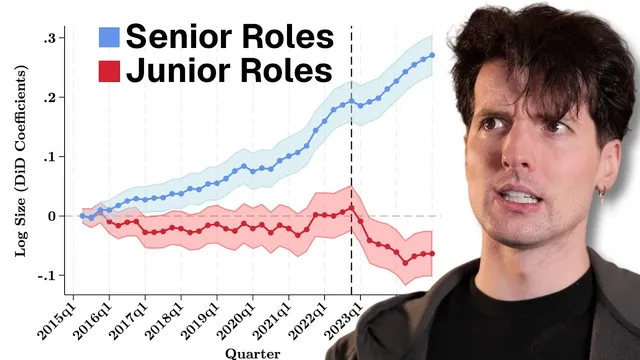
A Harvard-commissioned study and ADP payroll data are used to show a seniority split: junior headcount declines while senior headcount grows as AI adoption accelerates.
Briefing
AI’s spread is coinciding with a measurable squeeze on early-career hiring—junior roles are shrinking while senior roles keep growing—across hundreds of thousands of firms. The practical takeaway is blunt: getting a job now depends less on “proving” ability through credentials and more on building trust, proximity to experienced people, and a path to seniority before the market hardens further.
The core evidence comes from a Harvard-commissioned study that tracks seniority-based technological change. A key pattern appears in a diagram: junior positions decline while senior positions rise steadily. The scope is unusually broad—researchers examined impacts across 250,000 firms—so the shift isn’t treated as a quirk of a few companies.
A second dataset deepens the concern using ADP payroll information for software developers. When headcount is broken out by age, early-career workers (roughly ages 22–25) show consistent declines. Ages 26–30 flatten slightly but don’t rebound strongly, while ages 31 and up keep growing. The timing matters: the trend becomes clearly visible as AI proliferation accelerates. COVID-era hiring disruption explains why the youngest cohorts are low overall, but the post-boom divergence is framed as a new, AI-linked break from the prior pattern.
Additional indicators point to AI becoming embedded in hiring expectations. Firms’ job postings increasingly mention AI, with both the number of companies making their first AI-related posting and the cumulative count of AI-mentioned roles rising over time.
Crucially, the shift isn’t presented as a simple story about companies “saving money” or cutting pay. Compensation changes don’t mirror headcount changes. For senior workers, pay trends upward; for beginner roles, the main change is fewer opportunities and fewer hires at lower levels. The argument also rejects several popular explanations—companies “hating juniors,” senior engineers “pulling the ladder up,” or wage suppression—calling those narratives distractions from what’s actually happening.
So why do junior roles get hit first? The transcript lays out a hiring logic that predates AI but becomes more painful under AI-driven automation. Companies hire juniors to multiply the output of seniors: juniors are cheaper and more available, but the real function is to help seniors break work into pieces, train future talent, and expand capacity. Yet large projects suffer from coordination costs—citing Frederick P. Brooks’ “Mythical Man-Month”—and management overhead is especially heavy when juniors are learning how to collaborate in real environments.
AI tools (the transcript specifically mentions Claude) are framed as reducing the friction that juniors create for managers. If a manager can get faster, more consistent execution from AI-assisted work than from a team of inexperienced engineers—especially when managers aren’t great—then the incentive to staff junior-heavy teams weakens. That doesn’t eliminate the need for senior engineers, but it changes the pipeline: fewer juniors means fewer future seniors.
The closing message shifts from labor-market diagnosis to career strategy. With junior pathways shrinking, the transcript emphasizes trust and mentorship networks: being around smarter peers, contributing to real problems, and building relationships where experienced people can vouch for capability. In a world flooded with AI-generated resumes, the “signal” becomes who has worked with whom, not who can produce polished paperwork.
Cornell Notes
Harvard-commissioned research and ADP payroll data point to a seniority split tied to AI adoption: junior headcount (especially ages 22–25) declines while senior headcount (31+) grows, across a very large sample of firms. The transcript argues the change is less about pay cuts and more about fewer entry-level opportunities, with AI reducing the coordination and management burden that juniors traditionally impose. Hiring juniors is described as a capacity-and-training bet—juniors help multiply senior output and eventually become the next generation of seniors—but AI can make that bet less attractive when managers struggle to coordinate teams. The practical implication is that job seekers need trust-based networks and proximity to experienced mentors, not just portfolio polish or AI-generated resumes.
What evidence is used to claim junior roles are shrinking while senior roles expand?
How does the transcript address the idea that companies are cutting wages to save money?
Why would AI disproportionately affect junior hiring first, even if companies still need senior talent?
What are the stated reasons companies hire juniors in the first place?
What career strategy does the transcript recommend for people trying to get hired now?
What does the transcript say about why “surround yourself with smart people” matters more than solo projects?
Review Questions
- What specific patterns in the ADP age-group headcount data are used to support the claim that junior hiring is shrinking?
- How does the transcript connect coordination costs (Mythical Man-Month) to the reduced incentive to hire juniors?
- Why does the transcript argue that trust-based networks matter more than AI-optimized resumes in the current market?
Key Points
- 1
A Harvard-commissioned study and ADP payroll data are used to show a seniority split: junior headcount declines while senior headcount grows as AI adoption accelerates.
- 2
The change is framed as primarily affecting employment levels and seniority distribution, not as a broad wage-cut strategy—senior pay is described as rising.
- 3
Firms increasingly mention AI in job descriptions, suggesting automation expectations are shifting hiring requirements.
- 4
Junior hiring is portrayed as a training-and-capacity bet that depends on coordination and management; AI tools can reduce the friction that makes that bet less attractive.
- 5
The transcript rejects several popular narratives (pay cuts, “companies hating juniors,” or senior engineers blocking juniors) as distractions from the measurable seniority shift.
- 6
Job seekers are advised to build trust through real collaboration and advice-seeking, because AI-generated resumes weaken traditional application signals.
- 7
Long-term market health depends on maintaining mentorship pipelines; fewer juniors can mean fewer future seniors and fewer people sharing senior-level knowledge.