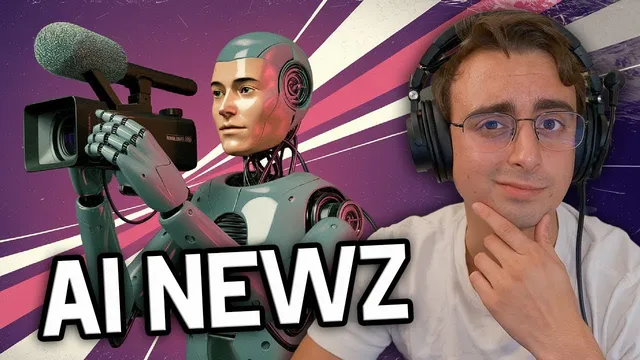
AI News Roundup: Pyramid Flow, Video Input LLM, Gemini 2.0 & more!
Based on MattVidPro's video on YouTube. If you like this content, support the original creators by watching, liking and subscribing to their content.
Cog video x Factory provides memory-optimized fine-tuning scripts for the Cog family of open video models, targeting a 5B parameter setup on a single 24 GB GPU.
Briefing
Open-source video generation just took a major step toward “single-GPU fine-tuning,” with a new repository of memory-optimized training scripts aimed at the Cog family of models. The pitch is straightforward: a 5 billion-parameter video model should be tunable using a 24 GB GPU—far more accessible than the multi-GPU setups many teams rely on. Cog video x Factory packages that capability into a practical workflow, lowering the barrier for developers who want to adapt open models for specific styles or tasks. The bigger implication is modifiability: if fine-tuning becomes routine, creators can target niche outputs like animation, specialized upscaling, or domain-specific footage rather than settling for generic text-to-video results.
That push toward control and customization shows up again in Runway’s Gen 3 Alpha turbo update, which adds image input for both endpoints of a generated clip. Instead of using an uploaded image as only the first (or last) frame, users can choose one image for the start and another for the end, letting the model generate the in-between frames. When the two images differ only slightly, the feature can increase continuity; when they differ more, it enables deliberate transitions. Runway also positions Gen 3 as a speed-and-reliability leader among video generators, making it a practical option for longer projects.
The most headline-grabbing development is Pyramid Flow, a fully open-source text-to-image-to-video model released under an MIT license. Built around training-efficient autoregressive video generation using flow matching, it’s trained on open datasets and targets high-quality outputs at 24 frames per second. Reported resolution is a little over 720p, and the model checkpoints are available on Hugging Face, setting up a fast path for community installs and experimentation. Early demos emphasize smooth motion and convincing environment behavior—waves hitting rocks, camera pans across an ocean, and other landscape-style scenes. The results are described as strong for open source, though not always matching the very top closed models; still, the availability of checkpoints and training details is framed as a catalyst for rapid iteration, including future fine-tuning for specific creative needs.
On the multimodal language-model front, a new model from Rhymes AI (Apache 2.0–licensed) is drawing attention for taking both images and video inputs into a text-based system. The transcript highlights that this kind of video intake remains rare across mainstream chat platforms, where video upload is typically unsupported. The model is also positioned as fine-tunable, with examples including debugging a code screenshot and converting handwriting into text.
Meanwhile, Google Gemini 2.0 is said to be in the works, with hints from a DeepMind event pointing to a multi-turn successor to Frontier models, plus vision and likely audio-related capabilities. OpenAI’s ChatGPT also gets incremental interface and command changes, including web search returning via slash commands, while an “01 preview” reasoning command still can’t actually see uploaded images.
Outside software, Tesla’s humanoid robots appear on stage performing tasks like pouring drinks and playing Rock Paper Scissors, but the transcript repeatedly flags that teleoperation is likely involved. Finally, Meta AI adds a new voice mode with cloned voices, though it’s described as a pipeline (speech-to-text, response, then text-to-speech) rather than the more natural “native multimodal” voice approach associated with advanced voice systems elsewhere.
Cornell Notes
The roundup centers on a shift toward more controllable and modifiable AI video generation—especially through open-source models that can be fine-tuned with consumer-grade hardware. Cog video x Factory packages memory-optimized scripts to fine-tune Cog-family video models, targeting a 5B parameter setup on a single 24 GB GPU. Runway’s Gen 3 Alpha turbo adds a practical control upgrade: users can select both the first and last frame images, letting the model generate the in-between sequence. Pyramid Flow pushes openness further with an MIT-licensed, flow-matching, 24 fps text-to-video model whose checkpoints are on Hugging Face, enabling community experimentation and future fine-tuning. The broader theme is faster iteration: open releases and endpoint control make it easier to tailor video outputs to specific creative styles and workflows.
Why does “single 24 GB GPU fine-tuning” matter for AI video creators and developers?
What new control does Runway’s Gen 3 Alpha turbo add with image inputs?
What is Pyramid Flow, and what technical choices make it notable?
How do the early Pyramid Flow demos characterize its strengths and limitations?
What’s distinctive about the Rhymes AI multimodal model mentioned in the roundup?
Review Questions
- Which specific change in Runway’s Gen 3 Alpha turbo improves temporal control, and how does it work in practice?
- What combination of licensing, training approach, and availability (checkpoints) makes Pyramid Flow especially relevant to open-source experimentation?
- Why is video intake in a text model considered a meaningful capability gap compared with many mainstream multimodal chat systems?
Key Points
- 1
Cog video x Factory provides memory-optimized fine-tuning scripts for the Cog family of open video models, targeting a 5B parameter setup on a single 24 GB GPU.
- 2
Runway’s Gen 3 Alpha turbo adds endpoint image control by letting users choose both the first frame and last frame images, generating the in-between sequence.
- 3
Pyramid Flow is an MIT-licensed, flow-matching, training-efficient open-source text-to-video model running at 24 fps, with checkpoints hosted on Hugging Face.
- 4
Early Pyramid Flow results are strongest for scenes resembling its training data (e.g., nature/stock-footage-style landscapes) and weaker for detailed human facial fidelity.
- 5
ChatGPT’s slash-command interface brings back web search, but an “01 preview” reasoning command still can’t analyze uploaded images.
- 6
Rhymes AI’s multimodal model is notable for accepting video inputs (not just images) and is described as fine-tunable under Apache 2.0.
- 7
Tesla’s humanoid robot demos are impressive but likely involve teleoperation, since full autonomy for such tasks isn’t shown as clearly achieved in the transcript.