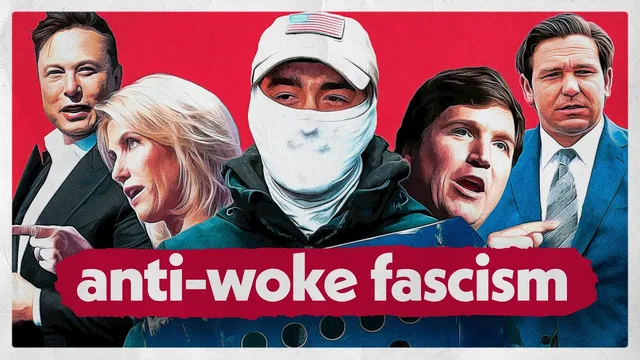
American Fascism And The Groomer Panic
Based on Second Thought's video on YouTube. If you like this content, support the original creators by watching, liking and subscribing to their content.
The transcript claims anti-LGBTQ “groomer” narratives have contributed to a measurable rise in harassment, threats, and violence, including bomb threats against institutions.
Briefing
A recurring “groomer panic” narrative—linking LGBTQ people, especially trans women, to child sexual abuse—has helped fuel a rise in harassment, threats, and violence, including bomb threats against hospitals and armed intimidation at public events. The core claim is that this rhetoric doesn’t stay confined to talk online: it creates a climate where queer people are treated as suspicious “recruiters,” which in turn justifies policing, doxxing, and sometimes direct attacks.
The transcript points to a pattern connecting targeted messaging to real-world harm. In 2022, violence against LGBTQ people and involvement by far-right militias increased, with more than 200 incidents reported in a single year, according to an ACLED reference. It then zooms in on a concrete example: Boston Children’s Hospital faced a wave of harassment after social media posts falsely claimed the hospital was performing hysterectomies on minors. The transcript stresses that the hospital’s actual gender-affirming care ranges from administrative steps like preferred names and pronouns to medical interventions such as puberty blockers and, for older patients, surgeries—care described as aligned with major medical associations and linked to reduced suicide risk. After the online campaign, the hospital received phone calls, emails, and death threats that escalated into a bomb threat, shutting the facility down. Months later, bomb threats continued, and the same account allegedly directed followers toward other hospitals.
A second mechanism described is how the “groomer” frame is broadened into a wider moral panic. The transcript lays out a three-step process: first, repeatedly associate queer people with pedophilia; second, wrap that association into a larger culture-war story—often using the catch-all term “woke”—that portrays society as under existential attack; third, legitimize vigilante action and state violence as necessary to stop the threat. In this telling, media figures and viral accounts use plausible deniability (“nothing to do with gay people”) while ensuring that, in practice, the accusations always land on LGBTQ teachers, parents, and institutions.
The transcript also argues that the “woke” framing functions like a universal solvent: it can attach to almost any story, making disparate events feel connected to a single dystopian collapse. It cites prominent examples of this rhetoric, including claims that “wokeness” is a mortal threat, and it contrasts the conservative leap from increased visibility to supposed recruitment. The transcript argues that more people coming out is often a social shift—similar to how stigma around left-handedness faded—rather than evidence of mass indoctrination.
Once the narrative is universalized, the transcript claims the final step is mobilization: audiences are told the government won’t protect children, so “intervention” becomes a moral duty. The result, it says, is stochastic terrorism—violence that can’t be predicted in detail but becomes statistically more likely when demonization is widespread. It links this to armed far-right appearances at events like drag brunches and to state actions that increase policing of LGBTQ people.
Finally, the transcript explicitly connects the current panic to fascist dynamics historically: fascism requires an out-group blamed for societal decline, and it often uses moral panic to justify repression. It draws an analogy to Nazi Germany’s demonization of queer people as “corruptors of youth,” describing how rumors and persecution escalated into brutal violence and concentration camps. The warning at the end is that if the “transgrooming” narrative loses effectiveness, the same rhetorical machinery can be redirected toward other targets under the “woke” umbrella—meaning the danger is structural, not limited to one group.
Cornell Notes
The transcript argues that a “groomer panic” narrative—portraying LGBTQ people, especially trans women, as child abusers—has helped drive harassment, threats, and violence. It describes a repeatable pipeline: repeatedly link queerness to pedophilia, embed that link in a broader “woke” culture-war story, and then treat vigilante action and harsher state policing as justified. A detailed case study centers on Boston Children’s Hospital, where false claims about gender-affirming care were amplified online and were followed by death threats and a bomb threat. The transcript frames the end result as stochastic terrorism: violence becomes more likely when demonization is widespread and audiences are told protection won’t come from authorities. It also argues the pattern fits historical fascist playbooks that rely on scapegoating and moral panic.
What is the transcript’s central mechanism for turning anti-LGBTQ rhetoric into real-world harm?
How does the Boston Children’s Hospital example function in the argument?
Why does the transcript say the “woke” framing matters beyond the specific groomer claims?
What does the transcript claim about increased LGBTQ visibility and “recruitment”?
How does the transcript connect rhetoric to violence without claiming every threat is directly ordered?
What historical comparison does the transcript make, and what purpose does it serve?
Review Questions
- What are the transcript’s three steps for transforming anti-LGBTQ claims into a moral panic and then into justification for violence?
- How does the transcript use the Boston Children’s Hospital case to support its broader claim about rhetoric leading to threats?
- What does the transcript mean by “stochastic terrorism,” and how does it connect that idea to media-driven demonization?
Key Points
- 1
The transcript claims anti-LGBTQ “groomer” narratives have contributed to a measurable rise in harassment, threats, and violence, including bomb threats against institutions.
- 2
A detailed case study centers on Boston Children’s Hospital, where false online claims were followed by death threats and a bomb threat that shut the hospital down.
- 3
The described escalation pathway links repeated associations of queerness with pedophilia to a broader “woke” culture-war story and then to vigilante and state action.
- 4
The transcript argues that increased LGBTQ visibility is often explained by reduced stigma rather than by recruitment or indoctrination.
- 5
It frames the violence risk as “stochastic terrorism,” where demonizing narratives increase the likelihood of attacks even when specific acts aren’t directly ordered.
- 6
The transcript argues the pattern matches historical fascist dynamics: scapegoating an out-group, portraying societal decline as caused by internal enemies, and using moral panic to justify repression.
- 7
It warns that if one narrative loses force, the same rhetorical machinery can be redirected to other targets under a flexible “woke” umbrella.