An Introduction to Systematic Literature Review (1)
Based on Research With Fawad's video on YouTube. If you like this content, support the original creators by watching, liking and subscribing to their content.
A literature review synthesizes existing research to identify both what is known and what remains unclear, including contradictions and missing evidence.
Briefing
Systematic literature review (SLR) is built to deliver the most dependable answer to a specific research question by using an unbiased, rigorous, and reproducible process for finding, assessing, and synthesizing prior studies. Unlike traditional literature reviews—which often summarize and critique research in a more narrative way—SLRs rely on pre-set eligibility criteria, an explicit search strategy, and transparent methods so that other researchers can repeat the work and arrive at the same set of included studies. That structure matters because it reduces selective inclusion and makes the resulting conclusions more suitable for evidence-based practice.
A literature review, in general, is an integrative summary of published research on a topic. It doesn’t just list study-by-study findings; it synthesizes what is known and can also highlight what remains unclear. The “gap” logic is central: researchers identify established findings, then point to relationships that have not been assessed, contradictions across studies, or areas where evidence is missing. For instance, in research on corporate social responsibility and organizational performance, some studies may report positive effects, others negative effects, and some no significant relationship—those conflicting results become a basis for specifying gaps and motivating further investigation.
SLRs are distinguished by several defining characteristics. First, the review scope is established in advance through a clear research question and predetermined eligibility criteria. Second, a systematic search is conducted to identify all studies that meet those criteria—studies that qualify should not be excluded simply because their results conflict with a preferred hypothesis. Third, the methodology for searching, assessing, analyzing, and synthesizing is explicit and reproducible, meaning researchers worldwide should be able to follow the same steps and retrieve the same number of relevant papers. Fourth, included studies are assessed for validity and risk of bias. Finally, extraction and synthesis use explicit methods, with the option to focus on qualitative or quantitative evidence.
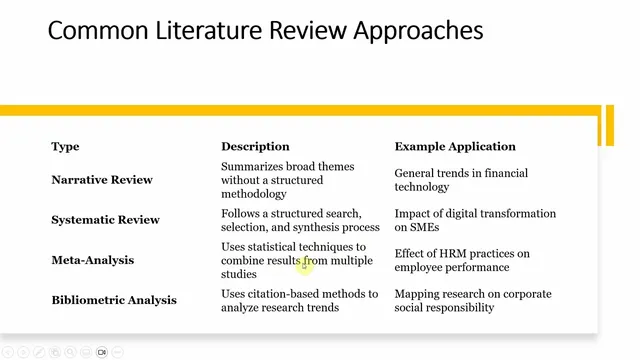
The transcript also contrasts common review approaches. Narrative reviews summarize broad themes using a structured methodology but are typically less comprehensive and more selective in practice. Systematic reviews use a more structured, question-led process and often define a time frame for included evidence. Meta-analysis goes further by applying statistical techniques to combine results across many studies—useful when dozens or hundreds of papers examine the same relationship, such as HR practices and employee performance. Bibliometric analysis uses citation-based methods to map research trends, such as how corporate social responsibility scholarship has evolved.
Conducting a literature review follows a shared workflow: identify and examine existing literature reviews, formulate a research question, search for sources, assess quality and select peer-reviewed studies, synthesize key information (often via extraction tables), and analyze the findings. The payoff is practical: systematic reviews provide the most dependable answer to a targeted question, clarify where evidence is strong or weak, and identify knowledge gaps that justify future research—while also communicating how much confidence practitioners, managers, policymakers, and media should place in the results based on study quality and methodological rigor.
Cornell Notes
A systematic literature review (SLR) aims to answer a specific research question using an unbiased, rigorous, and reproducible method for searching, selecting, assessing, and synthesizing prior studies. It differs from traditional narrative reviews by using pre-defined eligibility criteria, a comprehensive search strategy, explicit extraction/synthesis procedures, and risk-of-bias assessment. The result is evidence that supports evidence-based practice and helps identify gaps—such as missing evidence, untested relationships, or contradictions across studies. SLRs also communicate the strength of the available evidence by evaluating the quality of included studies and their methodological weaknesses. Other review types—narrative review, systematic review, meta-analysis, and bibliometric analysis—vary in structure and whether they synthesize qualitatively, statistically, or through citation mapping.
What makes a literature review more than a summary of individual papers?
How does an SLR reduce bias compared with a traditional literature review?
What are the core characteristics that make an SLR reproducible?
When should researchers use meta-analysis instead of a standard systematic review?
What does bibliometric analysis add that other review types don’t?
What practical workflow does the transcript recommend for conducting a review?
Review Questions
- How do predetermined eligibility criteria and risk-of-bias assessment change the credibility of conclusions in an SLR?
- Give an example of how contradictions in prior studies (e.g., positive vs negative vs null effects) become a “gap” to justify further research.
- Compare narrative review, systematic review, meta-analysis, and bibliometric analysis in terms of method and what each produces.
Key Points
- 1
A literature review synthesizes existing research to identify both what is known and what remains unclear, including contradictions and missing evidence.
- 2
SLRs answer a specific research question using an unbiased, rigorous, and systematic approach designed for evidence-based practice.
- 3
SLRs require pre-defined scope, including a clear research question and predetermined eligibility criteria.
- 4
A systematic search in an SLR should include all studies meeting the criteria and avoid excluding qualifying studies due to conflicting results.
- 5
SLR methods must be explicit and reproducible, allowing other researchers to repeat the search and selection process.
- 6
Included studies in an SLR are assessed for validity and risk of bias, and extraction/synthesis use explicit methods for qualitative or quantitative evidence.
- 7
Traditional reviews tend to be more narrative and selective, while SLRs are more comprehensive, well-documented, and replicable.