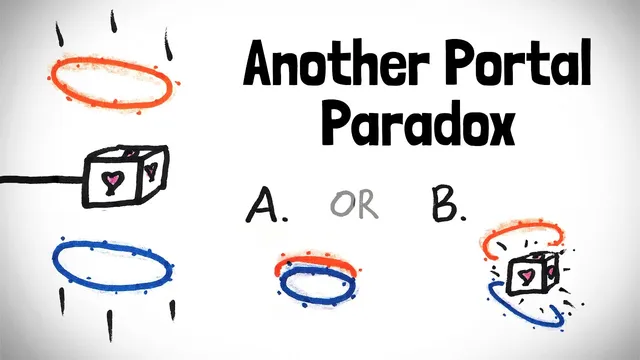
Another Portal Paradox
Based on minutephysics's video on YouTube. If you like this content, support the original creators by watching, liking and subscribing to their content.
A portal stopping partway through an object can be modeled as a momentum-transfer process using a mechanical analogue (two connected parts).
Briefing
Portal’s core rule—objects entering one portal exit the other with the same speed, with direction determined by portal orientation—creates room for paradoxes once the portals behave in ways physics would normally forbid. The most striking “halfway” scenario asks what happens if a portal stops partway through an object. With physically realistic portals, the cleanest way to reason it out is to replace the portal with a mechanical analogue: two cubes connected by a rope, where the “orange portal” ends between them. The upper cube shoots out of the “blue” portal at full speed; the rope then yanks the lower cube upward. If the rope is weak, it breaks. If it’s strong and the cubes have equal mass, momentum sharing forces both cubes to emerge from the blue portal at half speed. Translating that back to a single cube yields a general rule: if the portal stops at 1/3 of the cube’s length, the cube exits at 1/3 the speed; if it stops at 1/2, it exits at 1/2 speed. For an extremely fragile cube, the “stopping” would instead tear it apart, but for a uniform, intact object the momentum-transfer picture predicts partial-speed emergence rather than a true paradox.
A second paradox gets subtler: what if a cube is “sandwiched” between two portals at once? The analysis again swaps the portal for a more physical stand-in. Imagine a piston extending through the blue portal; because there’s no meaningful “inside” to a portal—everything on one side is effectively outside on the other—there’s no place for the piston to keep extending without interacting with itself. When the piston returns and hits its rear face, three outcomes emerge depending on rigidity and mass. A weak piston would crumple like it hits a solid wall. A rigid piston with extremely heavy portals would stop expanding because the portals can’t separate further. But if the portals aren’t heavy, the momentum bookkeeping implies something stranger: the piston’s push on the orange portal drives the orange portal left, while the blue portal absorbs the incoming piston momentum and gets pushed right. The net result is that the portals themselves get pushed apart.
The same logic applies to the sandwich-cube case. The blue portal moving toward the cube acts like a piston, driving the cube out of the orange portal until the cube collides with itself. If the cube is weak, it crumples. If it’s strong, the collision forces the portals to stop or even bounce—effectively the portals recoil from the self-impact.
The paradoxes aren’t all original. The “sandwich” challenge came from someone testing a sandbox version of Portal, while the “halfway through the cube” question was posed by a “portal physics & rendering” programmer from the team behind Portal 1 and 2. The solutions, however, are presented as the video’s own hypotheses: since moving portals weren’t implemented in the games, the physics remains open to interpretation—making paradox analysis the point.
Cornell Notes
Portal’s speed-and-direction rule can be extended into scenarios that feel impossible, but the paradoxes become tractable when replaced with mechanical analogues. For the “portal stops halfway through a cube” case, the setup is treated like two equal-mass cubes connected by a rope: the portion of the object that reaches the blue portal exits first, then momentum transfer determines how fast the rest emerges. A strong, uniform cube exits at a fraction of the full speed matching the stopping fraction (1/2, 1/3, etc.), while a very fragile cube may tear. For “sandwiching a cube between two portals,” the reasoning uses a piston analogy: self-collision forces either crumpling, stopping, or recoil. If portals aren’t extremely heavy, momentum conservation implies the portals can be pushed apart or bounce.
Why does the “portal stops halfway through a cube” scenario map to two cubes connected by a rope?
What determines whether the cube tears versus exits at reduced speed in the halfway case?
In the rope-and-cubes model, why do both cubes emerge at half speed when the rope is strong and masses match?
How does the “sandwich a cube between two portals” paradox get reframed using a piston?
Why does momentum conservation imply the portals might get pushed apart in the sandwich scenario?
Review Questions
- In the halfway-through-cube model, what role does the assumption of equal mass and a strong connection play in predicting half-speed emergence?
- What physical condition would make the sandwich-cube outcome more like “crumpling” than “portals bouncing,” according to the piston analogy?
- How does changing the stopping fraction (1/2 to 1/3) alter the predicted exit speed, and what assumption about the cube’s uniformity supports that rule?
Key Points
- 1
A portal stopping partway through an object can be modeled as a momentum-transfer process using a mechanical analogue (two connected parts).
- 2
If the connection is weak, the object can fail (tear or break); if strong and uniform, the object emerges at a reduced speed matching the stopping fraction.
- 3
For a uniform cube, stopping at 1/2 implies emergence at 1/2 speed; stopping at 1/3 implies 1/3 speed, with the general rule following the stopping proportion.
- 4
The “sandwich” paradox is analyzed by replacing portals with a piston that returns and collides with itself, since portals have no true “inside.”
- 5
Depending on rigidity and portal mass, the piston/cube can crumple, stop, or force the portals to recoil.
- 6
When portals aren’t extremely heavy, momentum conservation predicts the portals can be pushed apart or bounce after self-collision.