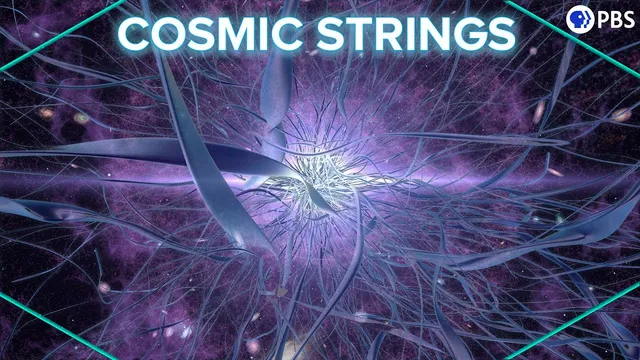
Are Cosmic Strings Cracks in the Universe?
Based on PBS Space Time's video on YouTube. If you like this content, support the original creators by watching, liking and subscribing to their content.
Cosmic strings are predicted topological defects formed when the Higgs field undergoes vacuum decay after the Big Bang and bubble regions with different phase angles merge.
Briefing
Cosmic strings are predicted universe-spanning “cracks” formed when quantum fields froze into a new vacuum state after the Big Bang—an imperfect phase transition that can leave persistent topological defects. The idea matters because these defects would carry enormous energy despite being subatomic in thickness, and their gravitational effects could offer a rare observational window into physics at extreme early-universe temperatures.
The mechanism starts with how quantum fields behave during phase transitions. At very high temperatures, the different vibrational “modes” of fields that later correspond to distinct forces effectively merge into a single master behavior. As the universe expands and cools, the Higgs field—treated as a fundamental field underlying mass—changes its energy landscape. Instead of a single stable vacuum value, the Higgs potential develops new minima arranged in a ring (described by two field-strength components). When the universe cools enough, the Higgs field undergoes vacuum decay: regions randomly “fall” from the old high-energy state into the new vacuum. Each decaying region expands outward at nearly the speed of light, and when multiple bubbles meet, their Higgs “phase angles” (the relative orientation of the two Higgs components) may fail to align.
In most places the field can smoothly reconcile those phases, but when several bubbles with incompatible phase angles join, the lowest-energy way to match them can require the phase to wind by 2π around a loop. That winding forces a knot-like region where the Higgs field can’t settle into the valley; it must remain at the top of the potential hill. In three dimensions, that knot becomes a cylindrical line defect: a cosmic string. The string is essentially a narrow filament of trapped high-energy vacuum, squeezed to about one-ten-trillionth the width of a proton, yet massive enough that every 100 meters of length carries the mass of Mars. Because the initial nucleation events occur across many causal horizons, a network of strings should form and stretch to scales comparable to the observable universe.
Cosmic strings aren’t static. Their extreme tension makes them vibrate, and collisions between string segments can lead to intercommutation—swapping connections—or to loop formation. Loops then fragment through repeated self-intersections, producing smaller loops that radiate gravitational waves. Over time, energy loss via gravitational radiation causes the network to slowly decay.
Detecting cosmic strings would rely on gravitational signatures. Oscillating strings and their kinks are expected to emit gravitational waves in beamed directions, potentially creating detectable bursts for future observatories such as LISA and for Pulsar Timing Arrays that track tiny timing irregularities in pulsar signals. Another route is gravitational lensing: a cosmic string can produce characteristic patterns of split images, potentially forming a chain of paired splits across the sky, though no such chain has been seen yet. Large all-sky surveys may improve the odds.
A key complication is distinguishing ordinary cosmic strings from “cosmic superstrings,” which could arise if string-theory strings were stretched to cosmic scales during inflation. Superstrings may intercommute less often, form junctions, and—if a junction lenses light—could produce distinctive multi-image patterns (including six-part images). Current searches haven’t found either type, but they have set bounds on the allowed string tensions, keeping the hunt alive. Finding a cosmic string would sharpen understanding of quantum fields, the universe’s earliest phase transitions, and potentially the plausibility of string theory itself—turning a theoretical “crack” into measurable physics.
Cornell Notes
Cosmic strings are predicted topological defects that could form when the Higgs field (and other quantum fields) undergo vacuum decay after the Big Bang. As the universe cools, the Higgs potential develops new minima arranged in a ring, so different regions fall into different phases of the new vacuum. When bubble regions meet with incompatible phase angles, the Higgs field can be forced to remain trapped at the high-energy “hilltop” along a line, creating a cosmic string: an extremely thin but enormously massive filament. The strings then vibrate, collide, intercommute, form loops, and radiate gravitational waves, gradually decaying. Detection would likely come from gravitational-wave bursts (including kink signals), pulsar timing irregularities, or distinctive gravitational lensing patterns; distinguishing them from cosmic superstrings may require observing junction-specific lensing signatures.
How does a Higgs-field phase transition produce a line defect rather than just smoothing out everywhere?
Why are cosmic strings so massive despite being extremely thin?
What dynamics govern how cosmic strings evolve over time?
Which gravitational-wave observables could reveal cosmic strings, and why?
How can gravitational lensing distinguish cosmic strings from other mass distributions?
What observational feature would best separate cosmic superstrings from ordinary cosmic strings?
Review Questions
- What changes in the Higgs potential at early-universe temperatures enable different bubble regions to acquire different phase angles?
- Describe the chain of events from string collisions to gravitational-wave emission and eventual decay.
- What lensing pattern would you look for to identify a cosmic string, and how might that differ for a cosmic superstring junction?
Key Points
- 1
Cosmic strings are predicted topological defects formed when the Higgs field undergoes vacuum decay after the Big Bang and bubble regions with different phase angles merge.
- 2
The Higgs potential develops a ring of new minima at lower temperatures, so different regions can choose different Higgs phase angles when the vacuum changes.
- 3
When phase angles cannot be reconciled smoothly, the Higgs field can remain trapped at the hilltop along a line, creating a cylindrical cosmic string core.
- 4
Cosmic strings are extremely thin but carry enormous mass per unit length because the string core stores trapped high-energy vacuum energy.
- 5
A cosmic-string network evolves through vibration, segment collisions, intercommutation, loop formation, and fragmentation, with energy loss dominated by gravitational-wave radiation.
- 6
Potential detection routes include gravitational-wave bursts (including kink signals) for instruments like LISA and Pulsar Timing Arrays, plus distinctive gravitational lensing patterns such as chains of split images.
- 7
Cosmic superstrings may be distinguished by reduced intercommutation and by junction-specific lensing signatures, potentially producing six-part images.