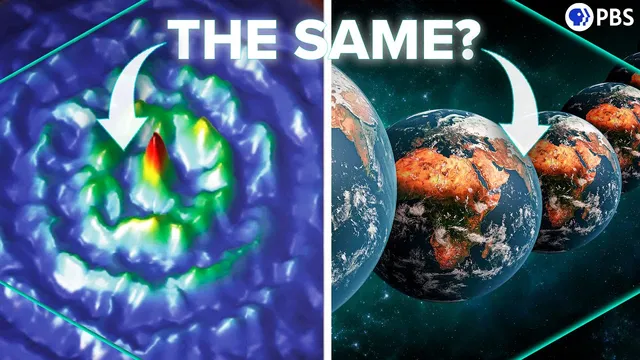
Are Many Worlds & Pilot Wave THE SAME Theory?
Based on PBS Space Time's video on YouTube. If you like this content, support the original creators by watching, liking and subscribing to their content.
Copenhagen treats measurement as an extra postulate: wavefunction collapse is instantaneous and random, and the Born rule is assumed rather than derived.
Briefing
Quantum mechanics’ biggest headache—how a deterministic wavefunction turns into a single, random-looking measurement result—has sparked competing interpretations. A growing line of thought argues that the two most famous alternatives, Many Worlds and Pilot Wave Theory, may be closer than they appear: both keep the wavefunction’s evolution deterministic under the Schrödinger equation and both treat “collapse” and randomness as something that emerges from deeper structure rather than as a fundamental law.
In the standard Copenhagen picture, the wavefunction evolves smoothly, but measurement forces an instantaneous, truly random collapse across the entire wavefunction. That creates two well-known tensions: the Born rule (why probabilities come from squaring the wavefunction) isn’t derived but assumed, and collapse looks non-local, seemingly conflicting with relativity’s locality. Copenhagen’s appeal is practical—its predictions match experiments—but its mechanism is conceptually awkward.
Pilot Wave Theory, associated with Louis deBroglie and developed by David Bohm, tries to restore determinism by adding “corpuscles” (actual particle positions) guided by a wavefunction. In the double-slit experiment, the guiding wave passes through both slits and interferes with itself to shape where the corpuscle is likely to land, while each corpuscle goes through only one slit. The apparent randomness comes from ignorance of the corpuscle’s initial position, not from nature injecting randomness. Crucially, the guiding wave is assumed to be unaffected by the corpuscle, so the wavefunction never collapses. Instead, the theory replaces collapse with a branching-like cascade of excitations: many detector pixels enter superpositions of excited and not excited, but only one cascade is “real” because only one pixel’s excited state is actually occupied by a corpuscle. The other cascades are treated as empty “phantoms.”
Many Worlds reaches a similar mathematical destination by stripping away the corpuscles. With only the wavefunction, the same detector-and-brain superpositions proliferate into multiple branches. Each branch corresponds to a different outcome, and observers become entangled with those outcomes, so each version of the observer experiences a definite result. The key difference is ontological: Pilot Wave treats corpuscles as markers of which branch is physically realized, while Many Worlds treats the wavefunction itself as the sole fundamental entity.
The transcript emphasizes a deep connection: if corpuscles in Pilot Wave are merely labels for which branch is “real,” then removing them turns Pilot Wave into Many Worlds. That said, the theories diverge on a major technical point—Pilot Wave’s guiding equation is explicitly non-local because it depends on entangled corpuscles across space. The discussion notes that hidden-variable approaches can’t preserve locality, which helps explain why Pilot Wave struggles to mesh cleanly with special relativity. Many Worlds avoids the guiding equation entirely by relying only on wavefunction evolution.
Finally, both interpretations face the Born rule. Copenhagen treats it as an extra rule. Pilot Wave can reproduce it if the corpuscle distribution initially matches the Born rule (density proportional to the wavefunction’s squared magnitude), after which the distribution stays consistent over time—though it doesn’t explain why that initial distribution holds. Many Worlds recovers the Born rule statistically by counting the relative density of observer experiences across branches, so probabilities correspond to how often an observer finds themselves in a given outcome branch.
Taken together, the central claim is that Many Worlds and Pilot Wave share the same underlying wave mechanics and differ mainly in what counts as “real” (corpuscles versus branches). That makes them look like two versions of the same framework—one with extra bookkeeping, one without—while leaving open the hardest questions about locality, relativity, and why the Born rule takes its specific form.
Cornell Notes
The transcript contrasts Copenhagen with two alternatives that keep the Schrödinger equation as the core dynamical law. Copenhagen adds a special, instantaneous, random wavefunction collapse at measurement and treats the Born rule (probabilities from squaring the wavefunction) as an extra postulate. Pilot Wave Theory restores determinism by adding corpuscles guided by a wavefunction; the wavefunction never collapses, and “randomness” comes from unknown initial corpuscle positions. Many Worlds removes corpuscles and instead treats the wavefunction’s branching into multiple non-interacting outcomes as physically real. Both approaches can reproduce measurement statistics, but they differ on locality (Pilot Wave’s guiding equation is non-local) and on what ultimately constitutes reality (corpuscles vs. branches).
Why does Copenhagen produce apparent randomness and non-locality in measurement?
How does Pilot Wave Theory explain the double-slit pattern without wavefunction collapse?
What happens inside the detector in Pilot Wave Theory, according to the transcript?
How does Many Worlds relate to Pilot Wave Theory if corpuscles are removed?
What role do locality and the Born rule play in distinguishing the interpretations?
Review Questions
- In what specific way does the transcript claim Pilot Wave avoids wavefunction collapse, and what replaces collapse in the measurement process?
- What is the transcript’s stated reason Pilot Wave struggles with special relativity, and how does Many Worlds sidestep that issue?
- How does each interpretation recover the Born rule—via initial corpuscle distributions or via branch statistics?
Key Points
- 1
Copenhagen treats measurement as an extra postulate: wavefunction collapse is instantaneous and random, and the Born rule is assumed rather than derived.
- 2
Pilot Wave Theory keeps Schrödinger evolution deterministic and replaces collapse with guided particle motion: corpuscles follow one path while the guiding wave interferes.
- 3
In the double-slit experiment, the guiding wave produces the interference pattern, but each photon’s corpuscle still lands at a single detector location shaped by that interference.
- 4
Pilot Wave’s detector dynamics involve many pixel superpositions, yet only one excitation cascade is “real” because only one cascade carries a corpuscle; the rest are empty phantoms.
- 5
Many Worlds removes corpuscles and treats the wavefunction’s branching into multiple outcomes as physically real, with observers becoming entangled with their branch.
- 6
Pilot Wave’s guiding equation is explicitly non-local due to entanglement across distant corpuscles, while Many Worlds relies only on local wavefunction evolution.
- 7
Both interpretations can recover the Born rule, but Copenhagen assumes it, Pilot Wave needs a Born-rule-matching initial corpuscle distribution, and Many Worlds uses branch-density statistics.