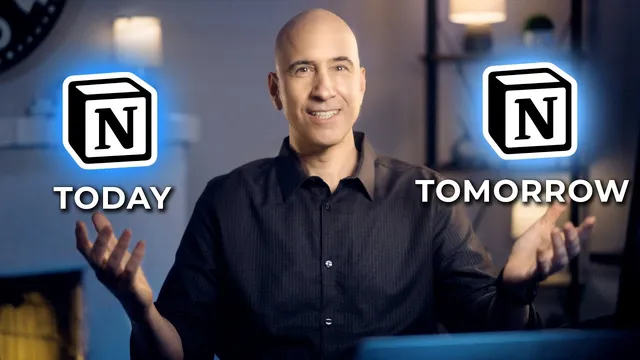
Are You Ready For Notion's New Era?
Based on August Bradley's video on YouTube. If you like this content, support the original creators by watching, liking and subscribing to their content.
Notion’s staying power is tied to rapid feature improvements and large user adoption, but the transcript argues community engagement has weakened and needs rebuilding.
Briefing
Notion’s next leap isn’t just more features—it’s the chance to turn personal knowledge and decision-making into a natural-language “life system” powered by AI, with the potential to extend from individuals to teams, families, and even future selves. The core claim is that Notion has already become a dominant hub for organizing work and life, and that its expanding ecosystem (including standalone apps) plus generative AI will make that hub far more interactive, context-aware, and useful for long-term growth.
The argument starts with momentum and reach. Notion’s mission—making toolmaking ubiquitous—has translated into scale: roughly a $10 billion valuation, 30 million users, and 4 million paying users. Feature velocity has also accelerated, with items like automations, internal AI, a calendar app, and a new formula capability cited as evidence that the platform is improving quickly. Yet there’s a cultural worry: the once vibrant Notion community has fragmented, with central discussion spaces allegedly crowded by template promotion rather than genuine exploration and support. The speaker frames this as a solvable problem—Notion’s product strength and growing adoption should be matched by renewed community energy.
On the product side, the central design philosophy is that Notion’s value depends on system design. The “it does many things but none well” criticism is dismissed as missing the point: Notion is positioned as a flexible foundation where users build their own workflows. In that framing, task management interfaces matter less than how well tasks connect to projects, and projects connect to life aspirations. The transcript repeatedly emphasizes the pillars/pipelines/vaults approach (referred to as PPV), where daily actions are aligned to higher goals, and where knowledge and media are stored in structured “vaults” for later retrieval.
Trade-offs are acknowledged. Notion’s cloud-first nature can mean slower load times and no offline mode, and the platform may not suit people who prioritize offline reliability. Still, the upside is broader functionality, synchronization, and collaboration—especially for users building interconnected systems.
A major forward-looking thread is Notion’s move toward a multi-product ecosystem. After the standalone Notion calendar app, discussion on X (Twitter) centered on “Infinity wars” style speculation about what other apps might join the Notion universe—messaging, email, tasks, forms, and whiteboards among the guesses. The practical rationale is interface quality: standalone apps can provide polished front ends for high-volume tasks while keeping Notion’s database power in the background. That shift could also improve offline capabilities for the most-used functions.
The biggest change, however, is conceptual: personalized software built by domain experts rather than generic developers, and AI interfaces that let users talk to their knowledge hubs like a “personal Jarvis.” The transcript imagines natural-language conversations with knowledge stored across time—using historical page versions as a metaphor for revisiting earlier versions of oneself, complete with forgotten thoughts, reflections, media, and decision context. It extends further into virtual therapists, future-self projections, and scenario planning.
Finally, the transcript argues that the real differentiator is context. AI becomes far more powerful when it has not just what a person currently knows, but also what they once knew and later forgot—then scales that context to groups. With privacy concerns addressed through self-curated inputs (contrasted with broad scraping by external AI providers), the pitch is that a well-designed PPV-style life system can maximize AI’s value while keeping control over what gets used. The conclusion is a call to engage—because Notion’s “new era” is framed as both a technical evolution and a community-driven one.
Cornell Notes
Notion’s growth is framed as more than feature expansion: it’s a platform foundation for AI-driven personal “life systems.” The transcript argues that Notion’s flexibility only becomes transformative when users design a coherent structure—especially the PPV approach that links daily actions to projects and life aspirations, and stores knowledge in vaults for later retrieval. A key future direction is a multi-app ecosystem (prompted by the standalone Notion calendar app), which could improve interfaces and eventually offline usefulness for common tasks. With generative AI and natural-language access, the system could support conversations with knowledge hubs, “future selves,” and even virtual therapy—first for individuals, then for teams and families—so long as privacy is handled through self-curated data inputs.
Why does the transcript insist that Notion’s usefulness depends more on system design than on the app’s built-in interfaces?
What trade-offs does the transcript acknowledge about using Notion as a cloud-first platform?
How does the transcript connect Notion’s move toward standalone apps to a future “multi-product world”?
What does “natural language access” to a knowledge vault enable in the transcript’s imagined future?
Why does the transcript argue that privacy control is easier with a single umbrella system like Notion?
How does the transcript scale the concept from individuals to teams and families?
Review Questions
- What specific role does the PPV-style alignment (values → routines/goals → pipelines → vaults) play in making AI useful rather than just “another chatbot”?
- Which interface and offline limitations are acknowledged, and how does the transcript propose standalone apps might mitigate them?
- How does the transcript’s privacy model differ from broad AI training/scraping, and why does it claim a single umbrella system matters?
Key Points
- 1
Notion’s staying power is tied to rapid feature improvements and large user adoption, but the transcript argues community engagement has weakened and needs rebuilding.
- 2
The platform’s real advantage comes from user-built system design that links tasks and projects to life aspirations, not from relying on generic interfaces.
- 3
Cloud-first trade-offs—no offline mode and slower load times—are presented as acceptable costs for broader sync, collaboration, and system-building flexibility.
- 4
Notion’s move toward standalone apps is framed as a practical fix for interface quality while preserving database power in the core platform.
- 5
Generative AI plus natural-language access could turn personal knowledge and decision-making into an interactive “life system,” including conversations with past and future selves.
- 6
The transcript claims AI becomes dramatically more valuable when it has full context, including forgotten reflections and group-shared documentation.
- 7
Privacy is positioned as controllable through self-curated inputs within a centralized system, rather than open-ended scraping by external AI models.