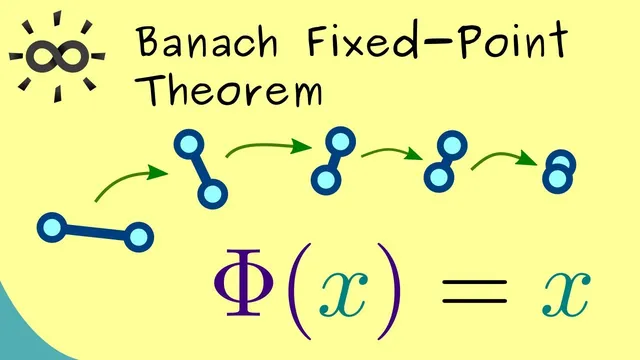
Banach Fixed-Point Theorem
Based on The Bright Side of Mathematics's video on YouTube. If you like this content, support the original creators by watching, liking and subscribing to their content.
Banach’s theorem requires a complete metric space (X, D) and a contraction F: X → X with a constant Q satisfying 0 < Q < 1.
Briefing
Banach’s fixed-point theorem guarantees a single, reliably reachable fixed point for a contraction on a complete metric space. The result matters because it turns an abstract “does a solution exist and is it unique?” question into a concrete iterative method—start anywhere, repeatedly apply the function, and the sequence converges to the same point.
The theorem starts with two ingredients. First, there must be a complete metric space (X, D): a set X with a distance function D that is symmetric, satisfies the triangle inequality, and has the key completeness property that every Cauchy sequence converges to a point in X. Second, there must be a map F: X → X that is a contraction. Contraction means there exists a constant Q with 0 < Q < 1 such that for all x, y in X, the distance between images shrinks by at least the factor Q: D(F(x), F(y)) ≤ Q · D(x, y).
A fixed point x* is a point that doesn’t move under the map, meaning F(x*) = x*. Under the contraction and completeness assumptions, Banach’s theorem asserts two things at once: existence and uniqueness of x*. It also provides a way to find x*: pick any starting point x0 in X, define an iterative sequence by x_{n+1} = F(x_n), and this sequence converges to x*.
The proof builds convergence from the contraction inequality. With a chosen starting point x0, the sequence (x_n) is generated by repeated application of F. The contraction property yields a bound on successive distances: D(x_{n+1}, x_n) ≤ Q^n · D(x_1, x_0). To show the whole sequence is Cauchy, distances between far-apart terms D(x_n, x_m) are estimated using the triangle inequality across the chain of intermediate iterates. Each step contributes a factor of Q, producing a geometric-sum bound. Because Q lies strictly between 0 and 1, the geometric series converges, and the estimate forces D(x_n, x_m) to go to zero as n and m grow—so (x_n) is Cauchy.
Completeness then supplies the missing link: every Cauchy sequence converges in X, so x_n → x*. Next, x* is shown to be a fixed point. Contractions are continuous in metric spaces, so taking limits through F gives F(x*) = x*. Finally, uniqueness follows from a short contradiction argument: if two distinct fixed points x* and x̂ existed, applying the contraction inequality to them would imply D(x*, x̂) ≤ Q · D(x*, x̂). Since D(x*, x̂) would be positive for distinct points, dividing would force 1 ≤ Q, contradicting Q < 1.
In short: on a complete metric space, a contraction has exactly one fixed point, and iterating the map from any starting point converges to it. That combination—uniqueness plus an effective construction—is why the theorem is widely used in analysis, including for proving uniqueness of solutions to differential equations under suitable conditions.
Cornell Notes
Banach’s fixed-point theorem applies to a complete metric space (X, D) and a contraction F: X → X. If there is a constant Q with 0 < Q < 1 such that D(F(x), F(y)) ≤ Q·D(x, y) for all x, y, then F has exactly one fixed point x*. Starting from any x0 and defining x_{n+1} = F(x_n), the iterates form a Cauchy sequence. Completeness guarantees convergence to some limit x*, and continuity of contractions lets one pass the limit through F to get F(x*) = x*. Uniqueness comes from the fact that two distinct fixed points would violate D(x*, x̂) ≤ Q·D(x*, x̂).
What two assumptions does Banach’s fixed-point theorem require before any conclusion about fixed points is possible?
How does the proof show that the iteration x_{n+1} = F(x_n) is Cauchy?
Why does completeness matter after establishing the sequence is Cauchy?
How is it proved that the limit x* is actually a fixed point of F?
What prevents there being two different fixed points?
Review Questions
- Why does the contraction constant Q being strictly less than 1 play a decisive role in both convergence and uniqueness?
- Where exactly does the triangle inequality enter the proof, and what does it accomplish in bounding D(x_n, x_m)?
- How does continuity of contractions justify the step F(lim x_n) = lim F(x_n) in a metric space setting?
Key Points
- 1
Banach’s theorem requires a complete metric space (X, D) and a contraction F: X → X with a constant Q satisfying 0 < Q < 1.
- 2
A contraction shrinks distances: D(F(x), F(y)) ≤ Q·D(x, y) for all x, y in X.
- 3
Iterating from any starting point via x_{n+1} = F(x_n) produces a Cauchy sequence.
- 4
Completeness guarantees the iterates converge to a limit x* that lies in X.
- 5
Continuity of contractions lets the limit pass through F, proving F(x*) = x*.
- 6
Uniqueness follows because two distinct fixed points would force 1 ≤ Q, contradicting Q < 1.