Behavior and Belief
Based on Vsauce's video on YouTube. If you like this content, support the original creators by watching, liking and subscribing to their content.
People often infer control from coincidence: when rewards follow actions, the brain treats those actions as causes even without evidence.
Briefing
Uncertainty doesn’t just make people uneasy—it pushes them to invent explanations that restore a sense of control. In “Behavior and Belief,” Michael and psychologist Aaron Blaisdell build a human version of B.F. Skinner’s classic conditioning work to show how quickly people turn random reward schedules into personal “causes,” then they pivot to a second experiment suggesting that belief can also generate vivid, meaningful experiences even when nothing supernatural is happening.
The centerpiece is “Victory Vault,” a staged game show designed as a human Skinner Box. Participants sit in a soundstage with a checkboard floor, a salient but useless button, cameras, and an ATM slot that dispenses dollar bills at regular intervals—independent of anything the participant does. At first, many contestants latch onto a specific action sequence, treating it like a trigger. Rebecca, for example, focuses on combinations involving the door and the button as money appears. Her behavior escalates into a ritual: she repeats actions in the hope of reproducing the reward. When the timing stops matching her old pattern, she doesn’t give up; she searches for a new one, shifting to other behaviors as the reward continues to arrive on schedule. Blaisdell frames this as “adventitious reinforcement” (reward arriving after an action, making that action feel causal) followed by “extinction” when the old belief stops fitting the outcomes.
Across multiple subjects, the button’s visibility shapes early superstition—people repeatedly ask whether they “should” push it, then build strategies around it. Some rituals become elaborate, while others reveal a different belief style: a few participants effectively conclude that nothing they do changes the money, leading them to stand still or avoid the button. The results underscore a key difference between humans and pigeons: humans arrive with expectations—about games, cameras, performance, and what “should” work—so their invented causes reflect their prior beliefs as much as the environment’s randomness.
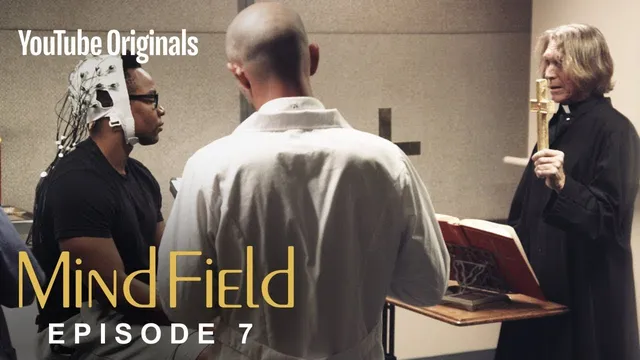
The episode then argues that these “lies” can become functionally real. If a belief is strong enough, it can produce real psychological effects—an idea illustrated by placebos. That logic drives a “reverse exorcism” study with Dr. Veissiére, where participants are led to expect a spirit possession experience. The setup blends religious iconography (crucifix, priest figure, ritual language) with scientific props (EEG cap, medical-style procedures) to relax critical defenses and intensify suggestion. Actors and staged procedures sell the seriousness of the event, while Veissiére guides the ritual with hypnosis-like techniques.
Participants report altered states that feel personal and vivid: sensations of a divine presence, emotional comfort, visions, and even an out-of-body experience involving a deceased mother. The researchers emphasize that the experiences were generated without any real causal mechanism tied to possession—yet the meaning and impact were real to the participants. The episode closes by framing humans as “belief-making machines”: when reality is uncertain, people generate patterns to regain control, and those patterns can shape behavior and experience even when they don’t match objective causality.
Cornell Notes
“Behavior and Belief” shows how people manufacture control when outcomes are uncertain. In “Victory Vault,” a human Skinner Box, dollar bills appear on a fixed schedule regardless of what participants do, but many contestants still treat their actions—especially around a salient button or door—as the cause of the money. When the timing stops matching an old ritual, behavior shifts again, reflecting belief updating via adventitious reinforcement and extinction. The episode then extends the same principle to placebos: a staged “reverse exorcism” combines religious and scientific cues to induce possession-like experiences, which participants describe as vivid and meaningful even though nothing supernatural is actually occurring. The takeaway: beliefs can be false yet still powerful.
How does “Victory Vault” function as a human version of Skinner’s experiments?
What do “adventitious reinforcement” and “extinction” look like in Rebecca’s behavior?
Why do some participants stand still or avoid the button while others build elaborate rituals?
What role does the “salient” button play in shaping superstitions?
How does the “reverse exorcism” study use belief to generate possession-like experiences?
What makes the reported experiences “real” in psychological terms despite being staged?
Review Questions
- In “Victory Vault,” what specific design choices make participants likely to infer a causal link between their actions and the money?
- How does the episode distinguish between a belief’s objective accuracy and its behavioral or emotional power?
- What cues (religious, scientific, social) were combined in the reverse exorcism setup, and how might each cue contribute to participants’ expectations?
Key Points
- 1
People often infer control from coincidence: when rewards follow actions, the brain treats those actions as causes even without evidence.
- 2
In a human Skinner Box, superstitious rituals emerge quickly and can shift when the timing no longer matches an old pattern.
- 3
Humans differ from pigeons because they arrive with expectations about games, cameras, and what “should” work, shaping the specific rituals they invent.
- 4
A salient but irrelevant stimulus (like the button) can anchor early beliefs and drive repeated behavior even when it has no effect on outcomes.
- 5
Beliefs can be false yet still produce real psychological experiences, as illustrated by placebo-like “reverse exorcism” reports.
- 6
Combining religious symbolism with scientific authority can intensify suggestion and make altered states feel meaningful and personal.
- 7
Skepticism varies across individuals, and that variation can determine whether someone forms a superstition or avoids ritual behavior.