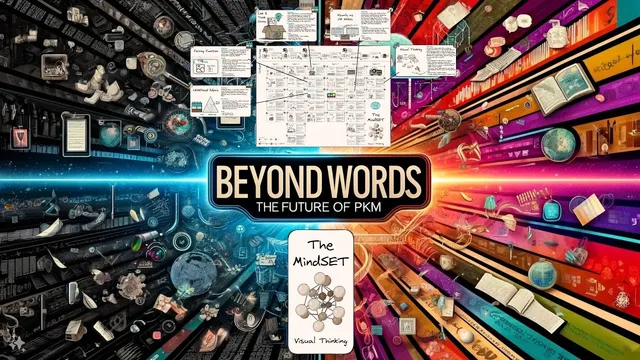
Beyond Words: The Future of PKM - Exploring 5 Cards from The MindSET Visual Thinking Framework
Based on Zsolt's Visual Personal Knowledge Management's video on YouTube. If you like this content, support the original creators by watching, liking and subscribing to their content.
The transcript frames knowledge as interconnected concept relationships, so notes should support navigation of those relationships rather than forcing linear reading.
Briefing
Visual personal knowledge management hinges on a simple shift: knowledge becomes easier to retrieve and understand when notes stop behaving like linear text and start behaving like interconnected visual models. The core claim is that most people learn through webs of concepts and relationships, but traditional note-taking forces information into a word-by-word sequence. By drawing those relationships back onto paper—then linking, reusing, and navigating them—notes turn into a feedback loop that helps people verify understanding and integrate new ideas.
The argument starts with a childhood contrast. Early learning often begins with drawing before writing, yet schooling trains attention toward alphabet mastery, vocabulary, and increasingly complex reading. That creates a “textual bias” in adulthood: even though people can store information, they struggle to connect it. The transcript frames this as a mismatch between how knowledge forms in the mind (as linked mental models) and how many systems store it (as standalone documents). The result is common: notes pile up, but the connections that make knowledge usable don’t automatically emerge.
To address that gap, the framework moves through three levels of PKM. First is 2D PKM: notes live as separate text files or notebook entries, and retrieval typically means scanning from start to finish. Second is 3D PKM: links, tags, index pages, content maps, and ontologies add a third dimension—relationships between notes—while still keeping the underlying documents text-based. Third is “beyond text” PKM, described as nonlinear notes that merge images, links, tags, and text. This approach is positioned as a practical way to absorb information without reading line by line, with Excalidraw and Excal brain (as tools within Obsidian) presented as central examples.
From there, the transcript introduces the MindSET Visual Thinking Framework, built as a set of 32 “cards.” Five cards illustrate how visual PKM should work in practice. One card focuses on visual thinking: translating concepts and relationships from reading into drawn concept maps, then using the drawing process to create a feedback loop. Another demonstrates “link and think icons,” where icons are not decoration but a navigational system—an automatically generated icon library and an “idea mixer” that gathers related concepts around a single icon (e.g., curiosity) across an entire Obsidian vault.
A third card covers “legalized ideas,” likened to atomic notes but visual: start with a broader visual, then carve out reusable components (like a neuron illustration) and repurpose them in new contexts. A fourth card introduces a “forcing function” using a condensed visual “virtual Post-It” to navigate at a meta level—where the same central visual appears across different views. The final card, “visuals as Zettelkasten notes,” emphasizes flip-and-retrieve design: the visual front supports quick scanning, while the back side holds the full Markdown details, metadata, tags, links, and ontology.
The closing section turns the framework into action: pick a concept and draw it, build a reusable visual vocabulary with consistent icons, treat illustrations like Lego blocks for reuse, and avoid the belief that only skilled artists can participate. A six-week Visual Thinking Workshop is offered as a structured way to practice these methods through creating a visual book-on-a-page summary.
Cornell Notes
The transcript argues that personal knowledge management works better when notes reflect how people actually think: as interconnected concept webs rather than linear text. It contrasts 2D PKM (separate text documents) with 3D PKM (adds links/tags) and then pushes further into nonlinear visual notes that combine images, links, tags, and text for faster comprehension and retrieval. The MindSET Visual Thinking Framework organizes this approach into 32 “cards,” with examples showing how drawing creates feedback loops, how icon libraries and “idea mixers” connect ideas across an Obsidian vault, and how visual components can be reused like “Lego blocks.” The workflow also supports meta-navigation via condensed “forcing function” visuals and detailed retrieval via flipable Zettelkasten-style notes.
Why does the transcript claim text-first note-taking can fail even when people capture lots of information?
How do 2D, 3D, and “beyond text” PKM differ in the transcript’s model?
What is the role of icons in “link and think icons,” and how does the “idea mixer” use them?
What does “legalized ideas” mean in practice, and why does it matter for reuse?
How does the “forcing function” card improve navigation across a knowledge system?
What does “visuals as Zettelkasten notes” add beyond a simple diagram?
Review Questions
- How does the transcript’s explanation of knowledge as a concept web challenge the effectiveness of linear, text-only note retrieval?
- In the MindSET framework, what mechanisms make visual notes both navigable at a meta level and detailed on demand?
- Why does the transcript emphasize reusable visual components (icons and carved-out illustrations) rather than creating new visuals from scratch each time?
Key Points
- 1
The transcript frames knowledge as interconnected concept relationships, so notes should support navigation of those relationships rather than forcing linear reading.
- 2
2D PKM treats notes as separate documents; 3D PKM adds links/tags, but still relies on text-first documents for comprehension.
- 3
Nonlinear visual notes combine images, links, tags, and text to reduce the need to read line-by-line while improving retrieval.
- 4
The MindSET Visual Thinking Framework organizes visual PKM into 32 cards, with practical techniques like concept mapping, icon-based linking, and reusable visual components.
- 5
Icons function as a visual vocabulary: an icon library and “idea mixer” help connect ideas across an entire Obsidian vault.
- 6
Reusable “Lego block” visuals are created by carving out parts of broader illustrations and repurposing them as atomic components.
- 7
Flipable Zettelkasten-style notes balance speed and depth by pairing a visual front with a detailed Markdown back side.