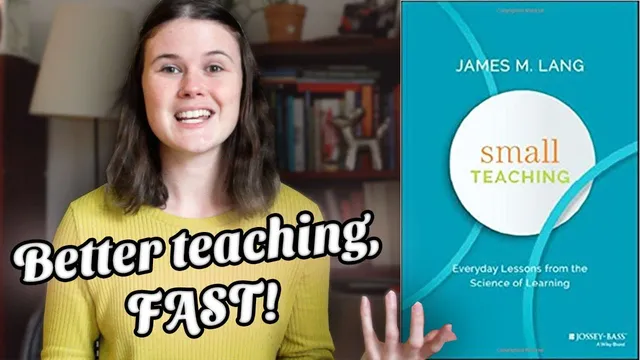
Books on Teaching: "Small Teaching" by James M Lang
Based on morganeua's video on YouTube. If you like this content, support the original creators by watching, liking and subscribing to their content.
Small Teaching focuses on implementing short, active learning techniques immediately during a term rather than waiting for major course redesigns.
Briefing
James M. Lang’s Small Teaching argues for a practical shift in higher-education instruction: instead of waiting for major professional-development overhauls, instructors can make “tiny” classroom changes—active, science-backed techniques that fit into roughly five to 15 minutes of class time—and still achieve large gains in student learning. The core appeal is immediacy. Lang frames mid-term professional development as a moment that often gets wasted because instructors don’t have time to test new ideas right away; by the end of the term, the window for experimentation closes and reflection time is scarce. Small Teaching’s answer is to adopt bite-sized exercises that can be implemented immediately, then iterated.
A central throughline is that each recommended practice is grounded in learning science and supported by evidence—either tested by Lang himself or by other instructors. The book breaks its guidance into short sections, including discussions of the science behind learning approaches and concrete classroom applications. The “small” label isn’t about being superficial; it’s about lowering the barrier to adoption so instructors can align day-to-day teaching with broader goals like student-centered learning and critical pedagogies without needing to redesign an entire course.
The transcript highlights retrieval practice as one of the first science-backed methods Lang brings forward. The recommended techniques are designed to be flexible across teaching contexts: they can work for lecturers, tutorial leaders, and instructors in classrooms ranging from a single person to cohorts of around a thousand. That scalability matters because it suggests the book’s strategies aren’t tied to a specific class size, discipline, or teaching format.
Another reason the book stands out, according to the notes shared, is how it connects research to actionable teaching moves. Rather than focusing only on student behavior—such as how learners should study for exams—Small Teaching is presented as a teacher-facing guide that translates learning science into classroom practice. The transcript also emphasizes Lang’s use of references throughout the book, pointing readers to other books and research articles that inform the recommendations, along with a curated set of further reading at the end.
Overall, the takeaway is a teaching workflow: pick one small, evidence-based technique, try it immediately in the current term, and build momentum toward larger pedagogical commitments over time. The book’s promise is that instructors can start tomorrow with changes that are short, testable, and backed by learning science—turning professional development into something that actually reshapes instruction.
Cornell Notes
Small Teaching by James M. Lang promotes “tiny” classroom interventions—active learning exercises that typically take about five to 15 minutes—that can produce outsized improvements in student learning. Lang links each technique to learning-science evidence, including research and classroom testing, and organizes guidance into short sections that pair the science behind learning with practical applications. The approach is designed for real university constraints: instructors often lack time to experiment mid-term or to fully redesign courses after professional development. Because the strategies are flexible, they can be used across class sizes and teaching roles, from lecturers to tutorial leaders. Retrieval practice is highlighted as an early method in the book, with additional activities teased for a follow-up video.
What problem does Small Teaching target for university instructors during a term?
What makes the book’s recommendations “small,” and why does that matter?
How does the book connect learning science to classroom action?
Why is retrieval practice singled out in the transcript?
Are the strategies limited to a particular class size or teaching role?
Review Questions
- Which constraints of university teaching does Small Teaching try to solve, and how do “five to 15 minute” interventions address them?
- How does the book’s evidence approach (science-backed, tested practices plus references) differ from student-only study advice?
- What role does retrieval practice play in the book’s early methods, and why might it be a good first experiment for an instructor?
Key Points
- 1
Small Teaching focuses on implementing short, active learning techniques immediately during a term rather than waiting for major course redesigns.
- 2
Each recommended classroom practice is tied to learning-science evidence and is described as tested by Lang or other instructors.
- 3
The book’s “small” strategies typically fit into about five to 15 minutes, making them easier to trial and iterate.
- 4
The guidance is meant to support broader goals like student-centered learning and critical pedagogies through practical, bite-sized steps.
- 5
The techniques are presented as adaptable across teaching roles and class sizes, from one-on-one settings to very large cohorts.
- 6
Retrieval practice is highlighted as an early, science-backed method in Lang’s framework.
- 7
The book includes references to other research and books throughout, plus further reading at the end for deeper follow-up.