Brain’s Hidden Learning Limits
Based on Artem Kirsanov's video on YouTube. If you like this content, support the original creators by watching, liking and subscribing to their content.
The brain’s wiring can impose hardware-like constraints on which neural activity patterns are possible, limiting what can be learned.
Briefing
Learning can feel limitless—until a new skill refuses to click. A Nature Neuroscience study highlighted in this transcript argues that the bottleneck isn’t just effort or strategy. Instead, the brain’s physical wiring imposes “hardware” constraints on which patterns of neural activity can be generated, even when animals receive clear feedback and rewards.
The core problem is that neuroscience can’t easily test learning rules by commanding the brain to produce specific neural sequences. Behavior can be measured, but the exact neural pattern behind each movement is hidden. Without direct control over neural activity, researchers traditionally can’t systematically ask whether certain sequences are harder—or impossible—because of how neurons are connected.
The study’s workaround uses brain-computer interface logic: rather than designing behaviors that might evoke particular neural activity, it makes neural activity the target. Monkeys view a cursor on a screen whose position is driven by recorded firing rates from roughly 90 motor-cortex neurons. The mapping between neural population activity and cursor movement is chosen during calibration so that the animals can learn, through trial and error, to move between targets to earn rewards.
The key insight comes from how the mapping is constructed. With one mapping—called the “movement in tension” view—the neural trajectories for leftward and rightward cursor movements overlap in the two-dimensional projection. At first glance, that overlap suggests flexibility: perhaps the same neural “tape” is being played in opposite directions. But that conclusion is incomplete because the cursor only reflects a single two-dimensional slice of a much higher-dimensional neural state space.
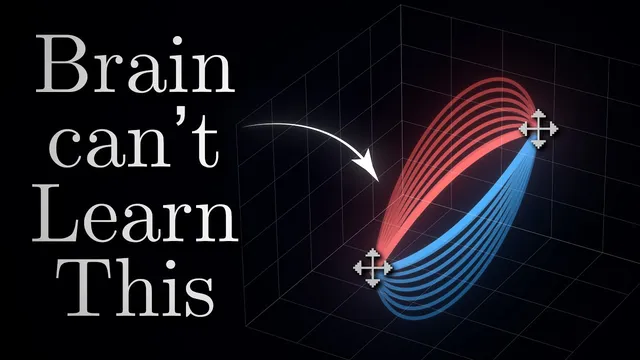
When researchers switch to a different mapping—“separation maximizing view”—the leftward and rightward neural trajectories become clearly distinct. The animals’ brains are not simply reversing the same pattern. They are using different neural dynamics for each direction.
That difference becomes decisive when the interface is changed again. Under the separation-maximizing mapping, monkeys initially move the cursor along curved paths rather than straight ones. Even though the task rewards them for reaching targets, the animals do not correct the trajectories to make them straight, despite the fact that straight-line movement is a natural motor strategy. The transcript frames this as evidence that the required neural dynamics may lie outside what the animals can voluntarily reshape.
To rule out motivation as the culprit, researchers impose a corridor constraint: the cursor must stay within a narrow path between targets. Achieving the goal now requires generating a time-reversed version of a previously learned neural sequence. Even with strong incentives and explicit visual constraints, monkeys fail to reverse the natural neural flow. The study’s conclusion is blunt: some neural sequence transformations are blocked by intrinsic circuit dynamics, so practice and reward cannot always overcome the brain’s built-in limits.
The broader takeaway is practical. Skill learning may succeed when new behaviors align with the brain’s preferred neural dynamics, and fail when they demand neural trajectories that the underlying circuitry cannot produce.
Cornell Notes
The transcript centers on a Nature Neuroscience finding that the brain’s learning capacity is constrained by the dynamics of its neural circuitry. Using a brain-computer interface, researchers recorded ~90 motor-cortex neurons in monkeys and mapped their activity to cursor movement on a screen. Different mathematical projections (“movement in tension” vs “separation maximizing”) revealed that leftward and rightward movements rely on distinct neural trajectories, not a simple reversal of the same pattern. When the task required monkeys to generate a time-reversed neural sequence—while staying within a narrow corridor—rewards and practice were not enough. The implication is that some neural sequence transformations are physically or dynamically inaccessible, shaping what skills can be learned.
Why can’t researchers simply test which neural sequences are learnable by observing behavior alone?
How does the brain-computer interface turn neural activity into something testable?
What is the significance of using two different projections: “movement in tension” and “separation maximizing”?
Why did curved cursor paths matter, even though monkeys still received rewards?
How did the corridor constraint test whether motivation could explain the failure to reverse neural sequences?
What broader claim does the study support about skill learning?
Review Questions
- What methodological obstacle prevents straightforward testing of learnable neural sequences using behavior alone, and how does a brain-computer interface address it?
- Compare “movement in tension” and “separation maximizing” projections: what different conclusions about neural flexibility do they lead to?
- Why does the corridor constraint strengthen the argument that neural sequence reversal is intrinsically limited rather than a motivation problem?
Key Points
- 1
The brain’s wiring can impose hardware-like constraints on which neural activity patterns are possible, limiting what can be learned.
- 2
Directly controlling and verifying specific neural sequences is difficult, so the study targets neural patterns themselves using a brain-computer interface.
- 3
A cursor task driven by ~90 motor-cortex neurons provides real-time feedback that enables learning through trial and error.
- 4
Different mathematical projections can reveal different structure in neural population trajectories, changing interpretations of whether movements are reversals or distinct patterns.
- 5
Monkeys did not correct curved trajectories under a separation-maximizing mapping, suggesting limited voluntary control over the underlying neural dynamics.
- 6
When success required generating a time-reversed neural sequence within a narrow corridor, monkeys failed even with rewards, indicating intrinsic constraints.
- 7
Skill acquisition may depend on whether required neural dynamics align with the brain’s intrinsic circuit dynamics rather than on effort alone.