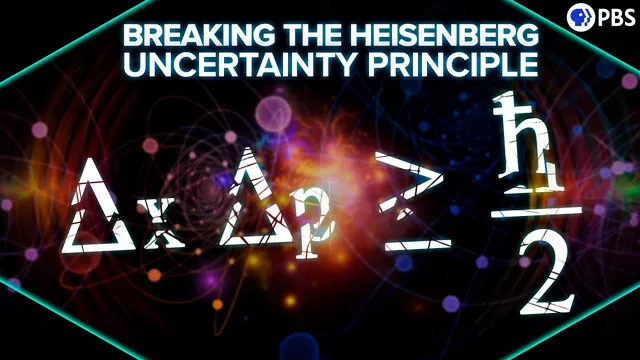
Breaking The Heisenberg Uncertainty Principle
Based on PBS Space Time's video on YouTube. If you like this content, support the original creators by watching, liking and subscribing to their content.
The Heisenberg uncertainty principle limits simultaneous precision for complementary variables, but it constrains uncertainty products rather than forbidding targeted improvements.
Briefing
Quantum mechanics sets a hard ceiling on how precisely nature can be measured, but precision experiments can still “spend” that uncertainty in smarter places. By reshaping the quantum noise that limits detection, LIGO can improve its sensitivity to faint gravitational waves—pushing closer to the Heisenberg uncertainty limit rather than being stopped by it.
The Heisenberg uncertainty principle says certain pairs of properties—called complementary variables—cannot both be known to perfect precision at the same time. Measuring a particle’s position ever more tightly makes its momentum uncertain; pinning down energy blurs the particle’s location in time. Heisenberg originally framed the effect as a consequence of measurement itself: using a photon to locate a particle delivers a momentum “kick,” and higher-energy photons used for better position accuracy kick the particle even harder. Niels Bohr disagreed with that interpretation, treating uncertainty as a deeper feature of reality through “complementarity,” where quantum systems reveal different aspects depending on what questions (measurements) are posed.
Modern experiments exploit the fact that the uncertainty principle constrains the product of uncertainties, not the usefulness of each uncertainty individually. If a measurement cares far more about one variable than the other, it can be advantageous to reduce uncertainty in the relevant quantity—even if that increases uncertainty in its complement. LIGO provides a concrete case. The Laser Interferometer Gravitational Wave Observatory uses two 4-km-long perpendicular arms in Washington State and Louisiana. Laser light is split, sent down both arms, and recombined so that—without a gravitational wave—the optical signals cancel by destructive interference. A passing gravitational wave changes the relative arm lengths in a characteristic way, spoiling the perfect cancellation and producing a detectable flicker of light.
That sensitivity depends on the phase of the laser beams. Quantum fluctuations prevent the phases from matching perfectly, creating low-level noise that can mask weak signals. In LIGO’s language, the complementary variables are phase and amplitude: phase precision determines how well the interferometer cancels and reconstructs the gravitational-wave-induced length change, while amplitude uncertainty relates to the photon number in the beam. Standard laser light distributes uncertainty roughly evenly between these variables, limiting how far phase can be stabilized.
The workaround is “squeezed light,” engineered so the uncertainty ellipse in phase space is compressed in the phase direction and stretched in the amplitude direction while keeping the total quantum uncertainty area fixed. LIGO achieves phase squeezing using quantum entanglement: a laser passes through a non-linear crystal that converts photons into entangled photon pairs. Sent through the interferometer arms, these correlated photons produce phase fluctuations that cancel more effectively upon recombination, reducing the flicker noise that hides faint gravitational waves.
The trade-off is real. Squeezing phase increases uncertainty in photon number, which raises radiation pressure noise as photons push on the mirrors. LIGO expects this cost to be manageable—especially for higher-frequency gravitational waves—and estimates that squeezed-light upgrades could enable detection of up to 50% more gravitational-wave events, including signals from farther away and lower-mass mergers involving black holes and neutron stars. The broader lesson is that quantum mechanics doesn’t merely impose limits; with the right quantum engineering, it can be navigated to extract more information from an inherently uncertain universe.
Cornell Notes
The Heisenberg uncertainty principle limits simultaneous precision for complementary variables, such as position–momentum or energy–time. But the limit constrains the product of uncertainties, so experiments can improve the measurement that matters most by increasing uncertainty in the less relevant quantity. LIGO targets phase noise in its interferometers: gravitational waves change arm lengths, which shows up as imperfect destructive interference sensitive to laser phase. Quantum fluctuations create phase mismatch noise that can hide faint signals. By injecting squeezed light—generated via entangled photon pairs from a non-linear crystal—LIGO reduces phase uncertainty (at the cost of increased amplitude/photon-number uncertainty), improving sensitivity and expected event rates.
Why does the Heisenberg uncertainty principle limit measurement precision in quantum systems?
How does LIGO’s measurement depend on quantum uncertainty?
What are the complementary variables in LIGO’s “uncertainty hack”?
What is squeezed light, and how does it reduce phase noise?
What trade-off does squeezed light introduce for LIGO?
What sensitivity gain does LIGO expect from squeezed-light upgrades?
Review Questions
- How does the uncertainty principle constrain complementary variables, and why doesn’t that automatically prevent better measurements?
- Describe how LIGO’s interferometer converts a gravitational-wave-induced arm-length change into a phase-sensitive optical signal.
- Explain how entanglement and a non-linear crystal produce squeezed light and why that reduces phase noise despite increasing amplitude uncertainty.
Key Points
- 1
The Heisenberg uncertainty principle limits simultaneous precision for complementary variables, but it constrains uncertainty products rather than forbidding targeted improvements.
- 2
Heisenberg’s original reasoning linked uncertainty to measurement disturbance, while Bohr framed uncertainty through complementarity and the limits of what can be asked simultaneously.
- 3
LIGO’s sensitivity is limited by quantum phase fluctuations that create flicker noise and can mask weak gravitational-wave signals.
- 4
In LIGO, the relevant complementary variables are phase (wave alignment) and amplitude (photon number), and improving phase precision directly improves detection.
- 5
Squeezed light redistributes quantum uncertainty in phase space, squeezing uncertainty in phase at the cost of increased uncertainty in amplitude.
- 6
LIGO generates phase-squeezed light using entangled photon pairs produced by a non-linear crystal, enabling correlated phase fluctuations that cancel more effectively.
- 7
The main trade-off is increased radiation pressure noise from higher photon-number uncertainty, which LIGO expects to be manageable for higher-frequency signals.