Building Blocks of Memory in the Brain
Based on Artem Kirsanov's video on YouTube. If you like this content, support the original creators by watching, liking and subscribing to their content.
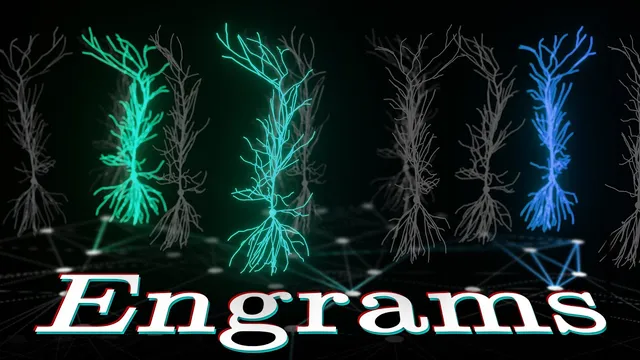
Engrams are sparse neuron ensembles whose activity is required for recall of a specific learned association, and activating them can trigger recall without the original cue.
Briefing
Memory is stored as physical “engram” changes in specific neuron ensembles, and those ensembles can be tagged, reactivated, and even manipulated to determine whether a memory is actually recalled. The central takeaway is that memory recall depends on the activity of the very neurons allocated during learning—not just on the brain’s general response to a cue—and that the brain links separate memories by overlapping or jointly reactivating their engram populations.
The concept traces back to Richard Semon, who coined “engram” for lasting physical changes produced by learning or experience. Early definitions were vague about biology, but later work established that neurons encode information through electrical activity and synaptic pattern changes. To study memory formation, researchers need both a behavioral readout and a way to monitor cellular changes. Fear conditioning provides a standard behavioral framework: a neutral conditional stimulus (like a tone or context) is paired with an aversive unconditional stimulus (like a mild foot shock). On the next day, freezing in response to the conditional cue indicates that the association was learned and can be retrieved.
At the cellular level, learning triggers rapid activation of immediate-early genes—especially fos and Arc—in neurons undergoing plasticity. Because gene expression itself is hard to measure directly, experiments link fos activation to a fluorescent reporter. One approach uses viral delivery of a fluorescent protein under a promoter matching fos, so neurons engaged during learning “glow” under a microscope. A key limitation is timing: viral spread and recovery can take weeks, making it impossible to know which glowing neurons correspond to the specific fear memory rather than other experiences. To solve this, researchers use engineered tagging systems that can be turned on only during a controlled window—drug-activated “tagging” during training—so only the neurons recruited to that particular memory are labeled.
With tagged engram cells in hand, “tag-and-manipulate” experiments test causality. During recall, the same engram population reactivates when the conditional stimulus is presented. Crucially, suppressing or killing those tagged neurons during the test trial abolishes freezing for that trained fear memory, while leaving other memories intact. Conversely, activating the engram neurons without the cue is sufficient to trigger freezing. Similar results appear in reward-based paradigms, suggesting the engram mechanism generalizes beyond fear.
Engram formation is sparse and region-dependent: in the amygdala, roughly 10–20% of responsive neurons join a given engram, while in the dentate gyrus the fraction is lower (about 2–6%). Even more striking, engram size stays conserved across different memories and stimulus strengths, implying internal constraints on how many neurons can be recruited. Evidence points to competition driven by intrinsic excitability: neurons with higher readiness to fire are more likely to be allocated. Inhibitory microcircuits help enforce this competition; blocking inhibitory interneurons increases engram size.
Engrams are also distributed. Using tissue clearing and whole-brain imaging, a single fear memory has been found across multiple regions, including hippocampus and amygdala as well as thalamus, hypothalamus, and brainstem—supporting an “engram complex” rather than a single storage site. Finally, memories become linked through overlap: when two memories are learned within a few hours, shared excitability windows cause overlapping engram populations, so extinguishing one weakens the other. When memories are separated by longer intervals, overlap drops and the memories can be extinguished independently. Separate engrams can also be coupled later through “core retrieval,” where simultaneous reactivation reorganizes traces so that one cue can trigger recall of the relationship between experiences (even if the individual contents remain intact).
Cornell Notes
Memory traces (“engram” ensembles) are physical changes in sparse groups of neurons allocated during learning. Immediate-early genes such as fos and Arc mark neurons undergoing plasticity, and tagging systems can link that activation to fluorescent reporters only during a controlled training window. When those tagged engram neurons are suppressed, fear recall fails; when they are activated without the cue, recall can be induced—showing engram activity is necessary and sufficient. Engrams are sparse and conserved in size across memories, likely due to competition shaped by intrinsic excitability and local inhibitory circuits. Memories also link when engram populations overlap (via excitability windows) or when separate engrams are repeatedly co-reactivated (core retrieval), creating shared neurons that encode the association between experiences.
What makes an engram “causal” for memory recall rather than just correlated activity?
How do immediate-early genes like fos and Arc help identify neurons involved in memory encoding?
Why does simple viral tagging fail for fear conditioning experiments, and how do timing-controlled systems fix it?
What determines which neurons are recruited into an engram if many neurons respond to an experience?
How can a single memory be stored across the brain rather than in one location?
How do memories become linked—what does “overlap” mean in practice?
Review Questions
- What experimental results demonstrate that engram neuron activity is both necessary and sufficient for recall?
- How do intrinsic excitability and inhibitory microcircuits contribute to the conserved sparsity of engrams?
- Describe two mechanisms for linking memories and explain how timing or co-retrieval changes engram overlap.
Key Points
- 1
Engrams are sparse neuron ensembles whose activity is required for recall of a specific learned association, and activating them can trigger recall without the original cue.
- 2
Immediate-early genes such as fos and Arc serve as molecular markers of neurons undergoing learning-related plasticity, enabling tagging strategies that visualize encoding cells.
- 3
Viral fluorescent tagging alone suffers from timing ambiguity; drug-controlled, transient tagging windows isolate neurons recruited during a chosen training session.
- 4
Engram size is conserved across different memories and stimulus strengths, suggesting internal constraints on allocation, with intrinsic excitability and inhibitory microcircuits driving competition.
- 5
Engrams are distributed across many brain regions, supporting an engram complex model rather than a single memory storage site.
- 6
Memory linkage can be encoded by overlap between engram populations when excitability windows overlap, or by core retrieval that co-reactivates separate engrams to create shared neurons.