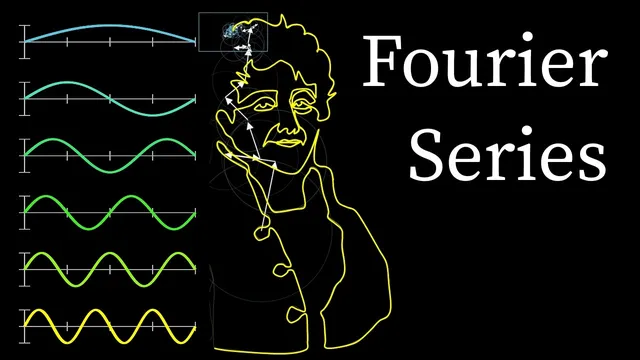
But what is a Fourier series? From heat flow to drawing with circles | DE4
Based on 3Blue1Brown's video on YouTube. If you like this content, support the original creators by watching, liking and subscribing to their content.
The heat equation’s linearity lets solutions be built by adding and scaling frequency-based solutions.
Briefing
Fourier series turn a messy, real-world initial condition—like a discontinuous step in temperature—into a controlled sum of simple, rotating components. The payoff is practical and conceptual: once a function is decomposed into frequency components, linear dynamics such as the heat equation become predictable because each frequency evolves independently, typically decaying at a rate tied to its frequency. That independence is what lets a swarm of rotating arrows trace out a target shape over time, and it’s why Fourier’s idea became foundational far beyond heat.
The story begins with the heat equation on a rod. When the initial temperature profile is a cosine wave tuned to satisfy boundary conditions, the solution is easy: the wave’s amplitude shrinks exponentially as time passes, and higher-frequency waves decay faster than lower-frequency ones. Linearity is the key structural property—solutions can be added and scaled—so any initial condition that can be written as a sum of such cosine waves can be evolved by evolving each wave separately. As time goes on, the faster-decaying high-frequency terms fade, leaving a smoother, low-frequency shape. In other words, the heat equation’s smoothing effect is encoded in the different decay rates of the frequency components.
That raises the central challenge Fourier tackled: most realistic initial conditions don’t look like tidy sine or cosine waves. A classic example is two rods brought into contact at opposite temperatures, producing a step function: flat at 1 on one side, flat at −1 on the other, with a jump discontinuity. Despite the step’s obvious mismatch with smooth oscillations, Fourier showed it can be represented as an infinite series of sine/cosine terms (subject to boundary conditions). For the step function, the coefficients follow a pattern involving odd frequencies—1, −1/3, 1/5, −1/7, and so on—scaled by 4/π. The representation is exact only in the infinite-sum sense: partial sums never perfectly match the discontinuity, but the limit does, with a subtle convention at the jump point.
To make the computations cleaner and to set up later tools, the discussion generalizes from real-valued functions to complex-valued functions that can be viewed as drawings in the complex plane. In this broader picture, each “frequency component” becomes a rotating vector on the unit circle. The fundamental building block is the complex exponential e^{i t}, which traces circles as t increases. A general Fourier decomposition expresses an arbitrary function f(t) (for t in [0,1]) as an infinite sum of terms c_n e^{2π i n t}, where the complex coefficients c_n determine the initial magnitudes and angles of each rotating vector.
Finding each coefficient becomes a clever filtering operation. The constant term c_0 is obtained by averaging f(t) over the interval, because every rotating non-constant term completes whole cycles and averages to zero. To extract c_n for any integer n, f(t) is multiplied by e^{−2π i n t} before averaging; this “freezes” the nth component while forcing all others to rotate through full cycles, again averaging them away. The resulting integral formula is the engine behind the animations: given a path (often imported from an SVG), the computer numerically approximates these integrals for a finite range of n, then reconstructs the drawing by summing the corresponding rotating vectors. As the number of vectors increases, the approximation converges toward the original path.
The heat-equation example and the rotating-vector framework converge on one larger lesson: exponential functions—especially complex exponentials—are the natural language for solving linear differential equations. Fourier series are not just a trick for oscillations; they’re a systematic way to break complicated behavior into components that evolve predictably under linear dynamics.
Cornell Notes
Fourier series decompose an arbitrary function into a sum of frequency components, each represented by a rotating vector (or equivalently, a complex exponential). For the heat equation, this matters because linearity lets each frequency evolve independently: higher frequencies decay faster, so solutions smooth out over time. Even a discontinuous step function—like the temperature jump when two rods at +1 and −1 are joined—can be written exactly as an infinite sine/cosine series with coefficients that fall off like 1/(odd frequency), scaled by 4/π. The complex-number formulation makes coefficient-finding systematic: multiply by e^{−2π i n t} and average over t to isolate c_n. In practice, animations approximate the infinite sum using finitely many n values, improving accuracy as more vectors are included.
Why does the heat equation smooth temperature distributions over time?
How can a discontinuous step function be represented using sine or cosine waves?
What changes when the decomposition is extended from real-valued functions to complex-valued functions?
How does multiplying by e^{−2π i n t} help isolate the coefficient c_n?
What does the coefficient c_0 represent in the rotating-vector picture?
How do animations approximate a Fourier series in practice?
Review Questions
- In the heat-equation setting, what specific property of the PDE makes it possible to evolve a complicated initial condition by evolving each frequency component separately?
- Why can’t a finite Fourier sum exactly reproduce a discontinuity, and what changes when the sum becomes infinite?
- In the complex-exponential formulation, what operation on f(t) isolates a particular coefficient c_n, and why do the other coefficients vanish under averaging?
Key Points
- 1
The heat equation’s linearity lets solutions be built by adding and scaling frequency-based solutions.
- 2
Cosine (frequency) components decay exponentially under the heat equation, with higher frequencies decaying faster and producing smoothing over time.
- 3
A discontinuous step function can still be represented exactly by an infinite Fourier series with coefficients that follow an odd-frequency pattern (scaled by 4/π).
- 4
Complex Fourier series interpret each frequency component as a rotating vector, with complex exponentials e^{2π i n t} as the basis functions.
- 5
Fourier coefficients can be extracted by multiplying f(t) by e^{−2π i n t} and averaging over t, which filters out all other frequencies.
- 6
Numerical approximations compute finitely many coefficients (via discretized integrals) and reconstruct the target path by summing the corresponding rotating vectors; accuracy improves as more terms are included.