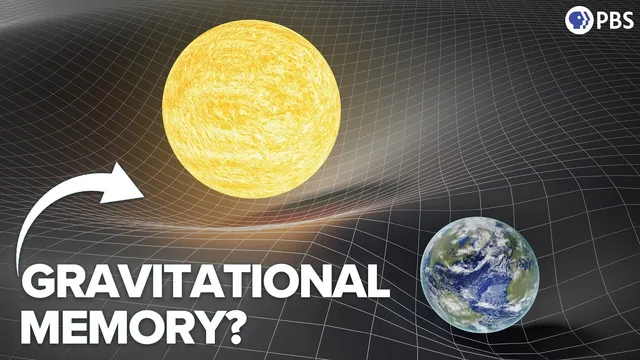
Can Space Time Remember?
Based on PBS Space Time's video on YouTube. If you like this content, support the original creators by watching, liking and subscribing to their content.
Gravitational memory refers to lasting changes in spacetime after a gravitational wave passes, meaning spacetime does not fully return to its original state.
Briefing
Gravitational waves may leave permanent “memory” in spacetime—tiny, lasting changes in how distances and motions line up after the wave has passed. Unlike the familiar oscillatory ripples detected by LIGO and Virgo, which largely return spacetime to its original state, a non-oscillatory component can produce a lasting imprint. If that imprint can be measured, it would not only confirm another prediction of general relativity, but also add new information about the sources of gravitational waves and potentially test whether Einstein’s equations need modification.
In general relativity, spacetime behaves like an elastic medium: masses and energy curve it, and accelerating objects generate gravitational waves. The waves already detected from merging black holes and neutron stars cause distances to oscillate—stretching and squeezing that reverses as the wave passes. But theory also predicts that gravitational waves can carry a “drag” effect, analogous to how a tsunami moves water and forces objects to follow its flow rather than merely bobbing up and down. That non-oscillatory component can leave behind a permanent displacement of matter relative to its original configuration.
Gravitational memory comes in multiple forms. One is the displacement memory effect: stars in a ring surrounding the wave’s axis may end up in a slightly warped configuration even after the wave has gone, rather than returning to a perfect circle. Another is a velocity kick memory effect, where the stars continue moving after the passage, reflecting a lasting change in their velocities. More subtle variants include gravitational “speed memory,” which can impart angular momentum along the wave’s path. Together, these effects represent spacetime failing to fully return to its initial state after the passage of a gravitational wave.
Detecting memory is difficult because the effect is extremely small and current detectors are not optimized for it. LIGO’s arms are anchored to Earth’s solid ground—metal, concrete, and the elasticity of the apparatus itself—so any tiny lasting spacetime change is likely to be suppressed or masked. LIGO and Virgo also operate at higher frequencies than where memory signals are expected to stand out. Even if memory exists in individual events, it may only become visible after many observations are combined.
A new observatory could change that. The Laser Interferometer Space Antenna (LISA), led by the European Space Agency and planned for launch in 2035, will use three spacecraft in a triangular formation separated by about 22 million kilometers. In space, free from the mechanical “pullback” of a rigid Earth-bound structure, LISA is designed to be sensitive to low-frequency gravitational waves—exactly where displacement memory should be detectable. Simulations of supermassive black hole mergers suggest the memory signal is strongest near the merger and persists afterward, producing a measurable offset in the detector’s strain even if an absolute permanent displacement cannot be directly measured.
If gravitational memory is observed, it would provide a robust, inevitable test of general relativity’s nonlinear structure. It could also help probe alternatives to Einstein’s gravity—especially modified gravity ideas that introduce nonlinear curvature terms to explain phenomena like dark matter. Beyond tests of gravity, memory could improve how analysts infer the properties of gravitational-wave sources, and it may even reveal the accumulated imprint of ancient gravitational waves from the early universe, including those potentially generated by cosmic inflation. In that sense, spacetime’s “memory” could become a new cosmic archive—one written in subtle, lasting warps and shifts rather than in the passing oscillations alone.
Cornell Notes
Gravitational waves are not only oscillatory ripples; they can also leave a permanent “memory” in spacetime. General relativity predicts several memory effects, including displacement memory (a lasting warp in relative positions) and velocity kick memory (stars keep moving after the wave). These signals are expected to be far weaker than the oscillations already detected by LIGO and Virgo, and current ground-based detectors are poorly suited to measure them. LISA, a space-based laser interferometer planned for launch in 2035, is designed to detect low-frequency gravitational waves and should be able to measure displacement memory from supermassive black hole mergers. Detecting memory would strengthen tests of Einstein’s nonlinear gravity and could help distinguish general relativity from modified gravity models, while also improving inference about gravitational-wave sources.
What does “gravitational memory” mean in physics, and how is it different from the gravitational waves LIGO and Virgo detect?
How do displacement memory and velocity kick memory differ in their observable effects?
Why are current detectors like LIGO and Virgo unlikely to measure memory from individual events?
What makes LISA better positioned to detect gravitational memory?
How could detecting gravitational memory test general relativity versus modified gravity?
What additional information might memory provide beyond the standard oscillatory waveform?
Review Questions
- If a gravitational wave produces only oscillatory stretching and squeezing that fully reverses, which type of memory effect would be absent—and why?
- What specific detector characteristics (frequency range and mechanical environment) make LISA more suitable than LIGO for memory measurements?
- How could a discrepancy between observed and predicted nonlinear gravitational memory point toward modified gravity rather than just experimental noise?
Key Points
- 1
Gravitational memory refers to lasting changes in spacetime after a gravitational wave passes, meaning spacetime does not fully return to its original state.
- 2
Displacement memory leaves a permanent geometric offset (e.g., a ring of stars becomes warped rather than perfectly circular).
- 3
Velocity kick memory leaves lasting motion, with stars continuing to move after the wave’s passage.
- 4
LIGO and Virgo are challenged by the weakness of memory signals, the elastic restoring forces of Earth-bound hardware, and sensitivity to higher frequencies than where memory is expected to stand out.
- 5
LISA’s space-based, low-frequency design is intended to detect displacement memory from supermassive black hole mergers, with simulations suggesting detectability near merger.
- 6
Detecting memory would provide a robust test of general relativity’s nonlinear predictions and could help distinguish Einstein gravity from modified gravity models.
- 7
Memory effects could also improve parameter inference for gravitational-wave sources and may preserve imprints of primordial gravitational waves from the early universe.