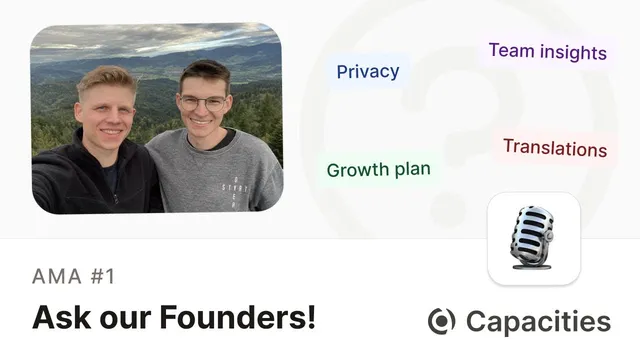
Capacities AMA with Steffen and Michael!
Based on Capacities's video on YouTube. If you like this content, support the original creators by watching, liking and subscribing to their content.
Capacities is designed around a “studio for your mind” experience that prioritizes individual knowledge work, not a team/business replacement strategy.
Briefing
Capacities positions itself less as a Notion replacement and more as a “studio for your mind”—a calm, intuitive workspace for individuals to connect ideas, process information, and turn it into output. The core pitch is a middle layer: not just storing notes, but linking content from multiple sources, contemplating and reflecting on it, and then expressing ideas through writing or other forms. The team argues that many existing note systems create friction through heavy structure (tables, folders, complex setups), so Capacities starts from a more natural network-of-ideas approach.
A major theme is what Capacities refuses to be. It’s not designed as an all-purpose tool for teams or businesses, and it avoids becoming a one-tool-fits-everyone platform with endless customization. Instead, it aims to stay simple enough that people can actually get work done—while still supporting different media types and workflows for modern knowledge work. The product’s philosophy is that freedom without clarity can slow users down, so the interface and flow should minimize decision-making while still letting people work in their own way.
On the practical side, the company emphasizes export and portability: users can export content to other apps and even to analog formats like PDF. Sharing is treated as a sensitive capability because it’s also where misuse can occur. The team describes having already dealt with phishing-style attacks created via the share feature by temporarily disabling sharing for new accounts (a measure that reportedly drove those attacks to zero) and removing harmful content quickly when detected.
Capacities also frames its roadmap around sustainability, privacy, and selective AI use. The company is fully bootstrapped and says subscriber plans (including “Believer” and “pro”) make it fully sustainable, which it credits for long-term planning freedom—without chasing quarterly growth targets or raising capital. Privacy is presented as a core value under GDPR compliance, with encryption discussed as a staged approach: encryption for individual nodes is viewed as a workable trade-off that preserves features like full-text search and easy sharing, while full end-to-end encryption for all content is not planned in the near term.
AI integration is treated with similar restraint. The guiding principle is that AI should be used only when it’s useful, not everywhere, and should support users rather than replace them. Features like AI auto-fill for properties are cited as examples of “micro intelligence” that helps without flooding users with generated content. The longer-term direction is increasing AI context awareness—such as summarizing PDFs and continuing work across multiple documents and notes—but the team avoids promising a single “holy grail” feature.
Finally, the AMA ties the product’s evolution to its origin story: Capacities began as a side and research project during university, later launched as a public beta in January 22, and became a full-time commitment after funding and subscriber support. The company credits close user relationships for iteration speed and says it’s building with a small, remote team that works largely through one-on-one collaboration and minimal meetings. The overall message: Capacities is building a personal knowledge workspace that feels welcoming and productive, then extending it carefully—through exports, privacy controls, and pragmatic AI—toward a more powerful “studio” for learning and idea work.
Cornell Notes
Capacities is built around a “studio for your mind” concept: a calm, intuitive workspace where individuals connect ideas, process information, and turn it into output. The product emphasizes a middle layer—linking content from different sources, reflecting on it, and then expressing work—rather than acting as a folder-and-table system. The team says it’s not aiming to become a Notion clone or a team/business solution; it avoids heavy customization and keeps the interface simple so people can actually get work done. Export and portability are central (including PDF export), while privacy is handled through GDPR compliance and a staged encryption approach (encryption for individual nodes, not full end-to-end for everything). AI is planned as a support tool used only when useful, with longer-term work focused on expanding AI context awareness across notes and documents.
Why does Capacities describe itself as more than a Notion alternative?
What does “studio for your mind” mean in practical product terms?
How does Capacities handle portability and sharing?
What privacy stance is described, and what encryption is planned?
How is AI integration approached—especially given the risk of “AI everywhere”?
What business model choices are tied to product decisions?
Review Questions
- How does Capacities’ “middle layer” workflow differ from a folder/table-first note system, and why does the team think that matters?
- What trade-offs does the team describe between simplicity and customization, and how does that shape the user experience?
- Which principles guide AI use in Capacities, and what longer-term technical direction is mentioned for AI context awareness?
Key Points
- 1
Capacities is designed around a “studio for your mind” experience that prioritizes individual knowledge work, not a team/business replacement strategy.
- 2
The product’s core workflow emphasizes a middle layer: linking ideas from multiple sources, then processing through reflection before producing output.
- 3
The team rejects heavy customization and plugin-style extensibility because they can undermine simplicity and intuitive flow.
- 4
Portability is a priority, with exports to other apps and analog formats like PDF, while sharing is treated as a security-sensitive feature.
- 5
Privacy is framed around GDPR compliance and a staged encryption plan, including encryption for individual nodes rather than full end-to-end encryption for all content.
- 6
AI is positioned as a support tool used only when useful, with longer-term plans focused on expanding AI context awareness across notes and documents.
- 7
The company credits its bootstrapped, subscriber-funded model for long-term product planning and close user feedback loops.