Categorical Independent Variable in Mediation Relationship using #SmartPLS4
Based on Research With Fawad's video on YouTube. If you like this content, support the original creators by watching, liking and subscribing to their content.
Organization type is coded as 0 (public sector) and 1 (private sector) and used as a categorical independent variable in a mediation model.
Briefing
The analysis tests whether organizational commitment acts as a mediator between organization type (public vs. private) and collaborative culture, using SmartPLS4 with a categorical independent variable. Organization type is coded as 0 for public sector and 1 for private sector, and the model links type → organizational commitment → collaborative culture. The key question is whether differences in collaborative culture across public and private organizations can be explained through differences in employees’ organizational commitment.
Before running mediation bootstrapping, the workflow includes a PLS-SEM measurement check (PLS SCM algorithm) for the latent constructs that have multiple indicators—organizational commitment and collaborative culture. Because the independent variable is categorical (type of organization with two categories), it is not included in the measurement model assessment; the focus stays on the reliability and validity of the latent constructs that are measured with indicators.
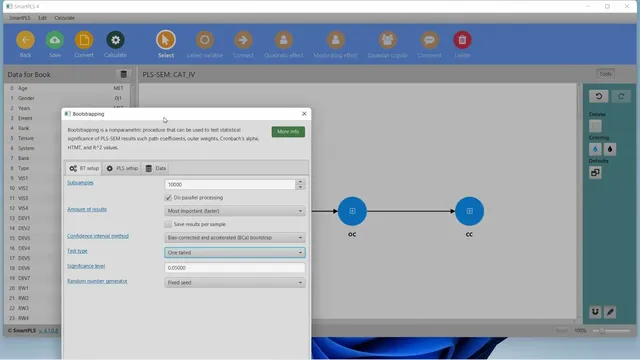
Bootstrapping is then run with 10,000 resamples to evaluate significance of the direct and indirect effects. The analysis uses a one-tailed testing approach, reflecting prior assumptions about the direction of relationships: employees in public sector organizations are expected to show higher organizational commitment, and higher organizational commitment is expected to improve collaborative culture. With these directional hypotheses in place, the results show that the path from organizational commitment to collaborative culture is positive and statistically significant—meaning higher commitment corresponds to higher collaborative culture.
Mediation is assessed through the indirect effect of organization type on collaborative culture via organizational commitment. The mediation result is significant, indicating that organizational commitment indeed mediates the relationship between organization type and collaborative culture. Importantly, the mediation effect is reported as negative. In this coding scheme, the negative sign is interpreted relative to the category ordering: it points to the lower category, which corresponds to public sector (coded as 0). Put simply, the sign indicates that public sector organizations have higher organizational commitment than private sector organizations.
Putting the pieces together, the model supports the hypothesis that organizational commitment mediates the type-of-organization effect on collaborative culture, and it identifies the direction of the difference: employees in public sector organizations exhibit higher organizational commitment, which in turn is associated with improved collaborative culture. Both the direct paths involved in the mediation chain and the specific indirect effects are significant, substantiating the proposed mechanism.
Cornell Notes
SmartPLS4 is used to test mediation with a categorical independent variable: organization type (public sector = 0, private sector = 1). The model tests whether organizational commitment mediates the relationship between organization type and collaborative culture. After running the PLS SCM algorithm for the measured latent constructs (excluding the categorical predictor from the measurement assessment), bootstrapping with 10,000 resamples evaluates significance. The path from organizational commitment to collaborative culture is positive and significant, and the indirect (mediated) effect of organization type on collaborative culture through commitment is also significant. The mediation effect’s negative sign is interpreted using the coding: it indicates the lower category (public sector) has higher organizational commitment than the private sector, which aligns with higher collaborative culture.
Why is the categorical independent variable excluded from the measurement model assessment in PLS SCM?
What does bootstrapping with 10,000 resamples accomplish in this mediation test?
How does the sign of the mediation effect get interpreted with the 0/1 coding of organization type?
What do the results say about the relationship between organizational commitment and collaborative culture?
What exactly is being tested by the mediation results, and what does “significant mediation” mean here?
Review Questions
- In a mediation model with a categorical predictor coded 0/1, how should you interpret a negative indirect effect sign?
- Which constructs should be included in the PLS SCM measurement assessment when the predictor is categorical, and why?
- What combination of path results is needed to support the claim that organizational commitment mediates the organization-type effect on collaborative culture?
Key Points
- 1
Organization type is coded as 0 (public sector) and 1 (private sector) and used as a categorical independent variable in a mediation model.
- 2
PLS SCM measurement assessment is run only for latent constructs with indicators (organizational commitment and collaborative culture), not for the categorical predictor.
- 3
Bootstrapping with 10,000 resamples is used to test the significance of mediation (indirect effects).
- 4
The path from organizational commitment to collaborative culture is positive and significant, linking higher commitment to higher collaborative culture.
- 5
The indirect effect of organization type on collaborative culture through organizational commitment is significant, confirming mediation.
- 6
The negative sign on the mediation effect is interpreted through coding: it indicates public sector organizations (coded 0) have higher organizational commitment than private sector organizations.