Caterpillar Creating A Culture of Employee Engagement
Based on APQC's video on YouTube. If you like this content, support the original creators by watching, liking and subscribing to their content.
Caterpillar treats engagement as a business metric tied to culture and leadership behavior, not a standalone HR initiative.
Briefing
Caterpillar’s employee engagement push treats engagement as a measurable, business-critical system—not a standalone HR program. Over an eight-year journey, the company defined engagement in ways that translate globally, embedded it into core talent and business processes, and used disciplined measurement and leader action to drive sustained improvements—rising from about one in two employees engaged to more than four in five.
A central lesson from the company’s approach is that engagement depends on culture and behavior, not slogans. Engagement is framed as employees’ commitment, effort, and loyalty, and leaders are taught to move beyond “compliance” (doing what’s required) toward “commitment” (believing in what’s being done). Caterpillar also uses a behavioral blueprint for leaders, emphasizing that employees’ perceptions shape day-to-day actions that ultimately affect business performance, brand, and culture.
To make engagement actionable across regions, Caterpillar avoided relying on the word “engagement” alone, since it didn’t translate well. Instead, it anchored the concept in worldwide drivers and split engagement into rational and emotional components. The rational side includes fundamentals such as competitive wages and benefits, safety, and tools and training. The emotional side is taught through “triple I”—identity, importance, and impact. Leaders are expected to help employees understand what it means to be a Caterpillar employee (identity), why following policies and values matters (importance), and how individual roles connect to real-world outcomes like building infrastructure and supporting communities after disasters (impact).
Caterpillar’s strategy then links engagement to the full talent lifecycle and major business processes. Engagement is integrated into recruiting and selection, training and development, rewards and retention, performance management, succession planning, and employment branding. It also shows up in learning initiatives, diversity and inclusion efforts, non-financial recognition, and succession decisions. A key operational principle is that leaders can’t delegate engagement to HR; it must be reinforced through everyday management.
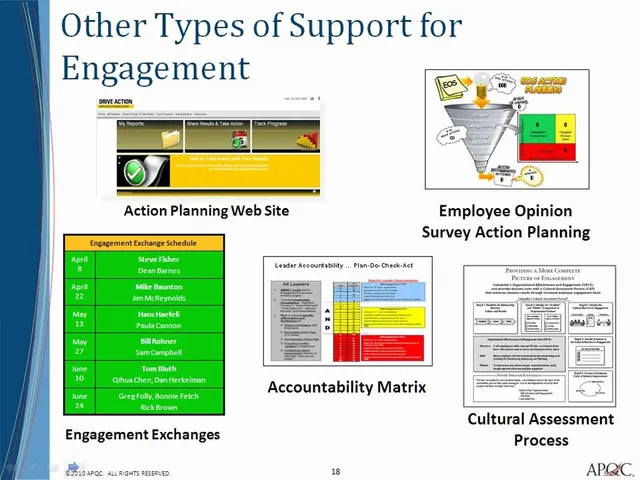
The company’s measurement system centers on an annual employee opinion survey, with 11 engagement-focused questions inside a larger instrument. Participation is voluntary and reported at 94%, delivered electronically in 15 languages. Crucially, Caterpillar treats survey follow-through as the engagement lever. Correlation studies inside the organization show large engagement gaps when employees report receiving feedback, seeing tangible actions, and experiencing genuine interest from their immediate supervisor. Leaders follow a six-step action cycle—share information, solicit ideas, create a short plan, confirm it, update progress at least every 30 days, and complete the plan.
Caterpillar also uses six sigma-style discipline to connect engagement to business outcomes, emphasizing correlation rather than claiming a simple cause-and-effect button. Engagement correlates with absenteeism, attrition, grievances in union facilities, and safety and quality metrics. The company reports a $75 million-plus improvement over two years attributed to engagement gains supported by six sigma tools.
Finally, engagement is reinforced through governance and incentives: engagement has become a top-tier business metric, is embedded in values and action, and is included in officer compensation targets and performance evaluations. Non-financial recognition—such as the chairman’s recognition award for engagement—adds visibility and prestige. The overall message is that engagement becomes durable only when it’s built into leadership competencies, talent management systems, and the daily “blocking and tackling” of communications, learning, performance management, leadership modeling, measurement with feedback, fair policies, selection criteria, decision-making authority, and clear reward explanations.
Cornell Notes
Caterpillar’s engagement strategy treats employee engagement as a business-critical system built into culture and day-to-day leadership. Engagement is defined as employees’ commitment, effort, and loyalty, and leaders are trained to move teams from compliance to commitment using “triple I” (identity, importance, impact). The company links engagement to talent management and major business processes, then measures it annually through an employee opinion survey with 11 engagement questions. The biggest gains come from what leaders do afterward: employees report higher engagement when they receive feedback, see tangible actions, and feel genuine interest from their immediate supervisor. Caterpillar reinforces the work through structured leader action steps, non-financial recognition, officer compensation targets, and six sigma-style correlation studies connecting engagement to outcomes like absenteeism, attrition, safety, and quality.
How does Caterpillar define “employee engagement,” and why does it matter for global consistency?
What is “triple I,” and how is it supposed to change leader behavior?
Why does Caterpillar emphasize a six-step action process after the employee opinion survey?
What does Caterpillar’s employee opinion survey look like, and how is it used?
How does Caterpillar connect engagement to business outcomes without claiming simple causation?
What role do rewards and governance play in sustaining engagement?
Review Questions
- What does Caterpillar’s engagement definition (commitment, effort, loyalty) imply about what leaders must manage day to day?
- Which parts of Caterpillar’s approach are designed to convert survey results into behavior change, and what evidence is used to justify that emphasis?
- How do “triple I” and the 60/40 survey split work together to make engagement both emotional and operational?
Key Points
- 1
Caterpillar treats engagement as a business metric tied to culture and leadership behavior, not a standalone HR initiative.
- 2
Engagement is defined as commitment, effort, and loyalty, and leaders are trained to move teams from compliance to commitment.
- 3
The emotional side of engagement is operationalized through “triple I” (identity, importance, impact), supported by leader storytelling.
- 4
Engagement is integrated across the talent lifecycle and major business processes, including learning, performance management, succession planning, and non-financial recognition.
- 5
The annual employee opinion survey is only the start; leader follow-through drives results through a six-step action cycle and at-least-30-day updates.
- 6
Caterpillar uses correlation studies (six sigma discipline) to link engagement to outcomes like absenteeism, attrition, safety, and quality rather than claiming simple causation.
- 7
Officer compensation targets and non-financial awards reinforce engagement so it remains a sustained leadership priority.