Change Management For Knowledge Management
Based on APQC's video on YouTube. If you like this content, support the original creators by watching, liking and subscribing to their content.
KM adoption depends on employee behavior change, so technology rollouts need a deliberate change strategy that addresses people, process, and incentives.
Briefing
Knowledge management succeeds or fails less on the strength of its tools and more on whether employees change how they work—especially as knowledge, technology, and business priorities keep shifting. That’s why change management is treated as a core requirement for KM: moving from “need to know” sharing or knowledge hoarding toward open collaboration demands deliberate planning, ongoing reinforcement, and alignment with business strategy.
The case for urgency is reinforced by how organizations are experiencing both an explosion of explicit knowledge and persistent friction in accessing the right expertise. More data is being captured and more knowledge assets are being created—emails, spreadsheets, documents, Wiki articles—yet many teams struggle to process, curate, and reuse that information instead of getting buried by it. At the same time, tacit knowledge (what lives in people’s heads) is harder to locate as work becomes more global and remote, informal networks become less visible, and the pace of organizational change accelerates.
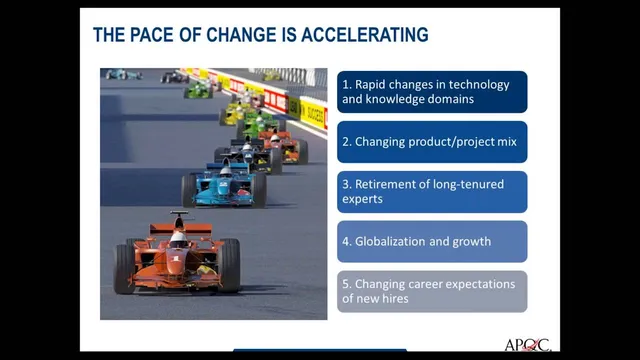
APQC research frames today’s expertise shortages as less about demographics and more about rapid change in knowledge and technology domains. The biggest driver cited is the speed at which knowledge and technology evolve, followed by the complexity of the product and project mix that forces broader expertise and integrated problem-solving. Globalization and shifting career expectations—where employees may stay only five to seven years—also mean knowledge moves faster and organizations must continually rebuild their internal capability.
Against that backdrop, KM implementations often stumble when they chase technology as a panacea—replacing share drives with SharePoint, launching an internal video channel, and expecting adoption to follow automatically. The stronger pattern in APQC’s KM capability research is that formal change management strategies materially improve outcomes. Organizations with KM change management are more likely to standardize knowledge capture and sharing approaches enterprise-wide, which not only improves efficiency but also increases cross-silo knowledge flow. They also become far more likely to identify and address barriers to knowledge sharing and use—ranging from weak sponsorship and time pressure to cultural mismatches and misaligned reward structures.
A successful KM change strategy typically includes eight recurring traits: visible top leadership support; starting with small pilot projects before scaling; recruiting KM champions from end users; balancing central support with local flexibility; comprehensive awareness and training; multi-channel communications supported by a distinctive brand; rewards and recognition integrated into performance management; and performance measures tied directly to knowledge outcomes. Training works best when it explains the business “why,” teaches employees how to use KM tools, and uses engaging formats—scavenger hunts, role-based sessions, and informal “office hours.” Communications should be treated like an advertising campaign, not a one-time email blast; only a minority of studied organizations had formal communication plans.
Finally, KM’s value extends beyond day-to-day adoption. Strong knowledge sharing networks and facilitated communication can reduce obstacles to organizational agility and help organizations manage large-scale change—mergers, reorganizations, and major shifts in how products and services are delivered. In examples such as Baker Hughes, KM networks and crowdsourcing tools support the human side of transformation by helping the organization communicate, reinforce new behaviors, and align knowledge practices with the new structure.
Cornell Notes
KM adoption hinges on behavior change, not on technology alone. As knowledge and technology domains shift rapidly—and work becomes more global and remote—organizations face expertise shortages and struggle to reuse both explicit and tacit knowledge. APQC’s research links formal KM change management to better standardization, stronger cross-silo knowledge flow, and a higher likelihood of systematically removing barriers such as weak sponsorship, time constraints, cultural friction, and misaligned rewards. Effective strategies combine top leadership support, pilots that scale, business-unit champions, central guidance with local flexibility, targeted training and communications with clear branding, and performance measures that reward knowledge outcomes. This approach also strengthens organizational agility during major transformations like mergers and reorgs.
Why does KM need a change management strategy even when new tools are introduced?
What’s driving expertise shortages, and how does that shape KM priorities?
How do pilots improve KM change outcomes?
What role do KM champions play, and how are they cultivated?
How should rewards, recognition, and performance measures be designed for KM?
How does KM help during large-scale organizational change?
Review Questions
- Which barriers to knowledge sharing are most likely to block KM adoption, and how can a change strategy address them systematically?
- What criteria make a KM pilot project “scalable,” and why does timing (e.g., 3–6 months) matter?
- How can performance measures unintentionally discourage knowledge sharing, and what alternative measurement approach would encourage reuse across units?
Key Points
- 1
KM adoption depends on employee behavior change, so technology rollouts need a deliberate change strategy that addresses people, process, and incentives.
- 2
Expertise shortages are driven primarily by rapid changes in knowledge/technology and by increasing complexity of projects—not just by demographics.
- 3
Formal KM change management improves enterprise standardization and increases cross-silo knowledge flow by reducing local fragmentation.
- 4
Successful KM change strategies start with small pilots, select pilots aligned to executive priorities, and scale only after capturing lessons learned.
- 5
KM champions and advocates—often embedded in business units—are essential for sustained adoption and for translating KM value into day-to-day work language.
- 6
Training and awareness should explain the business “why,” teach tool usage, and use engaging formats plus informal support like office hours.
- 7
Rewards, recognition, and performance measures must align with knowledge outcomes; misaligned metrics can actively discourage sharing.