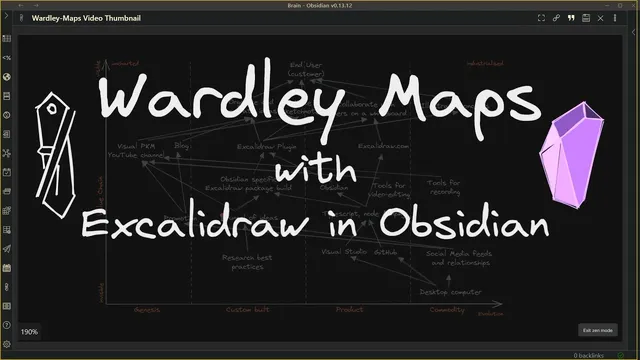
Convert Obsidian into a Workbench for Strategic Planning with Wardley Maps and Excalidraw
Based on Zsolt's Visual Personal Knowledge Management's video on YouTube. If you like this content, support the original creators by watching, liking and subscribing to their content.
Wardley mapping translates a system’s value chain into a shared visual blueprint anchored on customer visibility.
Briefing
Wardley mapping is presented as a practical workbench for strategic planning: it turns a messy business landscape into a shared, visual blueprint of how a system delivers value—and then guides choices about what to do next. The core idea is to sketch a work system (a business, market, or service) by placing customer-facing needs and the people who benefit at the top, then tracing the value chain down to the underlying chain of needs that makes those offerings possible. That structure matters because it forces teams to align on a common understanding of the landscape before debating strategy, and it anchors decisions to what customers can actually see.
The framework also links strategy to two organizing principles. First, the “true north” is the customer: what sits higher in the value chain is more visible to end users, while deeper components are less visible and therefore require different management approaches. Second, the horizontal placement signals evolutionary stage—how far a component has progressed from rare and uncertain beginnings to industrialized, standardized commodity. Simon Wardley’s evolution is described in four stages (genesis, custom-built, product, and commodity), with the message that there is no universal playbook. Instead, different stages call for different tactics: in-house agile development fits genesis work, lean practices support product development by emphasizing learning and waste reduction, and six sigma or outsourcing is suited to commodity components.
To make the planning cycle actionable, the transcript ties Wardley mapping to broader strategic thinking. It distinguishes “why” as purpose (winning the game) versus movement (advancing a piece on the chessboard), and it references a strategy cycle associated with John Boyd’s OODA loop and Sun Tzu’s art of war. The map is then extended with three layers of analysis—landscape, climate, and doctrine. “Climatic patterns” are the forces that change the map regardless of actions; the transcript highlights two: everything evolves and no one size fits all, noting that Wardley introduces 30 such patterns. “Doctrine” consists of universal principles that tend to remain useful across contexts; the transcript cites 38 doctrines, including focusing on user needs, using common language, and challenging assumptions through the act of mapping.
Finally, the transcript argues that strategy isn’t only about choosing the right doctrine—it’s about selecting the right “gameplay.” Examples include using open approaches like open source or open data to accelerate evolution, or using patents to ring-fence technology and slow its progression. While pen-and-paper and Post-it notes can work, the practical emphasis shifts to turning maps into living knowledge in Obsidian using Excalidraw. The workflow allows components to become clickable links, supports layered maps, and connects drawings to stored background notes. The transcript recommends starting with a simple map, then using linked resources (including “Wardlepedia”) and importing frequently used patterns, doctrines, and gameplay into a vault for later reference and sharing.
Cornell Notes
Wardley mapping is presented as a strategic planning method that turns a system’s value chain into a visual “blueprint.” Customers anchor the map at the top, and the horizontal position of components signals evolutionary stage—from genesis to commodity—so different parts of the system call for different tactics. The framework adds layers for analysis: climatic patterns (forces like “everything evolves” and “no one size fits all”), doctrine (principles such as focusing on user needs), and gameplay (how to move the system, e.g., open approaches to accelerate evolution or patents to slow it). The transcript then connects this to practical knowledge management by using Excalidraw drawings inside Obsidian, linking map components to notes and additional layers. The result is a reusable workbench for aligning teams and revisiting strategy as conditions change.
How does Wardley mapping structure a system so strategy discussions become more concrete?
Why does “true north” matter in the map, and how does it affect where tactics apply?
What does the map’s horizontal position represent, and what tactics match each evolutionary stage?
What are climatic patterns, doctrine, and gameplay—and how do they work together?
How does using Excalidraw and Obsidian turn a static map into a reusable planning tool?
Review Questions
- If a component is in the genesis stage, what management approach is suggested, and why does evolutionary stage change the recommended tactic?
- How do climatic patterns differ from doctrine, and how might each influence strategic decisions on a Wardley map?
- What does it mean to treat gameplay as the “why of movement,” and give one example of gameplay mentioned in the transcript.
Key Points
- 1
Wardley mapping translates a system’s value chain into a shared visual blueprint anchored on customer visibility.
- 2
The map’s horizontal axis represents evolutionary stage, which determines which tactics fit best (genesis, custom-built, product, commodity).
- 3
Different parts of the value chain require different strategies because there is no one-size-fits-all approach.
- 4
Climatic patterns describe external forces that change the landscape regardless of actions, while doctrine provides broadly useful principles.
- 5
Gameplay focuses on how to move the system—using approaches like open source/open data to accelerate evolution or patents to slow it down.
- 6
Building the map in a tool like Excalidraw inside Obsidian turns it into a living knowledge system through links, layered maps, and reusable pages.