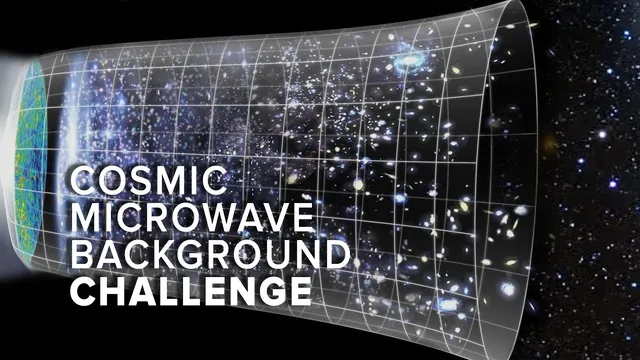
Cosmic Microwave Background Challenge | Space Time | PBS Digital Studios
Based on PBS Space Time's video on YouTube. If you like this content, support the original creators by watching, liking and subscribing to their content.
CMB photons were released around 380,000 years after the Big Bang when the universe cooled enough for hydrogen to form.
Briefing
Cosmic microwave background (CMB) photons offer a direct snapshot of the early universe—released about 380,000 years after the Big Bang when the cosmos cooled enough for hydrogen to form. Before that moment, the universe was filled with a hot plasma of free electrons and nuclei, making it effectively opaque: photons repeatedly scattered off free electrons and couldn’t travel far. Once recombination occurred—electrons captured by protons to form the first hydrogen atoms—the universe became transparent, and the released photons have been streaming through space ever since.
The challenge centers on how far those photons traveled to reach us today, accounting for cosmic expansion. At the time the CMB was emitted, the region that would later become the Milky Way was only about 43 million light-years away from the “patch of space” being observed. But because the universe has expanded dramatically since then, the same patch of space is now much farther from us. By the present day, the structures that those early plasma regions evolve into—galaxies and clusters—are about 1,100 times farther away than they were at emission. That expansion implies an observable universe spanning roughly 93 billion light-years across, so the CMB photons’ journey is far longer than the original physical separation at emission.
The first question in the episode asks for the physical distance the CMB light traveled through an expanding universe to reach us now, intentionally requiring no math. The setup emphasizes that the photons didn’t just cross a fixed distance; they traveled through a universe whose scale factor grew, stretching the path length relative to the original 43 million light-year separation.
The second question turns to the physics just before recombination, when the universe was opaque due to scattering. It asks for the average distance a photon could travel before being scattered by an electron—essentially the photon’s mean free path in a plasma dominated by protons, electrons, and helium nuclei. Solving it requires estimating the baryonic mass and volume of the observable universe, using the CMB redshift, and applying the Thomson Scattering Cross-section. The expected result doesn’t need extreme precision; an order-of-magnitude estimate within about a factor of two is considered acceptable, but the calculations must be shown.
Participants are invited to email their answers to pbsspacetime@gmail.com with the subject line “CMB Challenge” within two weeks. Three correct submissions are selected for each of the two questions, with winners receiving PBS Space Time t-shirts. The episode also includes an announcement about a public seminar on March 14th at Lehman College in New York City related to a new LIGO gravitational-wave discovery, with RSVPs handled via email using the subject line “NYC Gravitational Waves.”
Cornell Notes
CMB photons were released when the universe cooled to about 380,000 years old and recombination turned an opaque plasma into a transparent gas. The episode frames two ways to estimate how far those photons traveled: (1) a conceptual distance through an expanding universe, using the fact that the Milky Way’s later region was ~43 million light-years away at emission but is now ~1,100 times farther, consistent with an observable universe ~93 billion light-years across; and (2) a physics calculation of a photon’s mean free path just before recombination, using baryonic mass/volume estimates, the CMB redshift, and the Thomson Scattering Cross-section. Both questions are designed to be solvable with reasonable approximations, but the second requires explicit calculations.
Why does the universe become transparent at recombination, and how does that relate to the CMB photons’ travel?
At emission, how far was the region that later becomes the Milky Way from the observed CMB patch, and what changes by today?
What does the first challenge question ask for, and why is it “no math required”?
What is the second challenge question’s target quantity, and what physical process sets it?
Which inputs are required to estimate the photon’s mean free path in the second question?
Review Questions
- How do recombination and the drop in free-electron scattering enable the CMB to propagate across the universe?
- Using the given 43 million light-year separation and the 1,100× expansion factor, what present-day distance scale does that imply for the observable region?
- What parameters determine a photon’s mean free path just before recombination, and why does the Thomson Scattering Cross-section matter?
Key Points
- 1
CMB photons were released around 380,000 years after the Big Bang when the universe cooled enough for hydrogen to form.
- 2
Before recombination, free electrons made the universe effectively opaque by scattering photons repeatedly.
- 3
Recombination reduced free electrons by binding them into hydrogen, allowing photons to travel freely and form the CMB.
- 4
The episode uses a reference separation of ~43 million light-years at emission for the Milky Way’s later region.
- 5
Cosmic expansion stretches distances by about a factor of 1,100, aligning with an observable universe roughly 93 billion light-years across.
- 6
The mean free path just before recombination can be estimated using baryonic mass/volume, the CMB redshift, and the Thomson Scattering Cross-section.
- 7
Winning submissions require explicit calculations for the mean-free-path question and must be emailed with the subject line “CMB Challenge.”