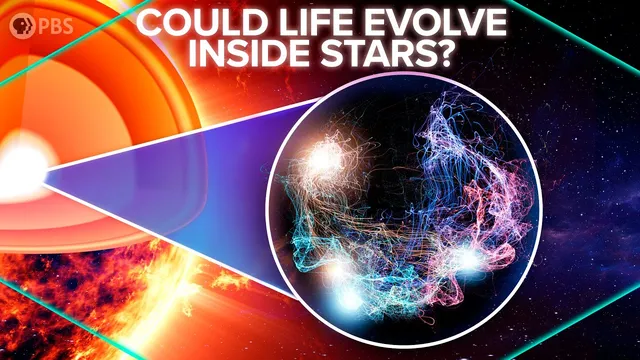
Could Life Evolve Inside Stars?
Based on PBS Space Time's video on YouTube. If you like this content, support the original creators by watching, liking and subscribing to their content.
Topological defects like cosmic strings and magnetic monopoles can arise from early-universe phase transitions and spontaneous symmetry breaking.
Briefing
Life might not need DNA—or even atoms—to get started. A recent physics proposal argues that “topological defects” formed in the early universe could, under the right conditions inside stars, assemble into bead-and-string chains with enough structure to store information, replicate, and tap into stellar free energy—an outline that loosely parallels the three core requirements for life.
The building blocks are cosmic strings and magnetic monopoles: defects that arise when fields undergo phase transitions and “spontaneous symmetry breaking.” In everyday terms, a topological defect is a mismatch that can’t be smoothed away without undoing the whole configuration—like a line that must remain in a fur rug when the ends are forced into incompatible directions. In physics, monopoles act like isolated north or south magnetic poles, while cosmic strings are extremely thin filaments. In some scenarios, monopoles can sit at the ends of strings, forming “beads,” and multiple beads can link into a chain.
Anchordoqui and Chudnovsky focus on whether such chains could behave like a chemistry. The first requirement—information storage—looks bleak for the simplest case. If monopoles come only in two types (north and south), the necklace can only alternate in one pattern, leaving no room for a “language.” The proposal gets traction by invoking more exotic early-universe physics where monopoles split into “semipoles.” With four semipole types (two derived from each original monopole type), the system gains multiple stable configurations—effectively four “letters.” Semipoles also change the interaction rules: unlike monopoles and anti-monopoles, which attract and annihilate, semipoles can form non-annihilating pairs. That opens the door to complex string segments capped by repelling semipole pairs, creating a richer structure reminiscent of how chemical bonds enable diverse molecules.
The second requirement—replication faster than disintegration—depends on star environments. Cosmic-string necklaces are expected to be unstable, but star interiors could provide the turbulence and magnetic/plasma dynamics needed to repeatedly stretch, break, and reconfigure them. The authors suggest that interactions with atomic nuclei might catalyze replication, potentially allowing a necklace to build an identical “parallel” chain that then detaches, similar in spirit to how RNA can reproduce.
The third requirement—free energy—exists naturally in stars. Energy flows from the fusion-powered core toward the surface, and thermodynamics says that usable work requires energy gradients between states. A hypothetical nuclear-life form could, in principle, harness that flow in ways that accelerate entropy production—either by redistributing energy across the electromagnetic spectrum (making the star appear cooler than expected) or by speeding up nuclear reactions that dissipate the star’s energy.
Still, the proposal is speculative and not a claim of discovery. The transcript emphasizes that cosmic strings and monopoles must first be verified, and that any “life-like” effect would need to survive detailed modeling against standard stellar physics. The authors’ main point is narrower but provocative: if life can emerge from other kinds of structure than carbon chemistry, stars could be one of the places where the universe’s physics might make it possible.
Cornell Notes
The proposal by Anchordoqui and Chudnovsky asks whether “nuclear life” could form from cosmic strings and magnetic monopoles inside stars. It treats cosmic-string/monopole chains as potential information carriers, but the simplest monopole setup can’t encode information because only one alternating configuration exists. Introducing semipoles—four types created when monopoles split after symmetry breaking—adds multiple stable configurations (“four letters”) and allows non-annihilating semipole pairs, enabling chemistry-like complexity. Replication is expected to rely on star interiors: turbulence could repeatedly break and reconfigure necklaces, while interactions with atomic nuclei might catalyze copying. Stellar cores also provide free energy via fusion-driven energy gradients, so a life-like system could accelerate entropy production in ways that might alter observable stellar behavior.
Why do cosmic strings and magnetic monopoles count as “topological defects,” and what does that imply about their persistence?
What blocks information storage in the simplest monopole “necklace,” and how do semipoles change the situation?
How does the semipole idea help create chemistry-like complexity rather than just a single repeating chain?
Why are stars central to the replication requirement, and what physical mechanism is suggested?
What does “free energy” mean here, and how could a hypothetical lifeform use it inside a star?
Review Questions
- What specific change in particle physics (monopoles splitting into semipoles) turns an information-dead necklace into a potentially information-rich system?
- How do the three life-like requirements—information storage, replication, and free energy—map onto the roles of semipoles, star turbulence, and stellar energy gradients?
- What observational signatures would be expected if a string/monopole-based system significantly altered stellar energy transport or reaction rates?
Key Points
- 1
Topological defects like cosmic strings and magnetic monopoles can arise from early-universe phase transitions and spontaneous symmetry breaking.
- 2
A simple monopole–anti-monopole necklace can’t encode information because it only supports an alternating configuration.
- 3
Semipoles—four types produced when monopoles split—provide multiple stable configurations that can act like a four-letter code.
- 4
Non-annihilating semipole pairs and repulsive interactions could let string segments form more complex, chemistry-like structures.
- 5
Star interiors may enable replication by repeatedly stretching, breaking, and reconfiguring necklaces faster than they disintegrate.
- 6
Atomic nuclei are proposed as possible catalysts for copying, though the detailed mechanism remains unspecified.
- 7
If such a system harnessed stellar free energy, it could accelerate entropy production and potentially make stars behave differently than standard models predict.