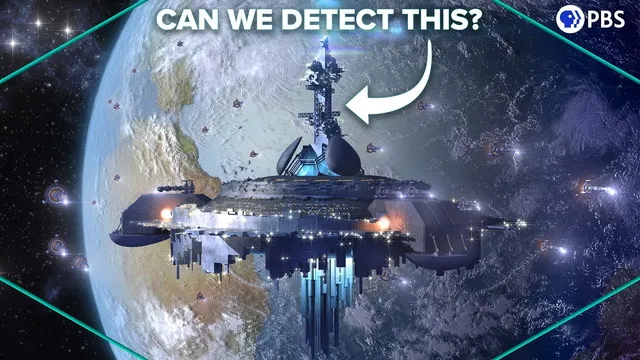
Could LIGO Find MASSIVE Alien Spaceships?
Based on PBS Space Time's video on YouTube. If you like this content, support the original creators by watching, liking and subscribing to their content.
Gravitational waves require acceleration; constant-speed straight-line motion would not generate detectable ripples.
Briefing
Gravitational-wave detectors like LIGO could, in principle, pick up the “wake” of a planet-mass alien spacecraft accelerating to near-light speed—but only under extremely demanding conditions on mass, acceleration time, and distance. A speculative framework dubbed RAMAcraft (“rapid and massive accelerating spacecraft”) models how a linearly accelerating, massive object would generate spacetime ripples with a frequency content that might fall inside LIGO’s sensitivity band. The key takeaway is that detectability hinges less on cruising speed and more on how violently the craft ramps up—how quickly it changes its motion—because gravitational radiation is driven by acceleration.
LIGO is tuned to gravitational-wave frequencies roughly from a few tens of hertz to a few thousand hertz, with best sensitivity in the middle. For an accelerating craft, the signal becomes a mix of frequencies: stronger acceleration boosts higher-frequency components, while longer acceleration times (or equivalently longer emission timescales and wavelengths) strengthen lower-frequency components. Under the paper’s assumptions—accelerating from rest up to about 30% of the speed of light—the model suggests the craft would need to reach that speed within “a few tens of seconds” to generate a waveform LIGO could plausibly detect. That implies a very abrupt acceleration profile, not a gentle ramp.
Mass requirements are even more severe. Because gravitational-wave strain scales with the strength of the source’s wake, the craft must be enormous. The analysis gives a sense of scale: an object with roughly Jupiter’s mass accelerating to a significant fraction of light speed in under a second might be detectable from the far side of the Milky Way. If the craft were farther—across cosmological distances—only truly stellar-scale masses (even approaching a solar mass) would work. Moving the source closer relaxes the mass constraint: within about 30 light-years, a moon-mass craft could be within reach. Even then, the scenario remains technologically implausible.
The discussion also frames why gravitational waves are a useful search channel for “technosignatures” at all. Electromagnetic signals fade quickly with distance (intensity drops with the square of distance), and telescopes typically monitor limited patches of sky. Gravitational waves weaken more slowly with distance (strain falls roughly with inverse distance), and they pass through dust and atmosphere with little attenuation, letting observatories monitor large regions of the universe continuously.
Finally, other gravitational-wave facilities could broaden the search. LISA (Laser Interferometer Space Antenna) should be sensitive to much lower frequencies thanks to its vastly longer arms, potentially catching RAMAcraft that accelerate over days. Pulsar Timing Arrays, which track timing shifts in pulsars across the Milky Way, could be sensitive to much longer acceleration timescales—months or years—though the mass scale still likely needs to be Jupiter-like across galactic distances.
Even if alien ships are unlikely, the underlying value is practical: the same methods could flag more natural sources that mimic linear acceleration, such as highly eccentric black-hole orbits, a star or giant planet plunging into a massive black hole, or certain supernova dynamics. The universe may not be full of spacecraft—but it is full of weird accelerations, and LIGO’s sensitivity can be turned into a map of what kinds of mass motion are detectable.
Cornell Notes
A speculative RAMAcraft model asks whether LIGO could detect gravitational waves from a massive object accelerating in a straight line, like a hypothetical alien ship. Detectability depends on the acceleration profile and the resulting frequency content: LIGO is most sensitive to signals in the tens to thousands of hertz range, so the craft would need to reach ~30% of light speed from rest in only a few tens of seconds (under the model’s assumptions). Mass is the other hard constraint: Jupiter-mass scales might be detectable across the Milky Way, while solar-mass scales would be needed at much larger distances. Gravitational waves also offer search advantages over light—strain falls more slowly with distance and waves pass through dust—so future detectors like LISA and Pulsar Timing Arrays could probe longer acceleration timescales. Even if RAMAcraft are unlikely, the same calculations help identify other astrophysical events that produce linearly accelerating “wakes.”
Why does an accelerating spacecraft matter more than a fast one for gravitational-wave detection?
How does LIGO’s frequency sensitivity translate into a requirement on acceleration time for a RAMAcraft?
What mass scales are implied for detectability at different distances?
Why are gravitational-wave searches better suited than electromagnetic searches for distant technosignatures?
How would LISA and Pulsar Timing Arrays change the RAMAcraft search?
If alien ships are unlikely, what kinds of natural events could produce similar signals?
Review Questions
- What aspects of motion (speed vs acceleration vs acceleration duration) most strongly control the gravitational-wave frequency content for a linearly accelerating source?
- Using LIGO’s stated frequency band, what acceleration timescale would you expect for a source ramping to ~30% of light speed?
- How do gravitational-wave distance scaling and sky coverage compare with electromagnetic searches, and why does that matter for detectability?
Key Points
- 1
Gravitational waves require acceleration; constant-speed straight-line motion would not generate detectable ripples.
- 2
LIGO’s sensitivity spans roughly tens to thousands of hertz, so a linearly accelerating source must produce a waveform with frequency components in that band.
- 3
Under the RAMAcraft assumptions (accelerating to ~30% of light speed), detectability with LIGO requires reaching that speed from rest in only a few tens of seconds.
- 4
Mass is a major limiter: Jupiter-mass scales may be detectable across the Milky Way, while solar-mass scales would be needed at much larger distances.
- 5
Gravitational-wave strain falls more slowly with distance than light intensity and is not blocked by dust, enabling wide, continuous monitoring.
- 6
LISA should extend the search to lower frequencies and longer acceleration times (days), while Pulsar Timing Arrays can probe even longer timescales (months to years).
- 7
Even without aliens, the same calculations help interpret other astrophysical accelerations that can mimic linear-motion “wakes.”