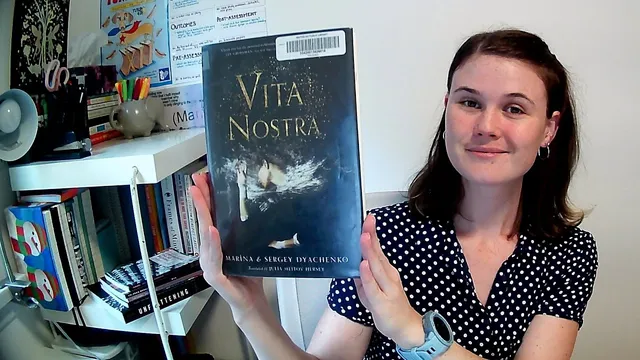
DARK SCIENCE-FANTASY recommendation - "Vita Nostra" by Marina and Sergey Dyachenko
Based on morganeua's video on YouTube. If you like this content, support the original creators by watching, liking and subscribing to their content.
“Vita Nostra” uses a coercive institute to turn higher education into a dark allegory about learning under uncertainty.
Briefing
“Vita Nostra” turns higher education into a dark, speculative ordeal: a student is forced through an incomprehensible institute where tasks yield unsettling “gold coins” and progress depends on breaking through the impossible. The result is a philosophical, science-fantasy narrative that reads like an allegory for learning—especially the kind that feels meaningless, frightening, and opaque until it suddenly isn’t.
The story follows Sasha Samokina, vacationing with her mother when a strange man begins shadowing her. He escalates from surveillance to coercion, assigning uncomfortable tasks and threatening consequences if she refuses. After she completes each task, she vomits strange gold coins. Those coins become her entry fee to an institute for special technologies—an education she’s told she can’t truly understand yet. Even after Sasha arrives at Torpa, the professors offer little clarity. They insist the curriculum will never be explained in a way that makes sense immediately, and that understanding only arrives in later years.
What makes the book stick is how it treats education as both psychological pressure and epistemic transformation. One major theme is intrinsic versus extrinsic motivation: the institute leans on fear, punishment, and the threat of failure to push students through material they can’t grasp. Another theme centers on the learning process itself—how knowing can paradoxically reduce certainty, and how confronting a complex text that looks like gibberish can become productive through immersion, repetition, and endurance. The narrative also leans into morally gray territory, offering a world where objective morality feels absent or irrelevant.
The atmosphere is further sharpened by absurdity: life is portrayed as cyclical, out of control, and ultimately meaningless—something to accept and meditate on rather than solve. The book also nods to intellectual frameworks such as Plato’s theory of forms and touches on linguistics and the philosophy of language, reinforcing the sense that reality is mediated by systems of thought.
Sasha’s journey drives the reader’s experience. The institute’s “inarticulable” curriculum is still rendered on the page through poetic, grounded metaphysical scenarios—never reduced to a cheesy explanation, yet never dismissed as purely unknowable. The pacing mirrors the theme: the first half reads quickly because the world feels more legible, while the complexity spikes in the second half, leaving the reader with questions and a sense that the ending may require rereading.
A standout moment comes when Sasha’s advisor—revealed as the same strange man—tells her to “break through the impossible” with a mechanical gesture: steal a wallet, break a window with a naked fist, do something she considers impossible. It’s a metaphor for loosening rigid mental stability to reach the next level of understanding.
For readers who want a twisted school system with philosophical depth, the book’s bite-sized, chapterless structure and its willingness to end without full clarity make it a distinctive recommendation—especially for those who like “Broken Earth” style institutional dread, though “Vita Nostra” leans more metaphysical than sociological.
Cornell Notes
“Vita Nostra” follows Sasha Samokina as a strange man coerces her into tasks that produce gold coins, which she must use to enter an institute for “special technologies.” The school refuses to explain what students will learn, insisting that understanding arrives only later, turning the curriculum into an allegory for higher education. Key themes include intrinsic vs. extrinsic motivation, fear-based punishment, and the learning process—how immersion in confusing material can gradually make it intelligible. The book’s world feels morally gray and absurd, with references to Plato’s theory of forms and ideas related to linguistics and the philosophy of language. The ending leaves many questions, encouraging rereading to fully grasp what happened.
How does the institute’s structure function as an allegory for education?
What role does fear and punishment play in motivating students?
Why does the book emphasize “learning the impossible” rather than explaining it?
How does the book treat the relationship between knowledge and understanding?
What makes the book’s tone “dark” and “speculative” beyond the school setting?
What intellectual references and themes show up, and what do they reinforce?
Review Questions
- Which moments show Sasha moving from confusion to a new “level” of understanding, and what mechanism drives that change?
- How does fear-based motivation in the institute compare with intrinsic motivation, based on the book’s examples?
- Why might the ending require rereading, given how the curriculum and “impossible” tasks are handled throughout the story?
Key Points
- 1
“Vita Nostra” uses a coercive institute to turn higher education into a dark allegory about learning under uncertainty.
- 2
Sasha Samokina’s entry into the school depends on gold coins produced after completing threatening tasks assigned by a strange man.
- 3
The institute withholds clear explanations, insisting that understanding arrives only in later years, which forces students to learn through immersion and endurance.
- 4
Fear and punishment function as the institute’s main motivational tools, shaping how students persist through incomprehensible material.
- 5
The book treats learning as a paradoxical process: immersion in “gibberish” can gradually make meaning emerge, even as knowledge complicates certainty.
- 6
Absurdity and moral ambiguity permeate the world, framing life as cyclical and out of control rather than solvable.
- 7
The narrative’s chapterless, bite-sized structure and escalating complexity make the second half feel especially demanding and question-heavy.